
Tag: France
-

NASA’s InSight mission lands on Mars to study planet’s hidden interior
InSight project manager Tom Hoffman motions to an image captured by the spacecraft minutes after landing on Mars. Credit: NASA/Bill Ingalls NASA’s InSight spacecraft plunged into the rarefied atmosphere of Mars at a speed of more than 12,000 mph Monday and braked to a gentle touchdown, setting the stage for a two-year surface mission to…
-
InSight tweaks trajectory to home in on Mars landing site
Artist’s concept of the InSight spacecraft in its interplanetary cruise configuration. Credit: NASA/JPL-Caltech On the eve of its blazing entry into the Martian atmosphere, NASA’s InSight spacecraft briefly pulsed its control jets Sunday to target a safe, flat landing zone near the planet’s equator — the last in a series of trajectory correction maneuvers since…
-

Video: JPL’s Rob Manning explains InSight’s entry, descent and landing
JPL chief engineer Rob Manning, a veteran of Mars mission teams dating back to Mars Pathfinder more than two decades ago, describes how the InSight spacecraft will enter the Martian atmosphere and touch down on the red planet. InSight’s “seven minutes of terror” begin with entry into the Martian atmosphere at a velocity of 12,300…
-
InSight’s entry, descent and landing timeline
Artist’s concept of the InSight spacecraft streaking into the Martian atmosphere. Credit: NASA/JPL-Caltech NASA’s InSight lander will fly from the outer edge of the Martian atmosphere at a speed of more than 12,000 mph to a controlled descent rate of 5 mph just above the red planet’s surface in less than seven minutes. The robotic…
-

Mars lander on course for Monday touchdown
STORY WRITTEN FOR CBS NEWS & USED WITH PERMISSION The InSight spacecraft approaches Mars in this artist’s concept. Credit: NASA/JPL-Caltech After a six-month voyage from Earth, NASA’s InSight Mars lander, streaking through space at at some 12,300 mph, will slam into the thin martian atmosphere Monday afternoon to begin a nail-biting six-and-a-half-minute descent to the surface, kicking…
-
Moroccan spy satellite launched aboard Vega rocket
A Vega rocket lifts off Tuesday night with the Mohammed VI-B satellite. Credit: ESA/CNES/Arianespace – Photo Optique Video du CSG – P. Piron A Vega launcher lifted off Tuesday night from a spaceport at the edge of South America’s Amazon rainforest, climbed into orbit on the power of four Italian- and Ukrainian-built rocket stages, and…
-

Live coverage: Vega rocket launches with Moroccan spy satellite
Live coverage of the countdown and launch of a Vega rocket with the Mohammed VI-B reconnaissance satellite for the government of Morocco. Text updates will appear automatically below. Follow us on Twitter. Arianespace’s live video webcast begins at approximately 0125 GMT (8:25 p.m. EST), and will be available on this page.
-

China-France Oceanography Satellite launches on research mission
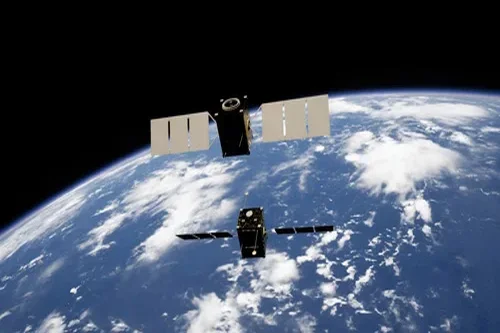
A joint oceanography research mission developed by Chinese and French scientists launched Monday on top of a Long March 2C rocket from the Jiuquan space center in remote northwestern China. After a period of post-launch checkouts and activations, the China-France Oceanography Satellite, or CFOSat, will begin a three-year mission to survey the world’s oceans, becoming…
-
MASCOT lander hops around asteroid, exceeding scientists’ expectations
This image was taken by MASCOT’s camera between 10 and 20 meters (32 and 65 feet) above the asteroid’s surface. Credit: MASCOT/DLR/JAXA BREMEN and COLOGNE, Germany — The MASCOT lander released from Japan’s Hayabusa 2 spacecraft this week made three hops to different locations on asteroid Ryugu before draining its battery, outliving its design life…
-

Descent begins for European asteroid lander
Artist’s concept of the Hayabusa 2 spacecraft approaching asteroid Ryugu. Credit: DLR A German-built landing probe the size of a microwave oven carrying a camera and a suite of scientific instruments was closing in on asteroid Ryugu Tuesday, riding aboard Japan’s Hayabusa 2 spacecraft to join two other robots deployed to the asteroid’s surface last…