
Tag: Io
-

Juno reveals Io’s inner structure and volcanic activity; investigates north pole cyclones
New data from NASA’s Juno mission, which has been orbiting Jupiter since 2016, has provided scientists with insight into the extreme winds and cyclones present within the gas giant’s atmosphere. The data allowed scientists to develop a model that better represents the fast jet stream circling Jupiter’s north pole, which is cluttered with many cyclones.…
-
Juno observes lava lake on Io, provides insight into Jupiter’s water abundance
In December 2023 and February 2024, NASA’s Juno spacecraft, currently in orbit around and investigating Jupiter and the Jovian system, made several close flybys of the innermost of the Galilean moons, Io. During the flybys, Juno came as close as 1,500 kilometers from the surface of Io, during which extensive data and imagery of the…
-
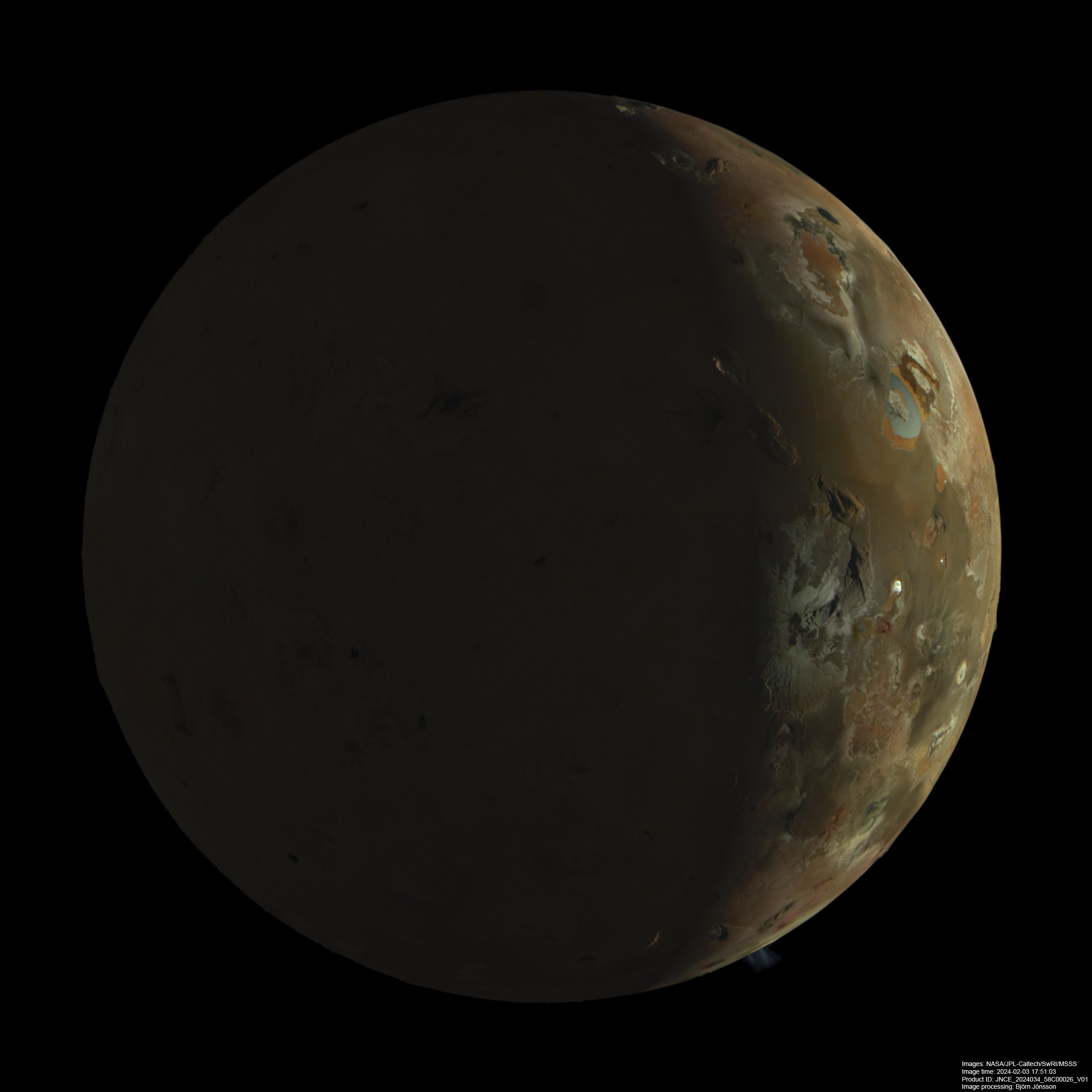
Daily Telescope: A stunning new image of Io reveals a volcanic plume
Welcome to the Daily Telescope. There is a little too much darkness in this world and not enough light, a little too much pseudoscience and not enough science. We’ll let other publications offer you a daily horoscope. At Ars Technica, we’re going to take a different route, finding inspiration from very real images of a…
-
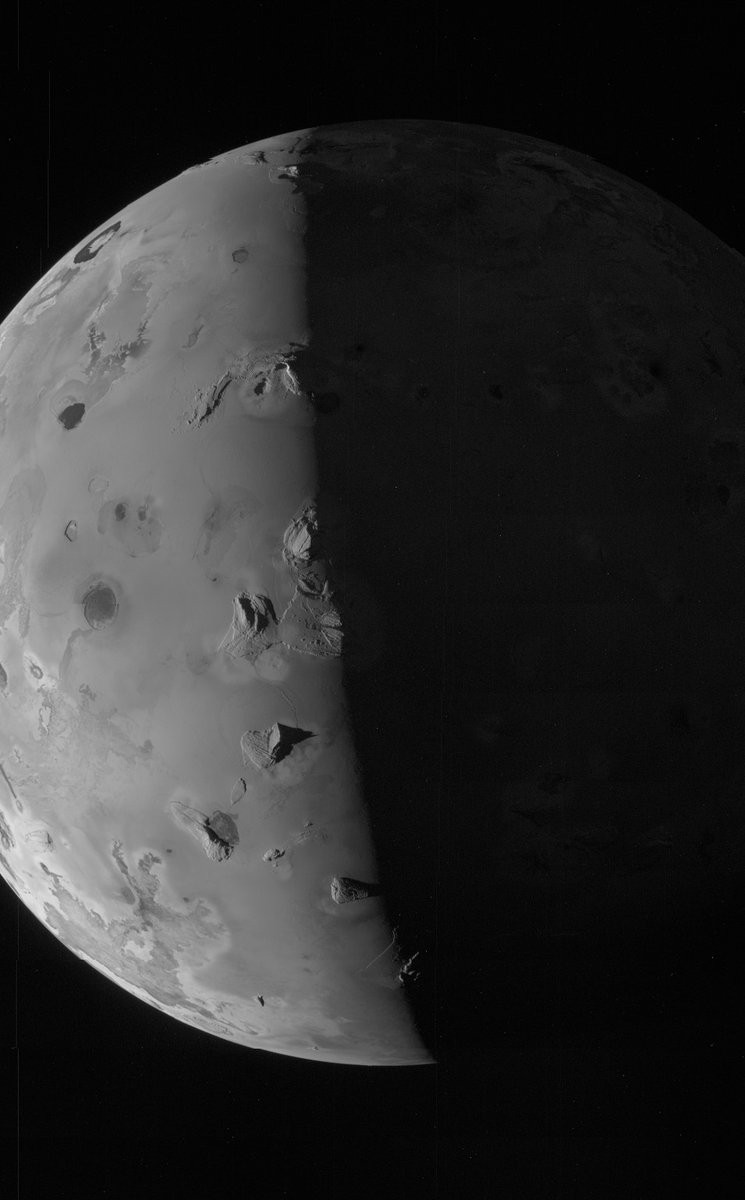
Juno makes its first ultra-close flyby of the volcano-covered moon Io
On Saturday NASA’s Juno spacecraft, which has been orbiting Jupiter for the better part of a decade, made its closest flyby of the innermost moon in the Jovian system. The spacecraft came to within 930 miles (1,500 km) of the surface of Io, a dense moon that is the fourth largest in the Solar System.…
-
NASA mission extension enables first flybys of Jupiter’s moons in 20 years
Artist’s concept of the Juno spacecraft at Jupiter. Credit: NASA/JPL-Caltech In a pair of mission extensions, NASA has cleared the way for more seismic observations on Mars with the robotic InSight lander and approved plans for the Juno spacecraft to alter its orbit and perform close flybys of Jupiter’s icy moon Europa, Ganymede, and the…
-
Juno team planning close flybys of Jupiter’s moons
The puzzling, fascinating surface of Jupiter’s icy moon Europa looms large in this newly-reprocessed color view, made from images taken by NASA’s Galileo spacecraft in the late 1990s. Credit: NASA/JPL-Caltech/SETI Institute NASA’s Juno spacecraft could perform the first close flybys since the early 2000s of three of Jupiter’s largest moons, including Europa, if the space…
-
NASA to assess proposals for probes to Venus, moons of Jupiter and Neptune
Artist’s concept of the solar system. Credit: NASA NASA announced Thursday it will fund four concept studies for potential robotic missions to Venus, Jupiter’s moon Io and Neptune’s moon Triton ahead of a decision next year to approve up to two of the projects for launch in the mid-to-late 2020s. The space agency chose the…
-
NASA picks missions to Venus, Triton and Io as finalists for Discovery funding
An artist’s conception shows the DAVINCI+ probe descending through Venus’ atmosphere on the end of a parachute. (NASA / GSFC Photo) NASA has selected four proposed Discovery-class interplanetary missions to receive $3 million to flesh out their concepts, with the aim of choosing one or two of them next year for further funding. Two of…
-
NASA’s Juno spacecraft sees moon’s otherworldly shadow on Jupiter
The shadow of Jupiter’s moon Io is cast on the cloud tops of the giant planet in this view taken Sept. 12 by a camera on-board NASA’s Juno spacecraft. Kevin Gill, a software engineer at NASA’s Jet Propulsion Laboratory, created this mosaic from imagery taken by the JunoCam instrument. Credit: NASA/JPL-Caltech/SwRI/MSSS/Kevin M. Gill Fresh images…
-
See Jupiter’s Galilean moons in motion from Juno’s camera
Juno’s visible camera had a bird’s-eye view of Jupiter’s four largest moons over the last few weeks, recording the satellites in their orbital ballet around the giant planet as the spacecraft approached from above Jupiter’s north pole. Io, Europa, Ganymede and Callisto — Jupiter’s four Galilean moons listed from the innermost to outermost — were…