
Tag: JAXA
-
Photos: Japan’s H-2A rocket prepared for launch with Michibiki 2
The second satellite in Japan’s regional space-based navigation constellation is set for launch Thursday aboard an H-2A rocket, and these photos show the hydrogen-fueled launcher’s preparations for liftoff, from stacking inside an assembly hangar at the Tanegashima Space Center through rollout to the launch pad. The two-stage, 174-foot-tall (53-meter) rocket is powered by hydrogen-fueled engines…
-

Japanese rocket scheduled for launch with navigation satellite
Ground crews attach one of the H-2A rocket’s solid-fueled boosters inside the Vehicle Assembly Building at the Tanegashima Space Center in advance of this week’s launch. Credit: MHI A Japanese H-2A rocket is set for launch Thursday with the country’s second navigation satellite, growing a network of beacons in the sky to give emergency responders,…
-
H-2A rocket launches with Japanese radar reconnaissance craft
H-IIAロケット33号機の打ち上げ 竹崎展望台より。 pic.twitter.com/dtpaszjeqY — 柴田孔明 (@koumeiShibata) March 17, 2017 A Japanese spy satellite launched aboard an H-2A rocket Friday, heading for a 300-mile-high (500-kilometer) orbit to track North Korean and Chinese military movements as tensions run high in the region. Equipped with a cloud-penetrating radar capable of seeing targets day or night, the secretive spacecraft was…
-

Japanese H-IIA rocket launches latest IGS spy satellite
Japan’s H-IIA rocket has lofted the next in a series of new-generation radar imaging satellite for the country’s military. The launch of latest IGS-5 spacecraft lifted off on schedule at 10:20 local time (01:20 UTC) on Friday, setting sail from the first pad of the Tanegashima Space Centre’s Yoshinobu Launch Complex. Japanese Mission: The launch…
-

Poor weather forecast delays Japanese spy satellite launch
File photo of an H-2A rocket inside the assembly building at the Tanegashima Space Center. Credit: JAXA Japanese officials have delayed the launch of a government-owned reconnaissance satellite until at least Friday, local time, because of bad weather predicted over the Tanegashima Space Center in southern Japan. Liftoff of an H-2A rocket with Japan’s sixth…
-
Japanese cargo ship ends mission after space debris experiment flounders
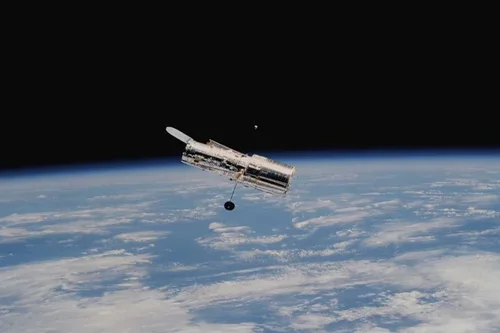
Artist’s concept of how the tether for Japan’s KITE experiment would have appeared when deployed from the HTV supply ship. Credit: JAXA Japan’s HTV supply ship fell to Earth on Sunday more than a week after leaving the International Space Station, burning up in the atmosphere after officials gave up on an experiment looking into…
-

Japanese cargo craft departs space station
The HTV 6 supply ship leaves the International Space Station on Friday. Credit: NASA TV/Spaceflight Now Japan’s sixth HTV supply ship departed the International Space Station on Friday and headed for a destructive re-entry over the South Pacific with trash and disused batteries from the research lab, but engineers will first use the spacecraft for…
-

Japanese spacecraft spots planet-spanning wave on Venus
In these images from Japan’s Akatsuki spacecraft, a stationary bow wave is seen on Venus over several days in December 2015. Credit: JAXA Images from Japan’s Akatsuki spacecraft have revealed a gigantic wave in the atmosphere of Venus, and scientists say it may be the largest such feature in the solar system. The bow-shaped wave…
-
Experimental flight of Japanese sounding rocket falls short of orbit
Credit: JAXA A small research rocket launched from Japan fell into the Pacific Ocean on Saturday after attempting to send a student-built CubeSat into orbit, Japanese officials said. The three-stage rocket took off at 2333 GMT (6:33 p.m. EST) Saturday from the Uchinoura Space Center in southern Japan’s Kagoshima prefecture, four days after inclement weather…
-

Japan’s SS-520 fails during TRICOM-1 launch to demo small rocket capability
Japan conducted an experimental launch, using a modified SS-520 sounding rocket to place a CubeSat, TRICOM-1, into low Earth orbit. The mission lifted off from the Uchinoura Space Centre at 08:33 local time (23:33 UTC on Saturday), aiming to mark a new record for small rocket launch capability. However, the launch has been declared as…