
Tag: Kuiper Belt
-

Scientists give nickname to New Horizons probe’s post-Pluto target: Ultima Thule
News Brief: Nearly three years after flying past Pluto, NASA’s New Horizons spacecraft is heading for a target more than 4 billion miles from Earth. It’s officially known as 2014 MU69, but now the New Horizons team has decided to call it Ultima Thule (“UL-ti-ma THOO-lee”), or Ultima for short. Ultima Thule is a Latin…
-
3.8 billion miles! New Horizons spacecraft sends pictures from farthest vantage point
These false-color images of two Kuiper Belt objects, 2012 HZ84 (left) and 2012 HE85 (right), helped give New Horizons’ LORRI instrument the title of farthest-out working camera. (NASA / JHUAPL / SwRI Photo) Two and a half years after becoming the first probe to study Pluto up close, NASA’s New Horizons spacecraft is gaining more…
-

Plot thickens as New Horizons moves within year of next flyby
Artist’s concept of the New Horizons spacecraft’s flyby of 2014 MU69. Credit: NASA/Johns Hopkins University Applied Physics Laboratory/Southwest Research Institute/Steve Gribben The final days before NASA’s New Horizons probe barrels in on its next destination on Jan. 1, 2019, should prove eventful, with scientists trying to sort out whether a distant mini-world detected by the…
-
Help NASA and New Horizons nickname the icy world they’re targeting after Pluto
An artist’s conception shows the New Horizons spacecraft flying past 2014 MU69, which scientists say could be a binary orbiting pair of bodies with diameters in the range of 11 to 12 miles. (NASA / JHUAPL / SwRI Illustration) 2014 MU69 just won’t cut it, so NASA and the folks behind the New Horizons mission…
-

Scientists firm up flyby plan for New Horizons’s next destination
Artist’s illustration of the New Horizons spacecraft communicating with Earth. Credit: NASA Now more than two years outbound from its historic encounter with Pluto, NASA’s New Horizons spacecraft is on target for a fleeting flyby less than 2,200 miles (3,500 kilometers) from 2014 MU69, an icy, city-sized world set to become the most distant object…
-
New Horizons might get more flyby targets; Pluto features get official names
More than two years after New Horizons flew past Pluto, becoming the first human-made object to visit the dwarf planet, numerous surface features discovered and explored by the craft now have official names as recognized by the International Astronomical Union. Meanwhile, New Horizons itself is preparing for its 1 January 2019 encounter with 2014 MU69,…
-

New Horizons might get more flyby targets; Pluto features get official names
More than two years after New Horizons flew past Pluto, becoming the first human-made object to visit the dwarf planet, numerous surface features discovered and explored by the craft now have official names as recognized by the International Astronomical Union. Meanwhile, New Horizons itself is preparing for its 1 January 2019 encounter with 2014 MU69,…
-

Astronomers give their official blessing to the first batch of place names on Pluto
Pluto’s first official surface-feature names are marked on this map, compiled from images and data gathered by NASA’s New Horizons spacecraft during its flight through the Pluto system in 2015. (IAU Map) Some of the best-known places on Pluto, including the heart-shaped Tombaugh Regio, have finally gone legit. But lots of other places, such as…
-
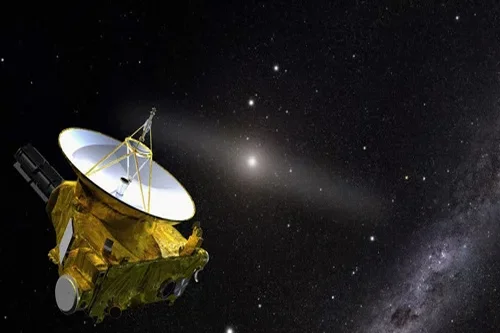
Astronomers give their official blessing to the first batch of place names on Pluto
Pluto’s first official surface-feature names are marked on this map, compiled from images and data gathered by NASA’s New Horizons spacecraft during its flight through the Pluto system in 2015. (IAU Map) Some of the best-known places on Pluto, including the heart-shaped Tombaugh Regio, have finally gone legit. But lots of other places, such as…
-
New Horizons’ next target might be a binary pair
One artist’s concept of Kuiper Belt object 2014 MU69, the next flyby target for NASA’s New Horizons mission. This binary concept is based on telescope observations made at Patagonia, Argentina, on July 17, 2017, when MU69 passed in front of a star. New Horizons theorize that it could be a single body with a large…