
Tag: Lockheed-Martin
-

Jupiter surprises in first trove of data from NASA’s Juno mission
This image shows Jupiter’s south pole, as seen by NASA’s Juno spacecraft from an altitude of 32,000 miles (52,000 kilometers). Image credit: NASA/JPL-Caltech/SwRI/MSSS/Betsy Asher Hall/Gervasio Robles The first months of observations of the solar system’s biggest planet from NASA’s Juno spacecraft have revealed huge swirling polar cyclones, previously-undetected structures and motions beneath Jupiter’s distinctive clouds,…
-

Juno spacecraft makes another pass by Jupiter
This image of cyclones near Jupiter’s north pole was captured by the JunoCam imager during Friday’s flyby. Credit: NASA/SWRI/MSSS Making its fifth science pass close to Jupiter’s turbulent cloud tops, NASA’s Juno spacecraft sailed by the solar system’s king planet Friday to collect another treasure trove of data on the giant world’s atmosphere, internal structure,…
-

InSight lander’s troubled seismometer passes major test
The InSight spacecraft is pictured in 2015 at Lockheed Martin’s assembly facility near Denver. Credit: NASA/JPL-Caltech/Lockheed Martin A balky interplanetary seismic instrument that ran into technical problems in 2015, forcing a two-year delay in the launch of NASA’s InSight lander to Mars, cleared a major test last week after engineers redesigned part of the sensor…
-
Scientists say thinning atmosphere drove the drying and cooling of Mars
Artist’s concept of a solar storm hitting Mars and stripping ions from the upper atmosphere. Credit: NASA/GSFC Data collected by NASA’s MAVEN spacecraft in its first two years at Mars confirm suspicions that the solar wind is blasting away the planet’s atmosphere and helped transform the world from a warmer, wetter and potentially habitable world…
-

Juno orbiter races by Jupiter on fourth science pass
This enhanced-color image of a mysterious dark spot on Jupiter seems to reveal a Jovian “galaxy” of swirling storms. The JunoCam imager acquired this image during Juno’s flyby Feb. 2 from an altitude of about 9,000 miles (14,500 kilometers). Citizen scientist Roman Tkachenko enhanced the color to bring out the rich detail in the storm and…
-

SpaceX nabs GPS launch contract as Air Force opens more missions for bidding
File photo of a Falcon 9 rocket launching from Cape Canaveral. Credit: SpaceX The U.S. Air Force this week awarded SpaceX a contract to launch a Global Positioning System satellite in early 2019, concluding the second of as many as 15 competitions the military plans to run over the next year to pit SpaceX against…
-
Orion’s parachutes tested under launch abort conditions
Credit: Gene Blevins/LA Daily News A model of NASA’s Orion spacecraft, in development to loft astronaut crews into deep space, was dropped from a U.S. Air Force cargo plane over Arizona on Wednesday in the latest in a series of tests to verify the capsule’s parachutes are up to the job of safely landing with…
-

Lightning mapper beams back first views from space
A sensitive infrared camera mounted on NOAA’s new GOES-16 weather satellite has captured its first astounding images of lightning flashes from a perch more than 22,000 miles (nearly 36,000 kilometers) out in space. The first-of-its-kind imager can detect in-cloud, cloud-to-cloud and cloud-to-ground lightning strikes, giving weather forecasters an inventory of the location, frequency and intensity…
-
NASA’s Juno spacecraft to remain in current orbit around Jupiter
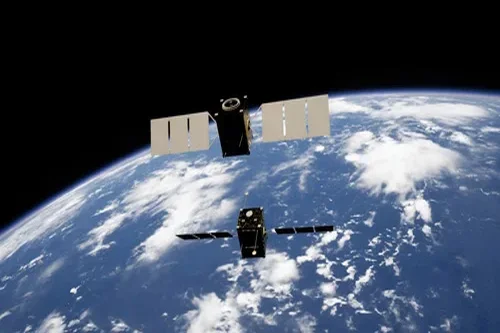
Artist’s concept of the Juno spacecraft at Jupiter. Credit: NASA/JPL-Caltech Concerns about the health of the Juno spacecraft’s main engine have compelled NASA managers to keep the research probe in its current arcing, high-altitude orbit around Jupiter, a decision that will delay the full science return from the $1.1 billion mission but should still allow…
-

Juno dives over Jupiter’s cloud tops with main engine still offline
Updated at 3:30 p.m. EST with additional comments from Scott Bolton. This amateur-processed image was taken on Dec. 11, 2016, at 9:27 a.m. PST (12:27 p.m. EST), as NASA’s Juno spacecraft performed its third close flyby of Jupiter. Credits: NASA/JPL-Caltech/SwRI/MSSS/Eric Jorgensen NASA’s Juno spacecraft made a high-speed pass less than 3,000 miles over Jupiter’s turbulent…