
Tag: New Horizons
-

NASA’s New Horizons and OSIRIS-REx spacecraft spot their deep-space targets
The picture on the left was created by adding 48 different exposures from the LORRI camera on NASA’s New Horizons probe. The picture on the right has been processed to subtract the light from background stars, leaving an icy object known as Ultima Thule shining dimly in the crosshairs. (NASA / JHUAPL / SwRI Photo)…
-

NASA’s New Horizons probe wakes up from its robotic slumber for post-Pluto flyby
An artist’s conception shows NASA’s New Horizons probe silhouetted by the sun, with the Kuiper Belt object known as Ultima Thule or 2014 MU69 dominating the scene. (NASA / JHUAPL / SwRI / Steve Gribben) The mission operations team for NASA’s New Horizons probe has awakened the spacecraft from its robotic hibernation, and now it’ll…
-
NASA’s New Horizons probe wakes up for New Year’s Day flyby
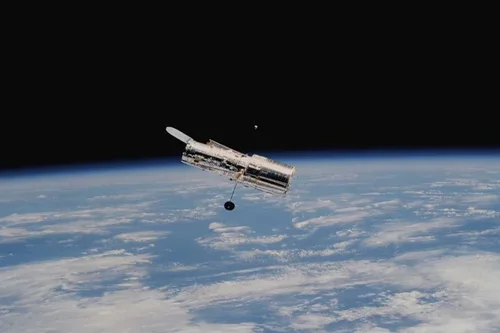
Artist’s concept of the New Horizons spacecraft. Credit: NASA/JHUAPL/SWRI Speeding through the outer reaches of the solar system nearly 3.8 billion miles from Earth, NASA’s New Horizons spacecraft has awakened from a five-and-a-half month slumber, ready for a second act after its 2015 flyby of Pluto with a New Year’s Day encounter with a primordial…
-
New Horizons comes out of hibernation ahead of January MU69 flyby
The New Horizons spacecraft has come out of hibernation to begin preparations for its January 2019 flyby of the Kuiper Belt object (KBO) 2014 MU69, nicknamed “Ultima Thule”. The flyby, set to occur in the early morning of January 1, 2019, will be the second for New Horizons, following its historic 2015 Pluto flyby. It…
-
Planetary scientists suggest that Pluto was put together from a billion comets
These maps, assembled using data from the Ralph spectral imager on NASA’s New Horizons probe, shows the relative concentration of four chemicals on Pluto’s surface. Methane is shown in purple, nitrogen in yellow, carbon monoxide in green, and water ice in blue. (NASA / JHUAPL / SwRI Images) Did Pluto form like its closer-in brethren…
-
Pluto’s champion recounts first mission to icy world – and gears up for the next one
The 1991 stamp that served as the rallying cry for the New Horizons mission to Pluto is “updated” by members of the New Horizons science team on July 14, 2015, the day the spacecraft flew past Pluto. Principal investigator Alan Stern is at far left. (Credit: Bill Ingalls / NASA) It took nine years for…
-
New Horizons spacecraft’s next distant destination gets a nickname
This image of Ultima Thule, or 2014 MU69, was captured by the Hubble Space Telescope in 2014. Credit: NASA/JHUAPL/SWRI The frozen faraway miniature world targeted for a high-speed flyby by NASA’s New Horizons spacecraft on Jan. 1, 2019, now has a nickname: Ultima Thule. Formally known as 2014 MU69, the robotic space probe’s next target…
-

Scientists give nickname to New Horizons probe’s post-Pluto target: Ultima Thule
News Brief: Nearly three years after flying past Pluto, NASA’s New Horizons spacecraft is heading for a target more than 4 billion miles from Earth. It’s officially known as 2014 MU69, but now the New Horizons team has decided to call it Ultima Thule (“UL-ti-ma THOO-lee”), or Ultima for short. Ultima Thule is a Latin…
-
3.8 billion miles! New Horizons spacecraft sends pictures from farthest vantage point
These false-color images of two Kuiper Belt objects, 2012 HZ84 (left) and 2012 HE85 (right), helped give New Horizons’ LORRI instrument the title of farthest-out working camera. (NASA / JHUAPL / SwRI Photo) Two and a half years after becoming the first probe to study Pluto up close, NASA’s New Horizons spacecraft is gaining more…
-
Plot thickens as New Horizons moves within year of next flyby
Artist’s concept of the New Horizons spacecraft’s flyby of 2014 MU69. Credit: NASA/Johns Hopkins University Applied Physics Laboratory/Southwest Research Institute/Steve Gribben The final days before NASA’s New Horizons probe barrels in on its next destination on Jan. 1, 2019, should prove eventful, with scientists trying to sort out whether a distant mini-world detected by the…