
Tag: Planetary Science
-
Israel’s Beresheet lander heads for make-or-break lunar capture maneuver
Artist’s illustration of the Beresheet lander in orbit round the moon. Credit: SpaceIL An Israeli spacecraft has one shot Thursday to swing into orbit around the moon with a six-minute engine firing, a critical maneuver that will set up for the privately-funded probe’s historic landing attempt April 11. The hydrazine-fueled main engine mounted to the…
-
Beresheet lander on course for the moon
A camera on-board the Beresheet lander captured this view of Earth from a distance of more than 23,000 miles (37,000 kilometers). Credit: SpaceIL The privately-funded Israeli Bersesheet lander is on course to enter orbit around the moon April 4 after another boost from its main engine Tuesday. A 60-second firing by Beresheet’s 100-pound-thrust main engine…
-
NASA’s OSIRIS-REx spacecraft finds particles flying off asteroid Bennu
The navigation camera on NASA’s robotic OSIRIS-REx spacecraft detected material streaming away from asteroid Bennu in this images taken Jan. 19. This view combines two images, one taken at a short exposure to resolve Bennu’s surface, and another at a longer exposure, revealing bright star-like dots, the material streaming away from the asteroid. Credit: NASA/Goddard/University…
-
Hayabusa 2’s asteroid touch-and-go comes to life in dramatic new video
A camera riding on Japan’s Hayabusa 2 spacecraft recorded stunning views of the probe’s final descent to asteroid Ryugu last month, showing the rocky debris kicked up by the robot explorer’s touch-and-go landing to collect a sample for return to Earth. The on-board camera observed Hayabusa 2’s sampling horn contact Ryugu’s gravelly surface Feb. 21,…
-

Computer reset cancels orbit-raising burn on Israel’s moon lander
Artist’s illustration of the Beresheet lander’s elliptical transfer orbit around Earth. Credit: SpaceIL A computer reset on the Israeli Beresheet lunar lander forced has the postponement of the mission’s first engine firing to begin maneuvering closer to the moon, officials said Tuesday. Mission managers said the robotic lander — seeking to become the first privately-funded…
-
Japanese probe lands on asteroid to capture sample
Moments after landing on asteroid Ryugu, Japan’s Hayabusa 2 captured this view of its landing zone from a distance of about 100 feet (30 meters), showing the probe’s shadow and markings left on the surface, likely from the spacecraft’s thruster jets firing to begin its ascent. Credit: JAXA Japan’s Hayabusa 2 spacecraft briefly landed on…
-
Photos: Beresheet lander tested for historic moon mission
The Beresheet moon lander will attempt to become the first privately-funded spacecraft to reach the moon, and these photos show the robotic probe’s journey through testing inside a clean room at Israel Aerospace Industries, followed by its attachment to a multi-satellite stack for launch on a Falcon 9 rocket. Beresheet, which means “genesis” or “in…
-
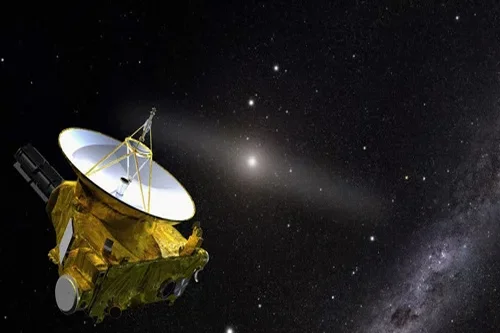
New Horizons finds Ultima Thule has an unexpected, flattened shape
Scientists’ understanding of the shape of Ultima Thule, officially known as 2014 MU69, has changed since the New Horizons spacecraft’s Jan. 1 flyby. Imagery downlinked by the probe in recent weeks suggests Ultima Thule’s two lobes have a flatter shape than the spherical projection suggested by the flyby’s initial pictures. The dashed blue line marks…
-
NASA orbiter spots Chinese lander on the moon
NASA’s Lunar Reconnaissance Orbiter captured this image of the Chang’e 4 lander and the Yutu 2 rover Feb. 1 from an altitude of 51 miles (82 kilometers). The Yutu 2 rover is annotated with the arrow on the upper left, and the Chang’e 4 stationary lander is annotated with the arrow at lower right. Credit:…
-

NASA declares Opportunity rover dead after 15 years on Mars
Opportunity’s front hazard-avoidance camera captured this image of the rover’s shadow July 26, 2004. Credit: NASA/JPL-Caltech Eight months after last hearing from the Opportunity rover, NASA officials announced the end of the craft’s 15-year mission Wednesday, closing out an ambitious chapter of Mars exploration that proved the Red Planet once harbored running water and demonstrated…