
Tag: Planetary Science
-

Photos: NASA’s InSight lander buttoned up for trip to Mars
The payload fairing of InSight’s Atlas 5 launcher was closed around the spacecraft April 16. Credit: USAF 30th Space Wing Now cocooned inside a heat shield and the nose shroud of an Atlas 5 rocket that will send it to Mars, NASA’s InSight lander is awaiting launch May 5 from Vandenberg Air Force Base, California.…
-

NASA to replace cracked heat shield in time for Mars 2020 rover launch
Artist’s concept of the Mars Science Laboratory, containing the Curiosity rover, entering the Martian atmosphere. The Mars 2020 mission will use the same heat shield design. Credit: NASA/JPL-Caltech NASA officials plan to replace the Mars 2020 rover’s heat shield after engineers discovered a crack in the structure earlier this month, but managers anticipate no delay…
-

Atlas 5/InSight launch windows
Artist’s concept of the United Launch Alliance Atlas 5 rocket on its launch pad at Vandenberg Air Force Base, California. Credit: NASA The United Launch Alliance Atlas 5 rocket carrying NASA’s InSight lander toward Mars will have a roughly two-hour predawn launch window each day from May 5 through June 8 to boost the science…
-

InSight Mars lander joined with Atlas 5 launcher at Vandenberg Air Force Base
File photo of a payload being lifted atop an Atlas 5 rocket at Vandenberg Air Force Base before a previous mission. Credit: United Launch Alliance Ground crews at Vandenberg Air Force Base on California’s Central Coast hoisted NASA’s InSight Mars lander atop a United Launch Alliance Atlas 5 rocket Monday, kicking off nearly two weeks…
-
NASA is counting on long-lived Mars orbiter lasting another decade
NASA’s Mars Reconnaissance Orbiter, seen here before its launch in 2005, carries the largest high-gain antenna ever sent to Mars for data relay and science downlinks. Credit: NASA NASA’s focus at the red planet has shifted to collecting and bringing rock samples back to Earth — a feat that could take a decade and leave…
-

NASA’s InSight lander inside one month to launch toward Mars
InSight’s heat shield (left) will soon be re-installed on the Mars lander (right) in preparation for launch May 5 from Vandenberg Air Force Base, California. Credit: Alex Polimeni/Spaceflight Now NASA’s InSight Mars lander will be buttoned up for launch in the coming weeks at Vandenberg Air Force Base in California, in preparation for its hoisting…
-

Saturn’s clouds run deep, rings may rain organics
Artist’s illustration of Saturn’s internal structure. Credit: NASA/JPL-Caltech Saturn’s clouds have roots deeper inside the planet’s atmosphere than scientists previously thought, and Saturn’s rings — now believed to have formed in the last 200 million years — appear to be raining organic molecules down on the planet, according to observations made by NASA’s Cassini spacecraft…
-
Atlas 5 rocket assembled for first Mars mission launch from Vandenberg
The Atlas 5’s first stage booster for the InSight mission arrives at Space Launch Complex 3-East at Vandenberg Air Force Base. Credit: NASA/Randy Beaudoin Ground crews at Vandenberg Air Force Base in California raised a United Launch Alliance Atlas 5 rocket on its launch pad earlier this month in preparation for liftoff May 5 with…
-
NASA to decide soon whether flying drone will launch with Mars 2020 rover
Artist’s illustration of the Mars helicopter drone that could travel to the red planet as soon as 2020. Credit: NASA/JPL-Caltech Testing of a lightweight robotic helicopter designed to fly in the alien atmosphere of Mars has produced encouraging results in recent months, and NASA officials expect to decide soon whether the aerial drone will accompany…
-
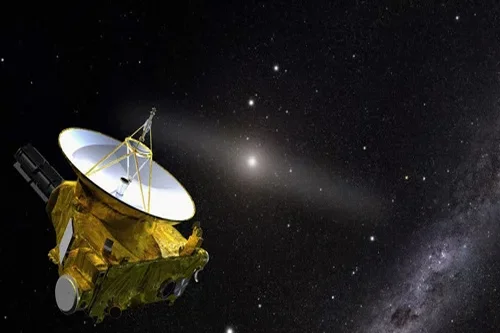
New Horizons spacecraft’s next distant destination gets a nickname
This image of Ultima Thule, or 2014 MU69, was captured by the Hubble Space Telescope in 2014. Credit: NASA/JHUAPL/SWRI The frozen faraway miniature world targeted for a high-speed flyby by NASA’s New Horizons spacecraft on Jan. 1, 2019, now has a nickname: Ultima Thule. Formally known as 2014 MU69, the robotic space probe’s next target…