
Tag: Rocket Lab
-
Rocket Report: Australia says yes to the launch; Russia delivers for Iran
Welcome to Edition 7.19 of the Rocket Report! Okay, we get it. We received more submissions from our readers on Australia’s approval of a launch permit for Gilmour Space than we’ve received on any other news story in recent memory. Thank you for your submissions as global rocket activity continues apace. We’ll cover Gilmour in…
-
Launch Roundup: SpaceX launches cargo resupply mission to ISS, Roscosmos and Rocket Lab also launch
This week got off to a flying start when new science experiments and cargo were launched to the International Space Station, and Roscosmos launched ionospheric research satellites. Rocket Lab has also launched its Electron rocket on the company’s quickest turnaround mission to date this week. Following a scrub of Sunday’s Starlink mission just moments before…
-

Rocket Lab launches 5 Internet of Things satellites following mid-week scrub
A Rocket Lab Electron rocket lifts off from New Zealand on the “Kinéis Killed the RadIOT Star” mission on Sept. 21, 2024, local time. Image: Rocket Lab Update Sept. 21: Rocket Lab confirms successful deployment of the payload. Rocket Lab launched its 53rd Electron rocket on a mission for the France-based Internet of Things company, Kinéis.…
-

Launch Roundup: Falcon 9 and Electron to extend satellite constellations
This week’s manifest includes the delayed launches of a Falcon 9 with Galileo global positioning satellites and an Electron with a second batch of satellites for Kinéis. SpaceX also launched a batch of 20 Starlink satellites from California as the constellation increases to 6,000 operational satellites. Following last weekend’s return and recovery of the Polaris…
-
Launch Roundup: Polaris Dawn, ISS crewed launch headline busy week
This week’s manifest features four Falcon 9 launches, including the highly anticipated Polaris Dawn crewed mission, a mission carrying AST SpaceMobile’s first five cellphone-compatible broadband satellites, and the delayed launch of two more satellites for Europe’s mid-Earth orbit Galileo constellation. Additionally, Roscosmos has launched the Soyuz MS-26 crewed mission to the International Space Station (ISS).…
-
Rocket Lab entered “hero mode” to finish Mars probes—now it’s up to Blue Origin
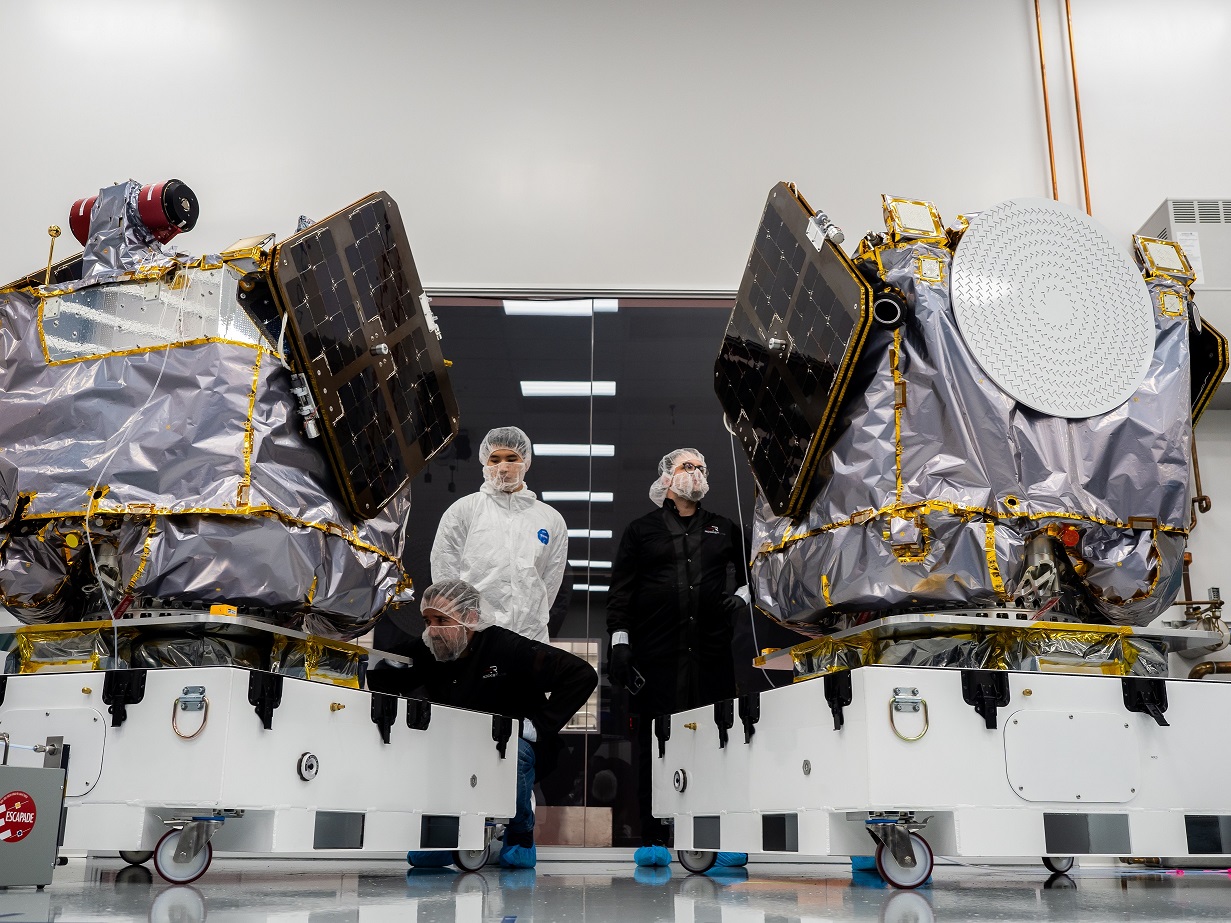
Two NASA spacecraft built by Rocket Lab are on the road from California to Florida this weekend to begin preparations for launch on Blue Origin’s first New Glenn rocket. These two science probes must launch between late September and mid-October to take advantage of a planetary alignment between Earth and Mars that only happens once…
-
Rocket Report: ULA is losing engineers; SpaceX is launching every two days
Welcome to Edition 7.07 of the Rocket Report! SpaceX has not missed a beat since the Federal Aviation Administration gave the company a green light to resume Falcon 9 launches after a failure last month. In 19 days, SpaceX has launched 10 flights of the Falcon 9 rocket, taking advantage of all three of its…
-
Rocket Lab’s Mars-bound twin satellites – Blue and Gold – hit the road ahead of Blue Origin launch
The fully integrated EscaPADE satellites sit inside a clean room at Rocket Lab’s Space Systems Group facility in Long Beach, California. Image: Rocket Lab Rocket Lab is gearing up for its first mission to another planet. In the fall, two of its spacecraft will hitch a ride onboard a Blue Origin New Glenn rocket to…
-
Rocket Lab launches 5th mission for Japanese Earth observation company, Synspective
Rocket Lab’s 51st Electron rocket stands at Pad B in Mahia, New Zealand, in preparation for the launch of the “Owl for One, Owl for All” mission. Image: Rocket Lab Rocket Lab launched its ninth mission of 2024 and its 51st Electron rocket launch to date. The flight sent an Earth observing satellite to low…
-
Falcon 9’s return to flight reminds spaceflight industry of past anomalies
Nearly every rocket that has flown has had an anomaly. With thousands of components that all need to work in perfect harmony to have a successful mission, there is likely to be one component that is unable to perform every once in a while. While witnessing an anomaly in spaceflight is not as improbable as…