
Tag: Solar System
-

Saturn’s clouds run deep, rings may rain organics
Artist’s illustration of Saturn’s internal structure. Credit: NASA/JPL-Caltech Saturn’s clouds have roots deeper inside the planet’s atmosphere than scientists previously thought, and Saturn’s rings — now believed to have formed in the last 200 million years — appear to be raining organic molecules down on the planet, according to observations made by NASA’s Cassini spacecraft…
-
NASA to decide soon whether flying drone will launch with Mars 2020 rover
Artist’s illustration of the Mars helicopter drone that could travel to the red planet as soon as 2020. Credit: NASA/JPL-Caltech Testing of a lightweight robotic helicopter designed to fly in the alien atmosphere of Mars has produced encouraging results in recent months, and NASA officials expect to decide soon whether the aerial drone will accompany…
-
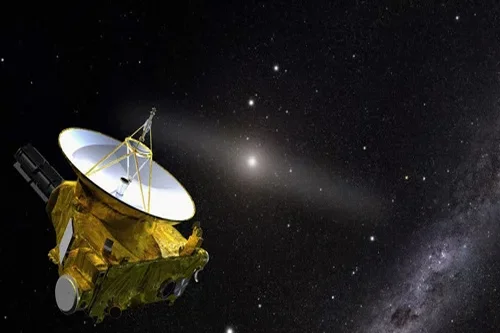
New Horizons spacecraft’s next distant destination gets a nickname
This image of Ultima Thule, or 2014 MU69, was captured by the Hubble Space Telescope in 2014. Credit: NASA/JHUAPL/SWRI The frozen faraway miniature world targeted for a high-speed flyby by NASA’s New Horizons spacecraft on Jan. 1, 2019, now has a nickname: Ultima Thule. Formally known as 2014 MU69, the robotic space probe’s next target…
-
Musk: Atmospheric tests of interplanetary spaceship could happen next year
Artist’s concept of the BFR spaceship deploying a satellite in orbit. Credit: SpaceX A team of SpaceX engineers is building a prototype of the spaceship Elon Musk hopes will one day carry people and cargo deep into the solar system, and it could begin low-altitude testing next year, kicking off a multi-step test campaign before…
-
Europe’s ExoMars orbiter nears start of methane-sniffing science mission
Artist’s concept of the ExoMars Trace Gas Orbiter during aerobraking at Mars. Credit: ESA/ATG medialab Nearly a year-and-a-half after arriving at the red planet, Europe’s ExoMars orbiter is finally approaching a planned perch around 250 miles over the rust-colored world after repeatedly dipping into the Martian atmosphere to lower its orbit. The end of a…
-
Saturn’s night side caught in “ringshine”
A patch of Saturn’s atmosphere was captured in this view from Cassini’s wide-angle camera on Sept. 14, 2017. Credit: NASA/JPL-Caltech/Space Science Institute In the final hours of its pioneering mission, NASA’s Cassini spacecraft opened its cameras to gaze down on Saturn, recording views of a nighttime cloudscape illuminated by sunlight reflected off countless tiny ice…
-
Photos: SpaceX’s imagery of Falcon Heavy test flight
SpaceX this week released a new batch of photos showing the Feb. 6 liftoff of the company’s first Falcon Heavy rocket from pad 39A at the Kennedy Space Center in Florida, followed by landing of the launcher’s two side boosters around eight minutes later at nearby Cape Canaveral Air Force Station. The Falcon Heavy lifted…
-
Elon Musk’s Tesla will have a close encounter with Earth in 2091
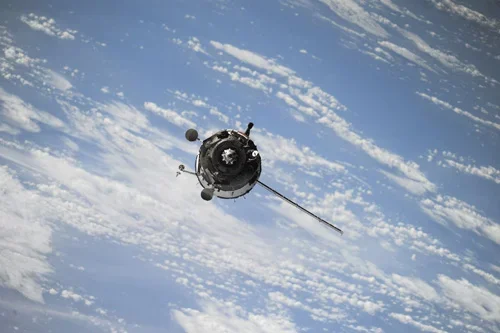
STORY WRITTEN FOR CBS NEWS & USED WITH PERMISSION Credit: SpaceX Even though it doesn’t obey any earthly speed limit and has a space-suited mannequin for a driver, Elon Musk’s Tesla Roadster won’t drive up his insurance rates anytime soon. Researchers say the sports car won’t have a really close encounter with Earth until 2091 and could…
-
Photos: Launch pad cameras capture Falcon Heavy’s fiery liftoff
This up-close sequence of photos shows the Falcon Heavy rocket lifting off from pad 39A at NASA’s Kennedy Space Center in Florida with nearly 5 million pounds of ground-shaking thrust. Using remote cameras, photographer Walter Scriptunas II took these images of the 229-foot-tall (70-meter) rocket firing off pad 39A at 3:45 p.m. EST (2045 GMT)…
-
Photos: More images of Falcon Heavy’s launch and booster landings
These additional views of the Falcon Heavy’s maiden liftoff from the Kennedy Space Center, and landing of its two side boosters at nearby Cape Canaveral Air Force Station, come from locations across the Florida spaceport. The Falcon Heavy lifted off from pad 39A at the Kennedy Space Center at 3:45 p.m. EST (2045 GMT), and…