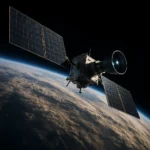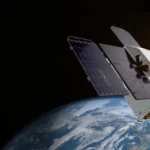
A multispectral payload is the camera a satellite uses to photograph the Earth in several separate colours at once including colours the human eye cannot see. An ordinary phone camera records three channels: red, green and blue. Combining them and we get a picture that looks like what we would see ourselves. A multispectral payload typically records somewhere between four and fifteen channels, and deliberately places several of them outside the visible range, in the near-infrared and shortwave infrared.
A visible photograph of a wheat field tells you the field is green but a multispectral image of the same field tells you how much chlorophyll is in the canopy, whether the crop is short of nitrogen, how much moisture is in the soil, and whether any of that has changed since last week.

Multispectral Payload Imaging
| Class | Band | Character |
| Panchromatic | 1 Band | One wide band collecting all available light — the most photons per pixel. Hence it produces sharpest images. |
| Multispectral | 3-15 Bands | Discrete bands with deliberate gaps between them. |
| Superspectral | Approx 15-100 Bands | More and narrower bands. |
| Hyperspectral | Over 100 Bands | Hundreds of contiguous narrow bands giving a continuous spectrum for every pixel. |
The key applications of multispectral payload are agriculture, forestry, water quality, mineral exploration, disaster preparedness, urban planning, insurance, and defense.
Components inside a Multispectral Payload:
Telescope: An astronomical mirror built from silicon carbide, brings all wavelengths to the same focus by construction and barely changes shape with temperature. Refractive designs persist at CubeSat scale where the optics are small enough that glass mass and chromatic correction are manageable. The colours can be separated using three techniques –
1. Dichroic beamsplitters divide the beam into broad groups typically visible-plus-near-infrared one way and shortwave infrared the other and route them to physically separate focal planes.
2. Stripe filters bonded to the detector, sometimes called butcher-block filters, put a different narrow interference filter over each strip of the array. The spacecraft’s forward motion sweeps every ground point under each stripe in turn.
3. Prisms or diffraction gratings spread wavelength continuously across one axis of the detector. This is the hyperspectral route; it costs an entire detector axis, which is why hyperspectral missions have narrow swaths.
Scanning Geometry: Modern payloads are overwhelmingly push-broom. Push-broom is a technique where a fixed line of detectors across the track, with the spacecraft’s motion building the image line by line. The older whisk-broom approach sweeps a mirror across the track fewer detectors to cross-calibrate, but much shorter dwell time per pixel. Small frame imagers, such as Planet’s Doves, capture a two-dimensional scene at once, like a conventional camera.
Time Delay Integration (TDI): At very high resolution, each pixel is over its ground target for such a short time that too few photons arrive. TDI solves this by using several detector rows per band and clocking the accumulated charge down the array at exactly the rate the scene moves across it.
Detectors and Cooling: Silicon works beautifully out to about 1,000 nm and then stops. Everything beyond that needs a different semiconductor mercury cadmium telluride or indium gallium arsenide and those materials generate significant dark current at room temperature.
Calibration: Ground-based vicarious calibration over sites such as Antarctic snowfields completes the picture.
Radiometric Resolution: How finely the sensor divides brightness matters as much as how finely it divides space. Extra bits preserve detail in dark water and bright snow within the same scene, and let an index be stretched further before quantization noise appears.