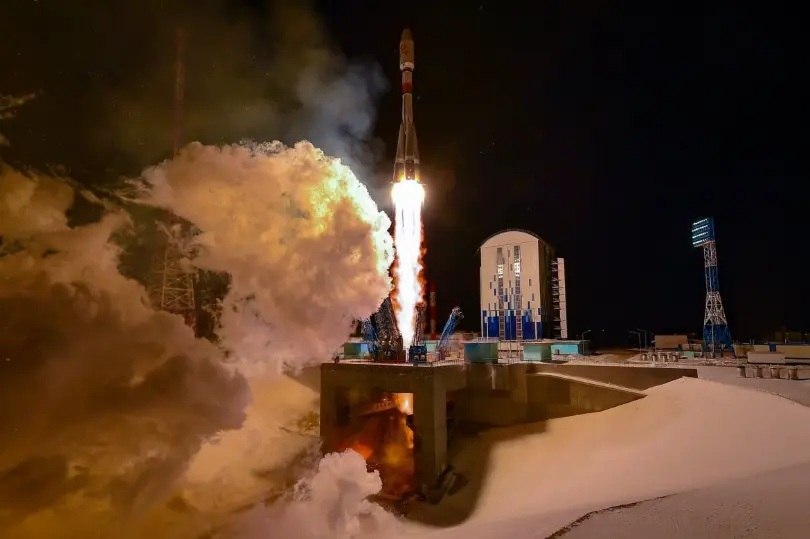
Arianespace, contracted through OneWeb, used a Russian Soyuz 2.1b rocket with a Fregat upper stage to place 36 new OneWeb satellites into orbit for the British government. The move resumed OneWeb launch operations after the company itself went bankrupt earlier this year.
Liftoff occurred at 07:26:26 EST (12:26:26 UTC) on Friday, 18 December from Site 1S at the Vostochny Cosmodrome in eastern Russia. The mission took nearly 4 hours to complete deployment of the all the satellites.
The Soyuz 2.1b rocket (also called the Soyuz ST-B when it flies from the Centre Spatial Guyanais [Guiana Space Centre] in South America), is a Russian workhorse launcher that’s primary difference comes in the use of a different Blok I stage engine than its Soyuz 2.1a (ST-A) counterpart.
The Blok-I stage on the “b” variant uses the staged combustion cycle RD-0124, providing improved performance and thus greater payload capability over the gas generator RD-0110 engine used on the “a” variant.
Despite the higher performance of the Soyuz 2.1b, it is the Soyuz 2.1a that is the human-rated version of the rocket, entrusted with crew (and cargo) launch operations to the International Space Station.
The Blok-I stage of both variants is ignited mid-flight to continue the climb to orbit that begins when the lower stages are ignited on the ground before liftoff.
Those ground-lit elements include the four side-mounted boosters, each using a single RD-107A engine and two vernier rockets, and the Blok-A core stage, which uses a single RD-108A engine and four verniers.

The first part of the launch sequence for the OneWeb 4 mission. (Credit: Arianespace)
The boosters and Blok-A and -I stages all burn RP-1 kerosene and liquid oxygen. The Fregat upper stage, however, uses an S5.92 engine that burns a highly toxic mixture of dinitrogen tetroxide and unsymmetrical dimethylhydrazine.
OneWeb’s custom dispenser system deployed the satellites after the Fregat brought them to a 450 km orbit inclined 87.4 degrees to the equator.
See Also
- Soyuz/OneWeb-4 UPDATES
- European Forum Section
- L2 Russian Section
- Click here to Join L2
After activation and checkout, the satellites will raise their orbits to their operational altitude of 1,200 km.
The launch was sold to OneWeb by Arianespace (the European company responsible for sales and launch operations for Europe) and Starsem, a French-Russian company responsible for the commercial sales of Soyuz outside the Russian Federation.
Inside Russia, Soyuz operations are handled by Roscosmos, the national space agency of the Russian Federation. Roscosmos, a stakeholder in Starsem, oversees the operations of its rockets when they are used by Arianespace regardless of the launch site.
Soyuz is the only orbital rocket that has launched from three different continents and countries — Baikonur, Kazakhstan and Vostochny, Russian Federation (Asia), Plesetsk (Europe) and the Centre Spatial Guyanais, French Guiana (South America)
This was the first flight for Arianespace, Starsem, and OneWeb from the Vostochny Cosmodrome in the Russian Far East.

The final part of the flight plan, including deorbit of the Fregat upper stage. (Credit; Arianespace)
The site was approved in 2007 and hosted its first launch in 2016. To date, all five missions from Vostochny have used a Soyuz 2 rocket.
Previous OneWeb missions have launched on Soyuz 2 rockets from the Centre Spatial Guyanais near the equator and the Baikonur Cosmodrome located at 45.9 degrees North.
Vostochny, at 51.5 degrees North, is the most efficient launch site of the three for OneWeb’s polar launch needs as it is the closest to a pole of the three launch sites. Nevertheless, and for unstated reasons, OneWeb’s seven planned launches in 2021 will be split between the more-efficient Vostochny and less-efficient Baikonur cosmodromes — with the Centre Spatial Guyanais not scheduled to host any additional OneWeb launches on Soyuz rockets as of publication.
It is likely that the planned seven launches of OneWeb satellite groups next year requires the use of both facilities for logistical reasons — though Vostochny is severely under-used compared to its counterparts (five launches in four years), so it is unclear why that location cannot host seven OneWeb launches across 12 months.
Regardless of where they launch from, the fact that more OneWeb satellites are launching again is a complete reversal of fortunes from March 2020 when the company filed for bankruptcy and all but shut-down, save essential personnel and operations to maintain the hardware already built as the bankruptcy worked its way through the court and OneWeb tried to find a buyer.
The high cost of both satellite launch and production, coupled with the COVID-19 pandemic, forced the decision just days after the company’s third launch.
#OneWebLaunch is coming
. Friday, December 18th lift-off is currently scheduled for 12:26:26 UTC, 7:26:26 AM EDT. The team is hard at work in Vostochny preparing. Stay tuned for more updates about our program. pic.twitter.com/zMqDxxkyOj
— Eutelsat OneWeb (@OneWeb) December 14, 2020

The United Kingdom’s government, via the National Security Strategic Investment Fund, co-purchased OneWeb in a consortium with Bharti Enterprises Ltd. (an Indian-based company with an operational arm in the U.K.) in July 2020 in a deal that saw each contribute $500 million (USD) to the acquisition.
The U.K.’s interest was reported at the time to revolve around a replacement for Galileo, the European Union’s GPS-alternative. As a consequence of leaving the EU, which the U.K. did in January this year, the country will be excluded from large parts of the Galileo system, notably the resilient secure communications aspects as well as defence.
Other objectives, such as ensuring broadband access to all households in the U.K., were also mentioned at the time of purchase.
However, the U.K. Space Agency (UKSA) reviewed the technical aspects of the deal prior to investment and stated it had “substantial technical and operational hurdles,” with additional concerns raised that the large risks in the project meant it did not meet the government’s criteria for return on investment. In particular, the different interests between Bharti Enterprises and the U.K. government were noted.
Nevertheless, Ministers in the U.K. government overrode the concerns and authorized the purchase in such a way that the U.K. government could veto significant changes to the constellation and OneWeb itself and prevent takeovers. This has typically been used to prevent foreign takeover of businesses considered part of the critical national infrastructure when privatised (e.g. NATS, the main air traffic control provider in the country).
Despite the still nebulous nature of the purchase and exactly what the U.K. will use the constellation for, what is known concretely is that the U.K. and Bharti Enterprises want to vastly increase the constellation from the authorized 648 satellites in the initial round to a total of 47,844.

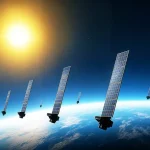
Visualization of a OneWeb satellite in orbit. (Credit: OneWeb)
That increase met with stiff push-back from the U.S. Federal Communications Commission (FCC), which still has authority over the system that is built in the U.S. and in which the constellation’s frequencies will be used.
In May 2020, OneWeb submitted an FCC filing to modify their license to increase the number of satellites as part of a Phase 2 deployment. The FCC response in August 2020 only granted an application up to 1,280 satellites noting a deep concern regarding orbital debris mitigation.
Given the lack of information regarding U.K. regulation of orbital debris, the FCC granted approval for just 1,280 satellites conditional on debris mitigation plans or evidence of direct and effective regulation.
OneWeb was given six years to launch half of the constellation and nine years to launch all of it.
Orbital debris mitigation is a key concern for satellite operators and launch providers.
Under the Space Industry Act 2018, the UKSA is charged with managing licensed operators, taking into account debris mitigation guidelines. Potentially in response to this constellation, in September 2020 the U.K. Ministry of Defence and UKSA signed an agreement to work together on monitoring threats and hazards in orbit.
UKSA also announced funding to a number of companies to work on debris tracking as well as a 2025 mission to remove an object from orbit.
Lead image: The Soyuz 2.1b with 36 OneWeb satellites lifts off right on time from Site 1S launch pad at Vostochny in 2016. Credit: Roscosmos