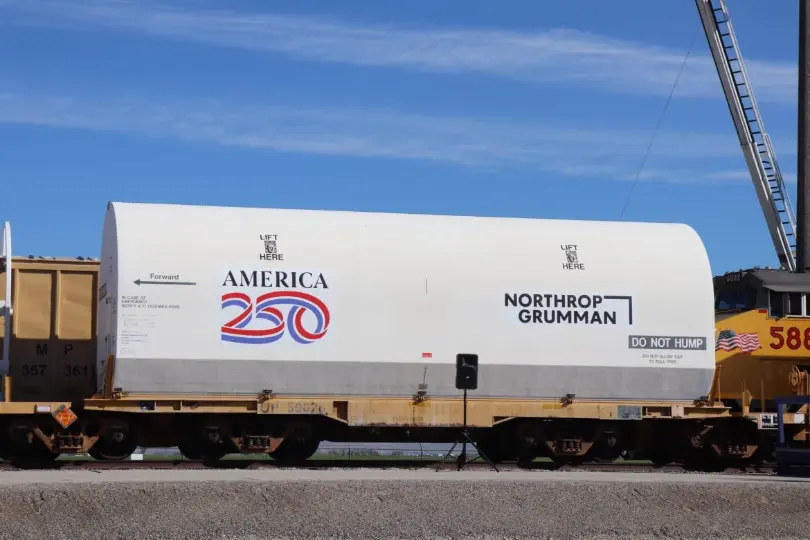
While there is some uncertainty regarding timelines and landers, the Artemis III mission — currently scheduled for the summer of 2027 — is being prepared for launch at NASA’s Kennedy Space Center in Florida. Northrop Grumman began shipping all eight remaining solid rocket booster segments for the mission’s Space Launch System (SLS) rocket from Utah on Tuesday, June 2.
The Union Pacific train carrying the eight solid rocket booster segments was christened at a ceremony that also featured several speakers. Northrop Grumman’s vice president and general manager of the launch and exploration division, Wendy Williams, started by congratulating NASA for the successful Artemis II mission. SLS deputy program manager Chris Cianciola stated that the booster segments are to be stacked this summer for Artemis III.

An Artemis III booster segment prior to departing Utah for Florida on June 2, 2026. (Credit: Justin Davenport for NSF)
Cianciola also confirmed that the Artemis III core stage and boosters will be rolled out to Launch Complex 39B at the Kennedy Space Center toward the end of this year for a wet dress rehearsal. This test will verify the rocket’s propellant loading, which suffered problematic hydrogen leaks during the Artemis I and Artemis II launch campaigns.
After the rehearsal is complete, Cianciola stated that the Artemis III stack will be prepared to support launch readiness as early as March 2027. However, that does not necessarily mean that Artemis III will fly then, as questions remain about the readiness of the SpaceX Starship and Blue Origin Blue Moon Human Landing System (HLS) vehicles.
Cianciola also noted that the Artemis II SLS vehicle “did its job” and achieved an orbital accuracy of 99.9% to place the Orion Integrity and its crew in a position to accomplish their mission. He and other speakers praised the teams at Northrop Grumman that worked on the boosters.

STS-127, STS-135, and Demo-2 astronaut Doug Hurley speaks at the ceremony prior to the Artemis III booster segments’ departure. (Credit: Justin Davenport for NSF)
After Chris Cianciola’s speech, STS-127, STS-135, and Demo-2 astronaut Doug Hurley spoke and discussed how the SLS solid rocket boosters provide 75% of the vehicle’s thrust during liftoff, providing 7.2 million pounds of thrust in total. Hurley now serves as Northrop Grumman’s senior director of business development.
Northrop Grumman’s senior director of NASA programs, Mark Pond, discussed how the company’s teams and hardware performed very well and noted that a booster casting for a future SLS mission was completed the day before, on Monday, June 1. The train carrying the booster segments to Florida will be pulled by Union Pacific locomotive 4547, which was built in partnership with Wabtec and GE Transportation.

The front of Union Pacific locomotive 4547 prior to its departure from Utah with eight Artemis III solid rocket booster segments. (Credit: Justin Davenport for NSF)
The eight booster segments are loaded into special containers that protect them from the hazards of their journey across the United States. These hazards can include extreme heat, extreme cold, and vibration inherent in riding on the rail tracks. One of these containers is decorated with a logo commemorating the United States of America’s 250th anniversary semiquincentennial, the same logo that flew on the SLS solid rocket boosters for Artemis II.
See Also
- Artemis III Updates
- SLS Forum Section
- Artemis Archives
- Click here to Join L2
The locomotive and its cargo will take between six and nine days to reach Kennedy Space Center in Cape Canaveral. Both aft booster segments and the core stage for Artemis III are already at the Kennedy Space Center, and the eight remaining booster segments will join them.
The SLS boosters were originally rated for stacking up to one year before launch, though waivers have been granted on prior occasions after additional analysis. There were concerns about the propellant sagging in a vertical orientation, but NASA cleared Artemis I’s boosters of this concern after additional testing.
The Artemis I solid rocket boosters were stacked for about 20 months, from March 2021 to November 2022, before the mission launched successfully on Nov. 16, 2022. If Artemis III’s boosters are stacked this summer, they could remain stacked until at least the first few months of 2028.

Artemis III core stage assembly rolling out of Michoud Assembly Facility on April 20, 2026. (Credit: NASA)
There are plans for three SLS flights in the next two years, with Artemis III in 2027 followed by the Artemis IV lunar landing in early 2028 and the Artemis V lunar landing in late 2028. The SLS vehicles for these flights are in production, but the HLS landers, or at least one of them, must also be ready for the flights to proceed.
Artemis III is planned as a low-Earth-orbit test mission for Orion and the HLS landers, which will inevitably culminate in lunar landing missions on Artemis IV and Artemis V. It is unclear whether both Blue Origin and SpaceX landers will be used for the mission. NASA is scheduled to announce the four-person crew for Artemis III on June 9.
(Lead image: One of eight Artemis III booster segments ready for transport to Florida on June 2, 2026. Credit: Justin Davenport for NSF)