Space Launch Delta 45 (SLD 45), which operates the Eastern Range, have cleared a major safety milestone following the anomaly involving a Blue Origin New Glenn rocket on May 28. The Blast Danger Area (BDA), a keep-out zone in place during hazardous vehicle operations like a static fire or launch, was removed on June 1 allowing teams to begin the damage assessment of the pad and surrounding infrastructure.
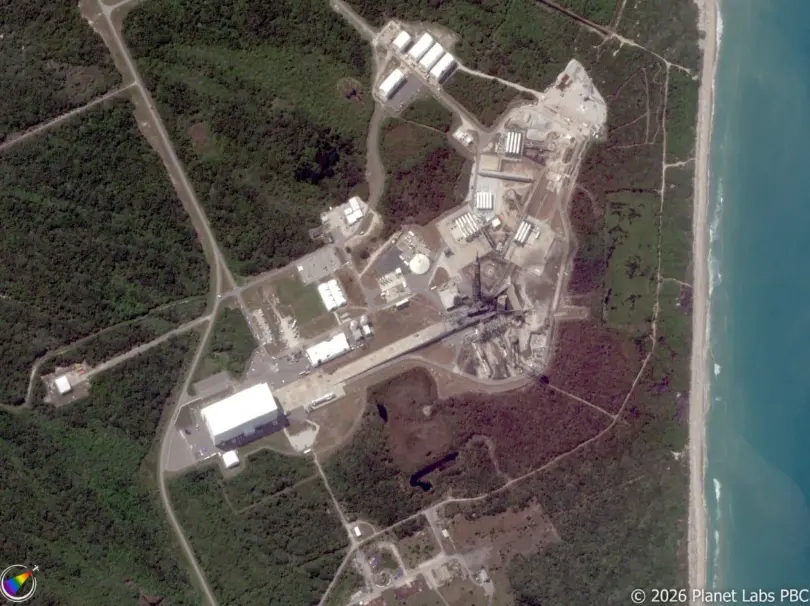
The BDA had remained in place since Blue Origin began preparing for the static fire attempt at Launch Complex 36 (LC-36) at the Cape Canaveral Space Force Station (CCSFS) in Florida early on the 28th. While typically removed shortly after detanking operations complete, it remained in place after the New Glenn rocket, without payload, created a fireball during an anomaly at the pad.
Col. Brian Chatman, the director of the Eastern Range and commander of SLD 45, confirmed this was the largest explosion they have ever had, yet their emergency response team was activated just five minutes after the explosion. They were operating at 100 percent capacity within 30 minutes of the event.
“We do have range personnel that are on console and weather personnel that are on console through any and all hazardous activities,” Col. Chatman said, noting Blue Origin remains the primary organization overseeing the test.
“Once an incident occurs, the roles and responsibilities fall over to Space Launch Delta 45. We have an incident commander that stands up and then takes control of that incident. The fire chief that is on duty at that point will roll into that incident commander role and responsibilities.”

Members of the 347th Rescue Group from Moody Air Force Base, Georgia, watch a launch at Patrick Space Force Base, Florida, June 5, 2024. (U.S. Space Force photo by Airman 1st Class Spencer Contr
The morning after, a small select team of Blue Origin personnel along with SLD 45 safety personnel were at the pad and surrounding area to observe initial damage. Fire teams worked to put out all the surrounding flames that remained while ordinance removal teams worked to clean up any dangerous debris before turning the pad fully back to Blue the Sunday following the anomaly.
Aerospace & Defense
(adsbygoogle = window.adsbygoogle || []).push({});
When it comes to damage, Col. Chatman said initial assessments are still continuing, but noted that outside of the launch pad itself, windows were seen blown out at nearby Hangar C, which is currently part of the Cape Canaveral Space Force Museum. A nearby weather balloon deployment device used by the SLD 45 weather team also received damage.
However, balloons from that area were still able to be used the day after the explosion, as the range supported the launch of a Falcon 9 in the morning at Space Launch Complex 40 (SLC-40) and an Atlas V launch in the evening from Space Launch Complex 41 (SLC-41). In fact, those balloons, after a special safety path was cleared, were deployed in support of that Atlas launch.

A Falcon 9 rocket carrying the Starlink 10-53 mission successfully launches from Space Launch Complex 40 at Cape Canaveral Space Force Station, Florida, on May 29, 2026. (U.S. Space Force photo by Gwendolyn Kurzen)
“In this instance, geography was our friend,” Col. Chatman noted. “[LC-36] our most southern launch pad, SLC-40 and 41, some of our most northern launch pads. That geographic separation allowed us to work through the anomaly, work through the firefighting, work through the re-entry down at Pad 36 while still facilitating launch operations up north with ULA and SpaceX.”
Col. Chatman does note that all of the debris that was found was within the designated BDA of 7,147 ft (2,178 m) in diameter from the rocket’s location on the pad. That represents a 100 percent TNT blast equivalent radius.
UPDATE: Debris from the 28 May 2026 anomaly could wash ashore along publicly accessible areas over the coming days or weeks, report debris to 911. Launch vehicle debris is potentially hazardous, direct contact poses a risk to personal health and welfare. https://t.co/LAvUsRdK4H
— Space Launch Delta 45 (@SLDelta45) May 29, 2026
“When we look at TNT, we’ve codified that the blast radius is with the amount of TNT that is used during an explosive operation, and that’s common across all of industry,” Chatman explained in response to a question from NSF. “So the amount of weight associated with the TNT matched to the amount of fuel that is in the launch vehicle drives the explosive arc and blast damage area that we establish from a keep-out zone perspective.”
Col. Chatman acknowledged that all personnel at the roadblocks located at the edge of the BDA were safe, verifying their numbers. They will, however, evaluate their current radius and adjust following their evaluations from this event, which could include them shrinking.
“The BDA for a New Glenn from one day to the next can shift based on the weather patterns and what’s happening just in the environment that day,” Col. Chatman noted.

New Glenn’s second flight as seen from the nearby Cape Canaveral Lighthouse. (Credit: Blue Origin)
While New Glenn is the largest rocket SLD 45 has ever supported, it is expected to be surpassed with the launch of SpaceX’s Starship vehicle from Florida. The company currently has a Starship launch pad at Launch Complex 39A (LC-39) at the Kennedy Space Center and is building at least two more at Space Launch Complex 37 (SLC-37) on CCSFS property.
For a 100 percent TNT blast equivalent, SLD 45 is expecting the BDA for Starship to extend to 12,000 ft (3,657 m) in diameter from whatever pad the rocket is on, once in hazardous operations. This would mean no launch providers within that radius would be able to access their launch pads during those events.
The same was true for this static fire. The closest launch pads to SLC-36, Stoke Space’s LC-14 and Relativity Space’s LC-16, remained off-limits until the area was deemed safe the morning after the explosion.
(Lead image: SpaceFromSpace / © 2026 Planet Labs PBC)