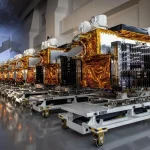
Azista BST Aerospace is expanding the satellite portfolio through modular Low Earth Orbit (LEO) satellite platforms designed to support Earth observation, scientific research, technology demonstration and commercial space applications. Headquartered in Gujarat, India, the company develops satellite buses that combine scalable architectures, secure communications, precision attitude control and electric propulsion to meet a broad range of mission requirements. Azista BST Aerospace addresses these requirements through standardized satellite buses that allow mission developers to configure payloads according to application-specific needs while providing a common engineering architecture.

Azista BST Aerospace develops modular satellite platforms that provide these core spacecraft functions while enabling customers to integrate mission-specific payloads for Earth observation, remote sensing, scientific research, communications and technology validation. By standardizing the satellite bus architecture, the company enables faster spacecraft development and more efficient integration without compromising mission flexibility. The LEOS family is designed to support both commercial and institutional missions requiring reliable spacecraft performance throughout extended operational lifetimes. The LEOS-50 platform serves as the primary workhorse within Azista BST Aerospace’s satellite portfolio. Designed for flexibility, LEOS-50 accommodates a wide variety of payloads while providing a stable spacecraft architecture suitable for multiple mission categories. The modular design enables customers to integrate Earth observation instruments, scientific sensors, communications payloads and technology demonstration systems according to specific mission objectives. The platform’s adaptability makes it suitable for organizations seeking a standardized spacecraft capable of supporting diverse operational requirements. The LEOS-50 platform is built around a core structure measuring 570 × 570 × 200 mm, providing a compact spacecraft foundation while maintaining sufficient space for subsystem integration. The platform also incorporates an extendable payload envelope with approximately 100 mm available on each side, allowing additional flexibility for payload accommodation depending on mission requirements. When required, the spacecraft can support a maximum payload volume of approximately 570 × 570 × 400 mm, enabling integration of larger instruments while preserving the standardized satellite architecture. This modular structural design simplifies payload integration across different mission configurations.

LEOS-50 is designed as a 50-kilogram-class satellite platform capable of supporting payload masses ranging from approximately 15 to 30 kilograms. The platform is engineered for a five-year operational design life in Low Earth Orbit, providing long-term mission capability for commercial, scientific and institutional satellite programs. This balance between compact spacecraft dimensions and meaningful payload capacity enables efficient deployment across a broad range of orbital applications. A distinguishing feature of LEOS-50 is its very fast target pointing capability, supporting attitude maneuvering rates of up to 5 degrees per second. Rapid pointing performance enables satellites to quickly reorient toward areas of interest, supporting applications requiring frequent observation of multiple ground targets or dynamic mission planning. High-agility attitude control also improves mission flexibility by enabling efficient retargeting while maximizing observation opportunities during each orbital pass. LEOS-50 incorporates communication systems designed to support both spacecraft operations and payload data transmission. The platform utilizes an S-band telemetry, tracking and command (TT&C) link operating at up to 2 Mbps, enabling reliable spacecraft command and health monitoring. Mission data generated by onboard payloads is transmitted through an X-band downlink capable of data rates up to 1 Gbps, allowing efficient transfer of large Earth observation datasets and scientific information to ground stations. The combination of S-band operational communications and high-capacity X-band payload transmission provides balanced support for routine spacecraft management and high-volume mission data delivery. LEOS-50 incorporates full encryption for both payload data and TT&C communications, helping protect operational commands and mission data throughout transmission. Encrypted communication supports mission integrity while providing additional protection for customers operating sensitive commercial, scientific or governmental payloads. The platform also integrates electric propulsion, providing efficient orbital maneuvering capabilities while minimizing propellant consumption. Electric propulsion supports orbit maintenance, station keeping, mission adjustments and end-of-life orbital management over extended mission durations. Compared with conventional chemical propulsion, electric propulsion enables greater propellant efficiency, making it well suited for long-term operations in Low Earth Orbit.
Also Read: What are the Different Types of Satellite Services?
Developed to accommodate larger and more demanding payloads, LEOS-100 provides increased spacecraft capacity while maintaining the modular engineering philosophy used throughout Azista BST Aerospace’s product portfolio. The platform is intended for missions requiring higher payload mass, greater electrical power availability, and support for larger remote sensing instruments. LEOS-100 is designed to support high-precision Earth observation payloads, including instruments capable of achieving 50-centimeter Ground Sampling Distance (GSD). The platform’s body-mounted solar panel configuration provides the electrical power required by advanced optical payloads while maintaining structural compatibility with high-performance imaging systems. This capability enables deployment of sophisticated remote sensing instruments suitable for environmental monitoring, infrastructure assessment, agriculture, urban planning, disaster management and scientific research. The LEOS-100 platform features a core structure measuring 600 × 600 × 200 mm, together with an extendable payload envelope similar to that used on LEOS-50. The spacecraft supports a maximum payload volume of approximately 600 × 600 × 800 mm, allowing significantly larger instruments and mission hardware to be integrated. Designed as a 150-kilogram-class satellite, LEOS-100 accommodates payload masses ranging from approximately 50 to 75 kilograms, supporting more complex mission configurations than smaller spacecraft platforms. One of LEOS-100’s key capabilities is the ability to support missions requiring up to 2 kilowatts of electrical power. Higher onboard power availability enables integration of more demanding payloads, including advanced imaging systems and other instruments requiring continuous electrical operation. This expanded power capability broadens the range of missions that can be supported using the standardized satellite platform. The platform supports 2 Mbps S-band telemetry, tracking and command communications together with 1 Gbps X-band payload downlinks, enabling efficient transmission of large observation datasets. As with the smaller platform, both TT&C and payload data communications are fully encrypted, supporting secure mission operations and protected data transmission. LEOS-100 also incorporates electric propulsion to support orbital maintenance and mission flexibility throughout the operational lifetime. The propulsion system enables efficient station keeping while supporting orbit adjustments necessary for Earth observation missions and long-duration spacecraft operations. Combined with the platform’s extended design life, electric propulsion contributes to sustained mission performance over multiple years in orbit.

The LEOS-50 and LEOS-100 platforms provide Azista BST Aerospace with satellite solutions capable of supporting a broad range of commercial, scientific, governmental and defense applications. Potential missions include Earth observation, remote sensing, environmental monitoring, technology demonstration, scientific research, communications and other payloads requiring secure communications, agile spacecraft control and reliable orbital performance. The modular architecture enables customers to design payload integration while benefiting from standardized spacecraft engineering and proven subsystem capabilities. Azista BST Aerospace provides scalable satellite solutions that combine modular spacecraft design, precision pointing, secure communications, high-speed X-band data transmission, electric propulsion and long-duration operational capability. By offering flexible payload accommodation together with standardized engineering, the company continues to support the evolving needs of commercial, institutional and governmental customers developing the next generation of Low Earth Orbit satellite missions.
About Azista BST Aerospace
Azista BST Aerospace is a satellite technology company headquartered in Gujarat, India, specializing in the design, development, manufacturing, integration and testing of satellite systems and space technologies. The company develops modular satellite platforms, including the LEOS-50 and LEOS-100 satellite buses, to support Earth observation, communications, scientific research and technology demonstration missions in Low Earth Orbit (LEO). The spacecraft integrate secure communications, precision attitude control, high-speed data downlinks and electric propulsion to meet a wide range of mission requirements. Through the satellite platforms and end-to-end spacecraft engineering capabilities, Azista BST Aerospace provides scalable space solutions for commercial, government and institutional customers.