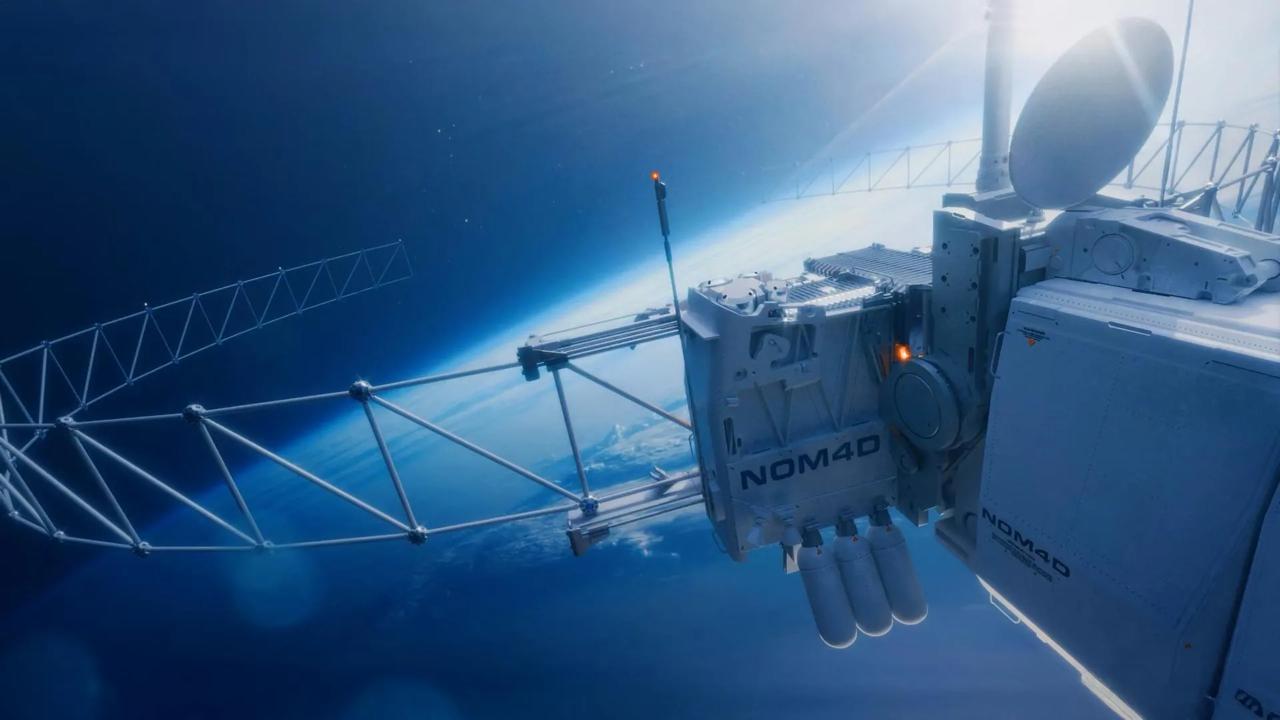
The robotic system was developed by Caltech researchers with funding from the Defense Advanced Research Projects Agency as part of DARPA’s Novel Orbital and Moon Manufacturing, Materials, and Mass-efficient Design program, known as NOM4D. DARPA established the program in 2022 to investigate technologies that could ferry raw materials from Earth for in-orbit manufacturing. The Caltech experiment is one of only two projects selected to advance to the program’s third phase, which involves demonstrating construction technologies in orbit.
The demonstration, called the Autonomous In-Space Tensioned Reflector Assembly, or ASTRA, is led by Sergio Pellegrino, the Joyce and Krent Kresa Professor of Aerospace and Civil Engineering at Caltech. “This is the first time that a structure has been autonomously constructed in space,” Pellegrino said. Rather than relying on astronauts, the robot uses an automated arm to retrieve structural tubes and connecting joints from storage dispensers, then joins the components into repeating sections called bays that form a larger framework known as a truss.
ASTRA spent six months in orbit attempting to construct a reflector antenna measuring 1.4 meters across, combining composite fiber tubes, aluminum connectors, and a reflective surface made from Kapton polymer film. The team encountered technical difficulties and scheduling constraints that prevented it from finishing the entire antenna, but the robot successfully assembled an initial section. The payload began its journey on March 30, 2026, aboard a SpaceX Transporter-16 mission from Vandenberg Space Force Base, traveling on Momentus Inc.’s Vigoride 7 orbital vehicle. ASTRA occupied about one cubic meter and contained two previously assembled truss bays, a robotic arm, and motorized dispensers loaded with parts.
The team had less than 12 months to manufacture, test, and deliver the space hardware to Momentus. “Developing a payload of this complexity on such a short timeline was an enormous undertaking for our small team,” Pellegrino said. Jaden Suh, a former Caltech postdoctoral scholar now at the University of Texas at Austin, said sending the hardware to space fulfilled a lifelong ambition. “A lot of my original ideas are included in this system, and it was just incredible seeing it reach space,” Suh said.
Researchers say the ability to assemble large structures directly in orbit could transform astronomy, communications, and space based energy systems, enabling telescopes with larger reflective surfaces, powerful radio antennas, and solar power stations beyond the size limits imposed by a rocket’s fairing. “NOM4D’s objective is to enable efficient, scalable construction of very large structures in space,” said Andrew Detor, DARPA program manager for NOM4D. “By ‘very large,’ I mean hundreds of meters or kilometers in scale. Nothing approaching that scale can be achieved today.” Pellegrino said the demonstration opens new avenues of research as the mission wraps up.
The other third-phase project, led by the University of Illinois Urbana-Champaign, will use a module attached to the International Space Station to investigate hardening carbon tubes in space, offering another way to manufacture structural components without completing every step on Earth.