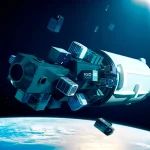
Gravitics is developing turnkey space cargo and logistics solutions designed to transport assets where they are needed in orbit while providing flexible services beyond conventional cargo resupply. Its cargo spacecraft is designed for efficient delivery operations and can optionally remain in orbit as a storage module after completing its delivery mission or serve as a disposal system at the end of the mission.
Gravitics says its cargo services are intended to provide lower-cost and faster-schedule options for commercial space customers, with missions supporting destinations beyond commercial space stations and the ISS. The company is targeting 2028 for its first cargo mission.
Also Read: Gravitics Secures $60M Space Force STRATFI Contract to Advance Orbital Carriers
The cargo system is designed to support a range of mission profiles, including delivery, tug and ferry services. The capabilities include Low Earth Orbit delivery, power options for payloads that need to remain charged and secondary missions with end-of-life de-orbit services. The spacecraft can also visit and deliver cargo to multiple destinations, while the versatile propulsion system provides positioning capabilities ranging from gentle orbital boosts and orbit raising to other in-space maneuvers.

A major feature of the platform is its on-orbit warehousing capability. The cargo bay can provide storage for payloads after delivery, extending the spacecraft’s usefulness beyond a single transportation mission. Flexible loading is intended for payloads that cannot remain idle on a launchpad, while last-minute loading capabilities add further operational flexibility. Together, these features are designed to give customers more options for when and where payloads are deployed and how cargo spacecraft can be used after reaching orbit.
The cargo spacecraft is designed around a 60-cubic-meter internal volume and a 5000–10000 kg cargo launch mass, with launch compatibility for 5-meter-plus fairing-class vehicles. The configuration also supports optional warehousing, docking and berthing interfaces, allowing the spacecraft to connect with different orbital destinations and infrastructure. Actual capabilities vary according to the destination orbit and specific mission constraints.

Gravitics’ approach positions cargo transportation as part of a broader in-space logistics architecture, where a single spacecraft can perform delivery, repositioning, storage, servicing, and end-of-life functions. The ability to combine cargo transport with tug and ferry operations, multi-destination delivery, on-orbit storage, flexible loading and de-orbit services provides a more adaptable logistics model for the expanding commercial space economy.
About Gravitics
Gravitics is a space infrastructure company developing and manufacturing large space structures, cargo logistics spacecraft, orbital carriers and space station modules. The spacecraft architecture is designed to support commercial and national-security applications, with common technologies and components extending across its cargo, orbital carrier and space station programmes.