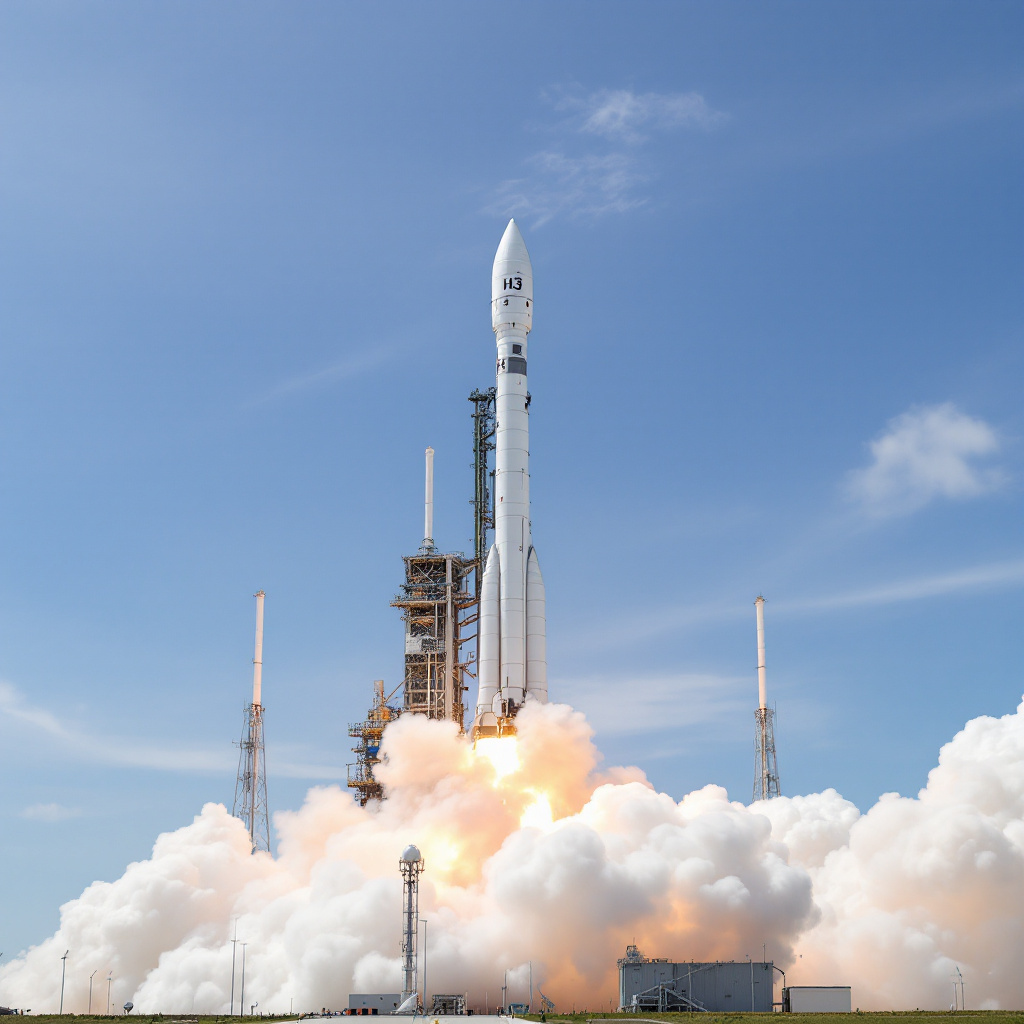
The launch was intended to complete the expansion of Japan’s Quasi-Zenith Satellite System, or QZSS, from four to seven satellites. That seven-satellite system, using a mix of geostationary and inclined geosynchronous orbits, would ensure at least four satellites are visible over Japan at any time, allowing them to be used exclusively for positioning without relying on signals from other navigation satellite systems.
That plan was set back when Michibiki 5 was lost in an H3 launch failure last December. An investigation linked the failure to shocks during payload fairing separation that damaged both the satellite and payload adapter, which in turn caused a pressure loss in the upper stage’s liquid hydrogen fuel system. The satellite itself appeared to fall off the adapter when the upper stage separated from the lower stage.
Michibiki 7 is a 4.9-metric-ton satellite that will operate in a slightly inclined geosynchronous orbit as part of QZSS, a regional navigation system designed to augment global services like the Global Positioning System. This launch marked the first flight since the December failure of the H3 configuration with two engines in its lower stage and two solid-fuel boosters. The H3 returned to flight in June on a test flight of a different configuration, the H3-30S, which uses three engines in its lower stage but no solid-fuel boosters and carried several small satellites.
Japanese officials are pushing to increase the H3’s launch rate and that of the Japanese launch industry in general. At the Spacetide conference in July, government officials said national space policy has a goal of 30 launches a year from Japan by the early 2030s. The launch of Michibiki 7 was just the third launch from Japan this year, two by the H3 and a failed launch in March of Kairos, a small launch vehicle operated by Space One.
Iwao Igarashi, vice president and general manager of the Space Systems Division at Mitsubishi Heavy Industries, the prime contractor for the H3, said initial plans for the H3 called for six launches a year. Speaking at a July 28 event where lunar lander company ispace signed a contract for an H3 launch of its Mission 3 lander in 2028, Igarashi said his company and JAXA are in talks to increase that capacity to eight launches a year. “With government officials, we are discussing if we want to increase that number even more,” he said.
The H3 alone will not be able to achieve the goal of 30 launches a year from Japan by the early 2030s, a steep increase over current activity. Reaching that target will require expanded capacity beyond the current H3 plans, as Igarashi described in the ongoing talks with JAXA.
JAXA and MHI did not disclose when the next H3 launch is planned. An H3 launch is projected for November for JAXA’s Martian Moons Exploration mission, which will travel to the moons of Mars and collect samples from Phobos for return to Earth. The second HTV-X cargo spacecraft mission to the International Space Station is also tentatively scheduled to fly this year on an H3.