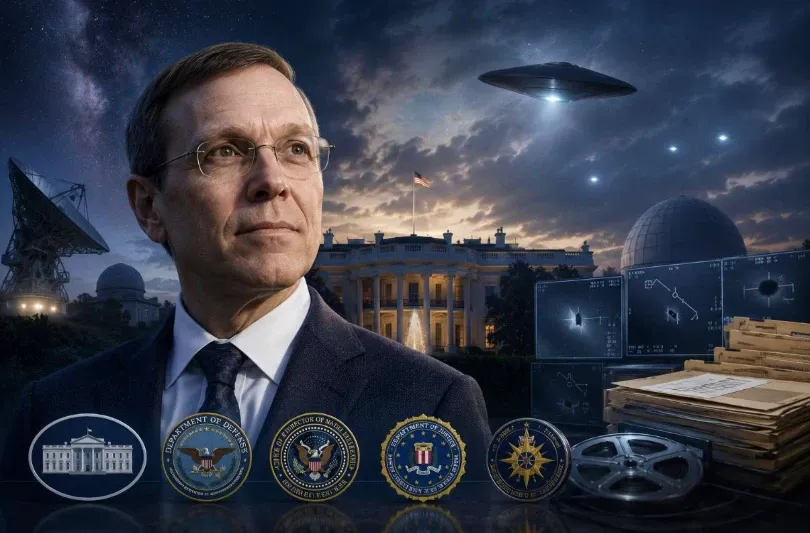
The appointment follows recent Trump administration initiatives to bring more transparency to the topic of UFOs. The UAP Science Advisory Council was established by the White House alongside the Pentagon’s All-Domain Anomaly Resolution Office, the Office of the Director of National Intelligence, the Federal Bureau of Investigation, and other members of the Intelligence Community. The council’s stated purpose is to help government agencies study the nature of UAP, with an emphasis on collecting and analyzing higher-quality data rather than relitigating older material that cannot be independently verified.
Loeb co-founded and leads the Galileo Project, designed to move the search for extraterrestrial technological signatures from anecdotal observation to systematic scientific research. He describes the assembled team as “an amazing A-team of exceptional scientists and experts,” drawing from data science, instrumentation, biology, oceanography, anthropology, and psychology. Members include Liberty Capito of the Olin Business School at Washington University in St. Louis, philosopher Carol Cleland of the University of Colorado Boulder, retired Navy admiral and oceanographer Tim Gallaudet, Stanford pathology professor Garry Nolan, and Skeptic magazine founder Michael Shermer, among others.
Council member Devesh Nandal, a postdoctoral fellow at the Center for Astrophysics at Harvard and Smithsonian, said the group is “focused on a data-driven and physics-based approach on the topic of UAP.” He said his role is to apply quantitative data analysis and astrophysics expertise to help decipher the origin of UAP. “Whether these events are of terrestrial or extraterrestrial origin, I am excited to apply my understanding of physics to decipher their true nature,” Nandal said. Capito described Loeb as “one of the most brilliant scientists of our time” and called the council “a blueprint for re-establishing the public’s trust in science.”
Loeb says identifying the unidentified deserves a high priority within both the US government and the scientific community. Cleland said she anticipates that a council of outside experts “will pressure the government to be more open about releasing information and allowing members of the council to interview UAP witnesses.” Mark Rodeghier, president and scientific director of the J. Allen Hynek Center for UFO Studies, called the involvement of serious, independent scientists “a potential positive development,” but cautioned that the council’s value could be limited without a clear mandate, access to relevant data, a collaborative relationship with government, and a path for public reporting.
Whether the Pentagon actually hands over the more than 50 requested documents and videos remains the immediate question, along with whether council members are granted access to interview UAP witnesses as Cleland anticipates.