Intuitive Machines and Texas A&M Space Institute are joining forces to accelerate lunar mission readiness by tackling one of the biggest challenges in space exploration: testing lunar terrain vehicles in Earth-bound environments. Simulating the Moon’s rugged and unpredictable surface on Earth has proven difficult, as terrestrial test sites—such as rocky deserts or confined areas with synthetic regolith—lack the scale, variability, and environmental extremes of the lunar landscape. Factors like shifting shadows, stark light contrasts, and low gravity significantly affect how vehicles move, grip, and endure, making precise simulation on Earth a persistent hurdle.
The new Texas A&M University Space Institute facility is designed to overcome those challenges. Funded by $200 million in state support championed by Texas State Representative Greg Bonnen, the facility is slated to open in the second half of 2026. Spanning 400,000 square feet, it features the world’s only indoor Lunar and Mars-scape, each covering 2.5 acres. For perspective, that’s nearly twice the size of the playing surface at Texas A&M’s Kyle Field.
The Space Institute facility works like a massive Etch-a-Sketch, with the ability to shift hundreds of tons of synthetic regolith and dynamically reconfigure terrain so researchers can reshape the surface on demand and study how vehicles and equipment perform in 1/6th gravity environments. Advanced lighting systems mimic the surface dynamics of the Moon, including shadows, light, and darkness. Research garages support development of space suits, rovers, and medical technologies.
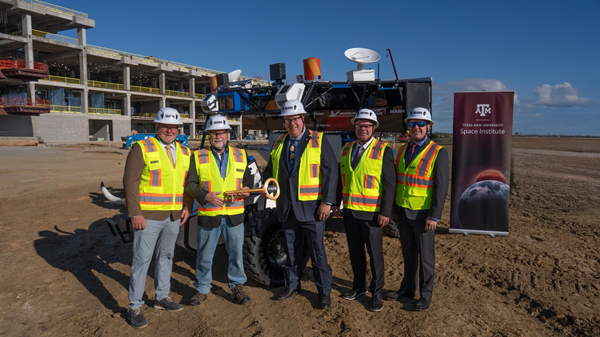
Building on this initiative, Intuitive Machines and Texas A&M have signed a lease agreement that will give Intuitive Machines a dedicated bay in the Space Institute facility, currently under construction near NASA’s Johnson Space Center. The agreement marks a new phase in their partnership, focused on advancing lunar mission readiness and developing a skilled workforce to support the next generation of space exploration. The facility will also benefit from Intuitive Machines’ lunar surface data, which informs simulation and planning efforts and is the most extensive on Earth.
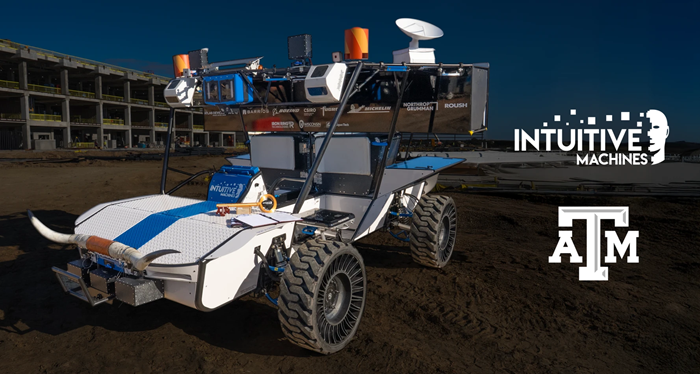
Intuitive Machines plans to use its leased bay to operate, test, and refine its Moon RACER (Reusable Autonomous Crewed Exploration Rover) lunar terrain vehicle. Developed for NASA’s Artemis campaign, Moon RACER is designed to support crewed surface mobility and cargo transport across challenging lunar terrain. The vehicle will be tested and refined within the institute’s simulated lunar environments, helping engineers optimize performance before deployment.
This work is further strengthened by Intuitive Machines’ work under contract for NASA’s Lunar Reconnaissance Orbiter Camera (LROC). The Intuitive Machines LROC team has spent the past 16 years building one of the most comprehensive visual and topographic datasets of the Moon, capturing more than 2.3 million high-resolution images, mapping over 98% of the lunar surface, and supporting Artemis and CLPS landing site selection. Their data has informed everything from Apollo site studies to terrain-relative navigation systems and student-led lunar research.
The Intuitive Machines LROC and Optical Navigation and Data Transmission teams collaborate to enable precise terrain modeling, autonomous surface operations, and the next phase of commercial lunar infrastructure. This foundational data directly supports mission planning at the Texas A&M University Space Institute, helping researchers simulate lunar conditions with a high level of accuracy.
“Thanks to the vision and support of the Chairman of the House Appropriations Committee, Greg Bonnen, and the strong collaboration between Intuitive Machines and Texas A&M, this facility is becoming a reality, and there’s truly nothing like it anywhere in the world,” said Jack Fischer, Senior Vice President of Operations at Intuitive Machines and retired U.S. astronaut. “The Texas A&M University Space Institute is a proving ground for lunar operations, where we can simulate terrain, rehearse missions, and refine our vehicles before they ever leave Earth, which ultimately contributes to longer and more successful Moon missions. We’re establishing a centre of excellence that enriches the greater Houston community and the global space industry.”
The institute is led by Dr. Nancy Currie-Gregg, former NASA astronaut and professor of practice in the Texas A&M College of Engineering, and Dr. Robert Ambrose, a leading expert in space robotics and mechanical engineering professor at Texas A&M. Their vision is to create a facility that supports mission concept development, applied research, and workforce training building a pipeline of highly skilled workers who will power future lunar and Martian missions.