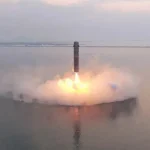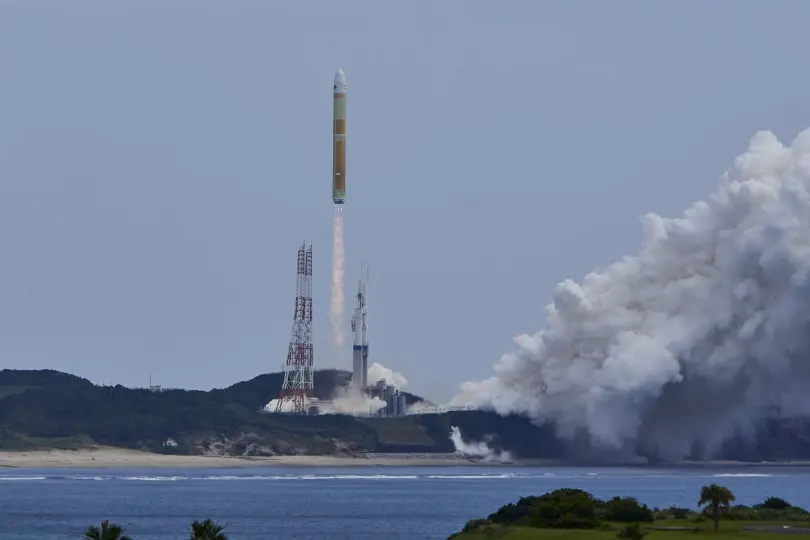
Japan’s H3 rocket successfully returned to flight Friday, with a launch that also marked the debut of a new configuration, optimized for smaller payloads. Liftoff took place at 00:53 UTC (9:53 a.m. local time) from the Tanegashima Space Center.
Friday’s launch was the eighth flight of the H3, and its first since a failure last December that resulted in the loss of the QZS-5 navigation satellite. During that mission, the rocket’s second stage was noted to have an off-nominal startup for its second planned burn, followed by a premature shutdown; however, an investigation has revealed that the failure occurred much earlier in the mission.
The root cause of the failure is now suspected to be a manufacturing defect in the payload adaptor that connects the satellite to the rocket’s upper stage. This had been redesigned for H3, using an adhesively-bonded construction rather than being bolted together, to reduce cost and weight. This is believed to have delaminated, and this, combined with stresses at the point of fairing separation late in the first-stage burn, led to the adaptor’s structural failure.
The anomaly caused the satellite to break free from the rocket — although it remained in place due to the rocket’s acceleration until the end of the first stage burn — and damaged the hydrogen tank pressurization systems on the second stage. The satellite fell away during the coast between first stage shutdown and second stage ignition, and although the second stage was underperforming during its first burn, this was offset by its lower-than-expected mass due to the missing payload.
Ahead of Friday’s launch, the payload adaptor underwent inspection and repair of any delamination, while its performance was monitored to gather data for future flights. On future flights, the Japan Aerospace Exploration Agency (JAXA) intends to either take the same approach or to reinforce the adaptor with fasteners, depending on mission and performance requirements.
In addition to marking H3’s return to flight, Friday’s launch was the first flight of the H3-30 configuration. This features a modified first stage, with three LE-9 engines instead of the two used on other versions of the rocket. This allows the first stage to deliver more thrust at liftoff — eliminating the need for solid rocket boosters during the early stages of flight. Compared with the other H3 configurations, the H3-30 is designed to carry smaller payloads into low-Earth orbit.
See Also
- H3-30S F6 Updates
- (adsbygoogle = window.adsbygoogle
- Japanese Section
- NSF Store
- Click here to Join L2
The H3 is a two-stage rocket built by Mitsubishi Heavy Industries, with two stages burning cryogenic propellants: liquid hydrogen and liquid oxygen. The first stage is powered by LE-9 engines, with two or four SRB-3 boosters providing additional thrust for launches with the two-engine version of the first stage. The second stage has a single LE-5B-3 engine, with the payload mounted atop the stage enclosed within the rocket’s payload fairing. H3 can fly with either a short fairing measuring 10.4 m in length, a longer 16.4 fairing, or a wider fairing for missions that require it. Friday’s launch used the short fairing, with the specific configuration designated H3-30S: the three-character variant number indicating three first-stage engines, no boosters, and a short fairing.
With this being the first H3 mission without solid rocket boosters, it also marked Japan’s first launch of an all-liquid-propellant rocket, as all of the country’s previous liquid-fueled rockets used solid motors to augment the first stage at liftoff.
The H3-30’s maiden flight marked the eighth launch overall for H3, with the mission designated H3 flight No.6 (F6), with missions F7 and F8 having already launched. Five of its seven previous launches have been successful; the rocket’s maiden flight in March 2023 also failed.
The main goal of Friday’s launch was to demonstrate the new H3-30 configuration, with the rocket carrying a 1,600-kg mass simulator, Vehicle Evaluation Payload 5 (VEP-5), as its primary payload. VEP-5 was not designed to separate from the rocket and remained fixed to its payload attachment fitting for the duration of the mission. Six small satellites rode aboard the mission as secondary payloads and were deployed after the second stage reached orbit.

Payload configuration for the H3 F6 mission, VEP-5 is the silver disk at the top of the stack (Credit: JAXA)
The Platform for Extra and Terrestrial Remote Examination with LCTF (PETREL), or Umitsubame, is a 65-kg satellite built by the Tokyo Institute of Technology that carries an experimental imaging payload. The payload will be used for both Earth observation and ultraviolet astronomy, depending on whether the satellite is in sunlight or in Earth’s shadow.
Shizuoka University’s STARS-X, also known as Shiraito, is the latest in a series of space tether experiments conducted by the university. Another 65-kg satellite, the satellite is designed to split into two sections separated by a one-kilometer tether and deploy a “climber” robot to traverse the tether. The mission will also test techniques for capturing space debris.
The Visible Extragalactic Background Radiation Exploration by CubeSat (VERTECS) mission, led by the Kyushu Institute of Technology, will observe background radiation originating from outside our galaxy to study the history of the early universe. VERTECS is a six-unit (6U) CubeSat.
The remaining three payloads were launched for commercial operators. The Hurtling Orbit Normalizer (HORN) satellites: HORN-L and HORN-R, are a pair of 6U CubeSats that were carried for Japanese startup BULL. These will test techniques for deorbiting satellites using a deployable sail, with the two spacecraft using differently sized sails to evaluate their performance. The BRO-22 satellite, flown for the French company Unseenlabs as part of the Breizh Reconnaissance Orbiter (BRO) constellation, will be used to detect electronic emissions from ships to identify vessels operating without transponder signals that may be engaged in illegal activities.

Tanegashima’s Yoshinobu Launch Complex during an H3 test firing in 2022. (Credit: JAXA)
H3 F6 launched from the second pad of the Yoshinobu Launch Complex at the Tanegashima Space Center, located on Tanegashima Island off the southern coast of Kyushu — the southernmost of Japan’s four main islands. The Yoshinobu complex was originally built for the H-II family of rockets, with H-II and H-IIA launches using Pad 1. Pad 2 was constructed in the early 2000s as a backup pad for the H-IIA, but was instead used to launch the larger H-IIB and later H3.
All of the H3’s launches to date have taken place from this pad, with integration taking place in a vehicle assembly building (VAB) about 500 m northwest of the pad before the rocket is rolled into position atop a mobile launch platform.
The moment of liftoff for Japanese rockets is termed X0, rather than the more familiar T0 used by many Western operators. The three LE-9 engines ignited shortly before this mark in the countdown, with the rocket beginning its climb away from the launch pad at X0.
With no solid rocket motors to jettison, the next major event in the flight was the separation of the payload fairing, around three minutes and 12 seconds after liftoff, with H3 already at an altitude of 125 km and traveling downrange at 3.1 km per second. This was followed, about 22 seconds later, by main engine cutoff (MECO), when the first stage engines shut down. MECO occurs much earlier in the flight with the H3-30 compared to other configurations, the extra engine meaning the stage burns through its propellant more quickly.
About eight seconds after MECO, the first and second stages separated, with second stage ignition occurring twelve seconds after separation. The second stage’s LE-5B-3 engine burned for 11 minutes and 21 seconds to complete insertion into low-Earth orbit. Deployment of the secondary payloads began with PETREL and STARS-X about 61 seconds after the burn ended, concluding with HORN-R at 30 minutes and six seconds mission elapsed time.
Following payload deployment, the mission entered a coast phase before the second stage restarted for a second burn at X+1 hour, 44 minutes, and 58 seconds. An 18-second burn deorbited the upper stage — with VEP-5 still attached — ensuring a safe reentry over the Indian Ocean.
Friday’s launch was the first of 2026 for both Japan and the H3 rocket. H3’s next launch is expected in the next few months, going from its smallest configuration for the F6 mission to its heaviest, with the H3-24W due to deploy the HTV-X2 cargo craft bound for the International Space Station.
(Lead image: H3-30S launches from Tanegashima. Credit: JAXA)