Five orbital launches are scheduled worldwide for this week. In China, a Chang Zheng 6A and Chang Zheng 7A are set to launch two unknown payloads into orbit. Meanwhile, SpaceX has three Falcon 9 launches on the manifest from Florida and California, with two Starlink missions and a classified mission for the National Reconnaissance Office.
Chang Zheng 7A | Unknown Payload
The first launch of the week is a Chang Zheng 7A, scheduled to launch on Wednesday, July 29, from Launch Complex 201 (LC-201) at the Wenchang Space Launch Site in China. The three-stage vehicle will launch within a one-hour, 57-minute launch window beginning at 11:42 UTC. The rocket is expected to follow an easterly trajectory to an unknown orbit.
The 60.13-m-tall Chang Zheng 7A, developed by the China Aerospace Science and Technology Corporation (CASC), is a three-stage medium-lift launch vehicle. The rocket has four liquid-fueled boosters fueled by kerosene (RP-1) and liquid oxygen (LOX). The first stage features two YF-100 oxidizer-rich staged combustion cycle engines fueled by RP-1 and LOX, while the second stage has four YF-115 engines also powered by RP-1 and LOX. An optional stage is also available, which features two YF-75 gas-generator-cycle engines powered by liquid hydrogen (LH2) and LOX. The rocket can carry up to 12,000 kg to low-Earth orbit (LEO) and has a liftoff thrust of 7,128 kN.
This mission will be Chang Zheng 7A’s 17th launch and third mission of 2026.

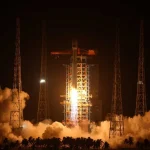
A Chang Zheng 6A launches from Taiyuan. (Credit: CASC)
Chang Zheng 6A | Unknown Payload
The second international launch of the week is a Chang Zheng 6A from Launch Complex 9A (LC-9A) at Taiyuan Satellite Launch Center in China on Thursday, July 30. A twenty-minute window opens at 00:52 UTC with a planned liftoff time of 01:00 UTC. The rocket will launch on a southeasterly trajectory to an unknown orbit.
Chang Zheng 6A is a two-stage medium-lift launch vehicle. The first stage is powered by two YF-100 engines fueled by RP-1 and LOX, with the second stage utilizing a single YF-115 engine fueled by the same propellants. Four FG-112 solid rocket boosters are attached to the first stage. The 50-m-tall vehicle is capable of carrying 5,000 kg to LEO and has a total liftoff thrust of 7,230 kN.
The launch will be the vehicle’s seventh mission of 2026 and 26th overall.
Falcon 9 | Starlink Group 17-52
The first SpaceX mission of the week is expected from Space Launch Complex 4 East (SLC-4E) at Vandenberg Space Force Base in California on Wednesday, July 29. Falcon 9 will launch on a southerly trajectory to a Sun-synchronous orbit (SSO) inclined by 97 degrees, where it will deploy a batch of Starlink v2 Mini satellites. The four-hour window begins at 7:00 PM PDT (02:00 UTC July 30).
SpaceX’s autonomous droneship Of Course I Still Love You will recover the booster, B1081, downrange in the Pacific Ocean. B1081 will be on its 26th flight after a 34-day turnaround, previously supporting NASA’s Crew-7 mission to the International Space Station (ISS), Transporter-10, Transporter-13, and 15 Starlink missions.
Falcon 9, a partially reusable two-stage vehicle, can deliver up to 22,000 kg to LEO and 8,300 kg to geostationary transfer orbit (GTO). The first stage utilizes nine Merlin 1D sea-level engines fueled by RP-1 and LOX, with the second stage’s single Merlin 1D vacuum-optimized engine fueled by the same propellants.
Falcon 9 | NROL-95
Falcon 9’s second mission of the week, NROL-95, is expected to launch on Thursday, July 30, from Space Launch Complex 40 (SLC-40) at the Cape Canaveral Space Force Station in Florida. A 12-minute launch window opens at 3:09 AM EDT, with Falcon 9 launching on a northeasterly trajectory to LEO to deliver a classified payload for the National Reconnaissance Office.
Following launch and stage separation, first stage booster B1096 will perform a return-to-launch-site landing at Landing Zone 2 (LZ-2). B1096 will be on its seventh flight, previously supporting the Amazon Leo (KF-01), IMAP & Others, NROL-77, GPS III SV09, CRS-34, and Starlink Group 6-87.
Falcon 9 | Starlink Group 17-53
The final mission of the week is scheduled to launch from SLC-4E at Vandenberg on Sunday, August 2. Similar to Starlink Group 17-52, Falcon 9 will launch on a southerly trajectory to an SSO inclined by 97 degrees, with a four-hour launch window opening at 7:00 AM PDT (14:00 UTC). The vehicle will deliver 24 Starlink v2 Mini satellites for SpaceX’s internet constellation.
Falcon booster B1063, flying on its 34th mission, will land atop Of Course I Still Love You downrange in the Pacific Ocean. B1063 previously supported the Sentinel-6A, DART, Transporter 7, Iridium-9 & OneWeb #19, Tranche 0B, NROL-113, NROL-167, NROL-149, NAOS & Others, and 24 Starlink missions.
The mission will be the 673rd Falcon 9 mission and the rocket’s 90th launch of 2026. Furthermore, this mission will mark the 182nd orbital launch attempt worldwide in 2026.
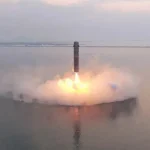
(Lead image: Falcon 9 launch and landing in Florida. Credit: Julia Bergeron for NSF)

The post Launch Preview: Falcon 9 and Chang Zheng rockets set to launch this week appeared first on NASASpaceFlight.com.