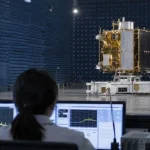
At 12:11 noon on March 15, 2025, the Long March-2D carrier rocket carrying the 4D Gaojing-302 satellite was launched from the Jiuquan Satellite Launch Center. Subsequently, the satellite successfully entered the predetermined orbit, and the launch mission was a complete success.
The Long March 2D carrier rocket was developed by the Eighth Academy of Aerospace Science and Technology. Development was launched in February 1990. Let’s briefly talk about the Eighth Academy of Aerospace Science and Technology.
1. Basic information
The Eighth Institute of Aerospace Science and Technology, also known as the Shanghai Institute of Aerospace Technology, is the only comprehensive aerospace institute in my country. As one of the three general academies of the Aerospace Science and Technology Group, the Eighth Academy of Aerospace Science and Technology undertakes tasks in multiple fields such as defense equipment, launch vehicles, applied satellites, space science, aerospace technology application industry and aerospace service industry. Unlike the First Academy and the Fifth Academy, the Eighth Academy is engaged in both rockets and satellites. The Eighth Institute has successfully developed large launch vehicles such as Storm 1, Long March 3 (first and second stages), Long March 4, and Long March 2D. It has participated in or independently launched my country’s first geostationary orbit communication satellite, my country’s first foreign commercial communication satellite Asia-1, Ziyu-1 satellite, my country’s first sun-synchronous orbit meteorological satellite Fengyun-1, my country’s first geosynchronous orbit meteorological satellite Fengyun-2, and multiple returnable scientific satellites.
2. Composition of departments
(1) Overall assembly unit
1. Missile Overall Design Department: Shanghai Institute of Mechanical and Electrical Engineering (Department 8)
The Eighth Department is an important overall unit for the construction of my country’s air and space defense forces. It is mainly engaged in cutting-edge development research of air and space defense products, key technology research, overall design, system integration, test verification, system delivery and after-sales services. It is the overall design department of my country’s air and space defense forces in multiple fields such as ground-to-air, ship-to-air, and air-to-air. , has test centers for guidance and control simulation, system simulation, and system anti-interference. It has the first-class domestic level in the fields of system overall design, aircraft overall design, navigation guidance and control, structural mechanics analysis, reliability analysis, electronic measurement and control, etc., and its radio frequency and infrared homing guidance simulation systems have reached the international advanced level.
2. Rocket overall design institute: Shanghai Aerospace Systems Engineering Institute (805 Institute)
The 805 Institute is an important overall design unit for launch vehicles and space science in my country. It is also the chief research and development unit for major national projects such as the Shanghai Space Base’s manned spaceflight and lunar exploration projects. Its business scope covers multiple fields such as “arrows, ships, satellites, and instruments.” The 805 Research Institute has developed launch vehicles such as Storm 1, Long March 2D, Long March 4 series, Long March 6 and Long March 5 booster modules. In addition, the 805 Institute also participated in the development of Shenzhou 1 to Shenzhou 11 spacecraft and Tianzhou 1 propulsion modules, Tiangong 1 and Tiangong 2 target aircraft resource modules, Tianhe core module resource modules, space docking mechanisms, lunar patrol detectors and other products, and the flight tests were all successful.
3. Satellite overall design institute: Shanghai Satellite Engineering Research Institute (509 Institute)
Institute 509 is the main force in my country’s space technology research and satellite development and production. It is the pioneer of my country’s electromagnetic satellites, the cradle of meteorological satellites, the birthplace of microwave remote sensing satellites, the founder of space monitoring satellites and the first creator of deep space detectors. Institute 509 is mainly engaged in satellite system demonstration, system design, development and application research. It is responsible for satellite project management, overall design, comprehensive testing and on-orbit management tasks. It is responsible for the development of structure, thermal control and test subsystems, the design of measurement and control, digital transmission, integrated electronic subsystems and the development of integrated power software. In 1975, China successfully developed and launched Shanghai’s first satellite “Changkong-103”. The satellite was developed by the Shanghai Turbine Plant Boiler Research Institute (known as “701 Workshop” to the outside world) on Huayin Road, Minhang, Shanghai, and later evolved into the 509 Research Institute. The 509 Institute led the development of the “Fengyun” series of satellites (including Fengyun 1, 2, 3, and 4), making my country one of the few countries with the capability to develop both geostationary and polar-orbiting meteorological satellites.
4. Missile Assembly Institute: Shanghai Aerospace Precision Machinery Research Institute (800 Institute)
The 800 Institute is mainly responsible for the tasks of final assembly and testing of weapon systems, manufacturing of structural parts of launch vehicles and other aerospace products, and strength and environmental testing. It has test analysis methods such as non-destructive testing, physical and chemical analysis, strength environmental testing, volume measurement, missile testing, etc., some design methods of ground equipment and carrier model pressurized transportation system cylinders, and research and development methods such as missile assembly, casting, sheet metal, non-metal processing, heat treatment, chemical milling, surface treatment, and cable manufacturing. Over the years, 800 Institute has continuously conquered the “two-sided three-layer welding” process of aluminum alloy storage tanks, laser-MIG arc bilateral simultaneous welding technology, ultra-large magnesium alloy melt refining and integral casting forming technology, filling the relevant domestic technology gaps.
5. Rocket Assembly Factory: Shanghai Aerospace Equipment Manufacturing Factory (Factory 149)
Factory 149 is the only unit in my country that integrates product manufacturing, final assembly testing and launch site services for launch vehicles, space vehicles and tactical weapons ground systems. Factory 149 has the country’s first medium-sized launch vehicle box bottom forming production line, which is used in Long March 6A and other models. It has also developed a 3.35-meter-diameter ultra-thin rocket tank integral bottom, and its technology has reached the international leading level. In addition, as a special welding research center named by the Science and Technology Commission, Factory 149 has domestic leading welding technologies, including friction spot welding, friction stir welding, etc. The welding materials cover magnesium, aluminum, copper alloys, etc., and the products are widely used in the aerospace field.
6. Satellite Assembly Institute: Shanghai Satellite Equipment Research Institute (812 Institute)
The 812 Institute is an important research and development unit in the development of China’s satellite industry. It is mainly responsible for satellite assembly and integration, spacecraft environmental test technology research and the development of related equipment and products. It is the system-level integration and testing unit for multiple series of satellites represented by China’s “Fengyun” series, “Practice” series, “Remote Sensing” series, “Tianwen-1” Mars orbiter, “Xihe” solar monitoring satellite, etc. The 812 Institute has built a world-class spacecraft AIT assembly and testing plant and a Shanghai space environment simulation laboratory for mechanics, vacuum, magnetism, EMC, calibration, etc. It has domestically advanced large-scale testing and testing equipment such as φ10m space ring mold equipment and a 500KN vibration table.
(2) Other units
1. Shanghai Radio Equipment Research Institute (802 Institute)
The 802 Institute was founded in 1965 and is mainly engaged in technical research, product development and production in the fields of precision guidance, photoelectric short-range detection, space exploration and remote sensing, data communications, target and environmental effects, and aerospace technology applications. 802 Institute has strong technical strength, with 1 national key laboratory, 3 Shanghai municipal key laboratories and multiple group-level R&D centers (such as precision guidance R&D center, laser detection technology R&D center, etc.). Various types of equipment have participated in National Day military parades and military exercises.
2. Shanghai Aerospace Control Technology Research Institute (803 Institute)
Institute 803 was founded in January 1960. It is one of the earliest units in my country engaged in the development of missile weapons, space transports, space vehicle control systems and inertial technology products. It is mainly responsible for the development, production and testing of guidance, navigation and control systems and core stand-alone aircraft for missile weapons, space transports and space vehicles. The control system developed by 803 covers navigation, guidance and control, and is widely used in Long March 4, Long March 6 launch vehicles, etc. The 803 Institute has established provincial and ministerial-level laboratories such as the “Astronomy Autonomous Navigation Laboratory” and “Spacecraft Intelligent Control Key Laboratory”. From the early “big platform” to the “small platform” and then to the fiber optic gyro strapdown inertial group, the 803 Institute has gradually realized lightweight, high-precision and redundant designs, which has effectively supported many major national tasks in my country.
3. Shanghai Aerospace Electronics and Communication Equipment Research Institute (804 Institute)
The 804 Institute is mainly responsible for the research, development and production of radar guidance stations for medium and low-altitude missile weapon systems, satellite applications, communication equipment and other products. It has professional research rooms and technology and standardization technical support research rooms for the research and development of guidance station radar overall, microwave and electromagnetic fields, launch and reception, modular frequency sources, servo control, signal and information processing, display control, mechatronics, microelectronic dielectric devices and other technologies.
4. Shanghai Aerospace Power Technology Research Institute (806 Institute)
Institute 806 is a professional research institute integrating solid engine and special engine technology research and model development, mass production, and testing. It has complete scientific research capabilities in the design, development, and mass production of medium and small solid engines. The institute is divided into two parts: the Shanghai headquarters is located in Minhang District, Shanghai, and is mainly responsible for the overall engine and component structure design, metal and non-metal parts processing, and component matching; the Huzhou base is located in the southern suburbs of Huzhou City, Zhejiang Province, and is mainly responsible for engine propellant, insulation layer formula design, engine charges, engine assembly and testing, etc.
5.Shanghai Precision Measurement and Testing Institute (808 Institute)
The 808 Institute is a comprehensive professional research institute responsible for technical foundation support of the Eighth Institute. It is mainly engaged in component quality assurance, component testing and analysis, and full-cycle component product assurance services.
6. Shanghai Space Power Research Institute (811 Institute)
The predecessor of the 811 Institute was the Shanghai Changning Battery Factory established in 1960. After many adjustments and mergers, it was officially established as the Shanghai Space Power Research Institute in 1990. The 811 Institute is mainly responsible for the research, design, manufacturing and testing of power supply systems, control equipment and power products for “satellites, rockets, missiles, ships, (detectors)” and other special equipment, as well as new energy industry incubation work. It is the only power supply professional institute of the Aerospace Science and Technology Group. The 811 Institute has the only national key laboratory for space power supply technology in China, with R&D centers in the fields of electronic power supply, chemical power supply, and physical power supply. It also has 5 national military standard production lines such as silicon/gallium arsenide solar cells and lithium-ion batteries, 2 aerospace-grade high-reliability product production lines, and multiple satellite power system platforms.
(3) China Aerospace Science and Technology Corporation Commercial Rocket Co., Ltd.
China Aerospace Science and Technology Group Commercial Rocket Co., Ltd. was established on September 26, 2024, with a registered capital of 1 billion yuan and its registered address in Shanghai. Aerospace Science and Technology Group holds 51% of the shares and is the controlling shareholder, while No. 149 Factory of the Eighth Institute holds 11.3% of the shares and is the second largest shareholder. On March 15, 2025, the reusable launch vehicle developed by the Aerospace Science and Technology Group Commercial Rocket Company completed the test run of the second-stage power system at the 101 Institute of the Sixth Academy. The test was a complete success, marking that the development of the Aerospace Science and Technology Group’s reusable commercial launch vehicle has entered a new stage of development.
3. Product Type Spectrum
(1) Rocket
Storm 1 (two-stage configuration), Long March 2D (two-stage configuration), Long March 4A (three-stage configuration), Long March 4B (three-stage configuration), Long March 4C (three-stage configuration), Long March 6 (three-stage configuration), Long March 6A (two-stage and semi-configuration), Long March 6C (two-stage configuration), and Long March 12 (two-stage configuration). Currently, Storm 1 and Long March 4A have been retired.
(2) Satellite
1. Meteorological satellite
(1) Fengyun series: Fengyun-1A, Fengyun-1B, Fengyun-1C, Fengyun-1D, Fengyun-3A, Fengyun-3B, Fengyun-3C, Fengyun-3D, Fengyun-3E, Fengyun-3G, Fengyun-4A, Fengyun-4B.
(2) Unkai series: Unkai 1 star 01, Unkai 1 star 02, Unkai 1 star 03, Unkai 2 star 01, Unkai 2 star 02, Unkai 2 star 03, Unkai 2 star 04, Unkai 2 star 05 star, Unkai-2 star 06, Unkai-2 star 07, Unkai-2 star 08, Unkai-2 star 09, Unkai-2 star 10, Unkai-2 star 11, Unkai-2 star 12, Unkai-3 star 02.
2.Remote sensing satellites
(1) Remote sensing series: Remote Sensing Satellite 1, Remote Sensing Satellite 3, Remote Sensing Satellite 6, Remote Sensing Satellite 8, Remote Sensing Satellite 10, Remote Sensing Satellite 13, Remote Sensing Satellite 15, Remote Sensing Satellite 18, Remote Sensing Satellite 19, Remote Sensing Satellite 22, Remote sensing satellite 23, remote sensing satellite 27, remote sensing satellite 29, remote sensing satellite 33, remote sensing satellite 33r, remote sensing satellite 33 02, remote sensing 33 03, remote sensing 33 04, remote sensing 34, Yaogan 34th 02 star, Yaogan 34th 03 star, Yaogan 34th 04 star, Yaogan 35th 01 group C star, Yaogan 35th 02 group C star, Yaogan 35th 03 group C star, Yaogan 35th 04 group C star, Yaogan 35th 0 5 group C stars, Yaogan 36th 01 group C star, Yaogan 36th 02 group C star, Yaogan 36th group 03 C star, Yaogan 36th group 04 C star, Yaogan 39th group 02 satellite A star, Yaogan 39th group 02 satellite B star, Yaogan 39th group satellite Satellite C of the 9th Group 02, Satellite A of the 03 Group of Yaogan 39, Satellite B of the 03 Group of Yaogan 39, Satellite Group C of Yaogan 39 03, Satellite A of Yaogan 39 04 Group, Satellite B of Yaogan 39 04, Yaogan 39 Remote Sensing 40 Group Satellite C, Remote Sensing 40 Satellite A, Remote Sensing 40 Satellite B, Remote Sensing 40 Satellite C, Remote Sensing 42 01, Remote Sensing 42 02, Remote Sensing 43 02 Group 01, Remote Sensing 43 02 Group 02 , Remote Sensing 43 02 Group 03 Stars, Remote Sensing 43 02 Group 04 Stars, Remote Sensing 43 02 Group 05 Stars, Remote Sensing 43 02 Group 06 Stars, Remote Sensing 43 01 Group 01 Stars, Remote Sensing 43 01 Group 02 Stars, Remote Sensing 43 01 group 03 stars, Remote Sensing 43 01 group 04 stars, Remote Sensing 43 01 group 05 stars, Remote Sensing 43 01 group 06 stars, Remote Sensing 43 01 group 07 stars, Remote Sensing 43 01 group 08 stars, Remote Sensing 43 01 group 09 stars.
(2) Gaofen series: Gaofen No.102 stars, Gaofen No.103 stars, Gaofen No.104 stars, Gaofen No.5, Gaofen No.501A stars, Gaofen No.502 stars, Gaofen No.6, Gaofen No.10, Gaofen No.10R, Gaofen No.1204 stars, Gaofen No.1205 stars.
3. Technology test satellite
(1) Practice series: Shijian-9A satellite, Shijian-9B satellite, Shijian-12, Shijian-15, and Shijian-25.
(2) Pujiang series: Pujiang No. 1, Pujiang No. 2.
(3) New technology test satellite series: new technology test satellite C, new technology test satellite D.
(4) Communication test satellite series: Communication Technology Test Satellite No. 6, Communication Technology Test Satellite No. 7, and Communication Technology Test Satellite No. 10.
(5) Experimental satellite series: Experimental satellite No.16A, Experimental satellite No.16B, Experimental satellite No.19, Experimental satellite No.21, Experimental satellite No.23.