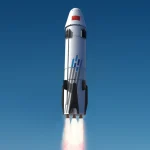
At 16:40 on June 1, 2026, the Long March 12B Yaoyuan-1 carrier rocket successfully launched the Qianfan Polar Orbit 08 satellite (a total of 2) into the predetermined orbit at the China Commercial Vehicle Research and Test Launch Station in the Dongfeng Commercial Aerospace Innovation Test Zone. The first flight mission was a complete success. The launch was completed “quietly” with almost no warm-up or momentum, but after the news of the successful orbit came out, the media instantly flooded the screen, social platforms became more popular, and the talk was endless.
1. Basic information about Chang Twelve B
The Long March 12B adopts a single-core two-stage configuration, with a rocket body diameter of 4.37 meters, a fairing diameter of 5.2 meters, and a total arrow length of about 72 meters. The first sub-stage uses nine YF-102R liquid oxygen and kerosene engines, and the second sub-stage uses one YF-102RV high-altitude liquid oxygen and kerosene engine. It has a low-Earth orbit transport capacity of about 20 tons and has the ability to adapt to multi-orbit missions. The diameter of the twelve-meter-long rocket body is between the traditional 3.35 meters and the large diameter of 5 meters. It can not only make use of existing railway transportation conditions (5 meters require sea transportation), but also leave enough space for the internal layout of the arrow. The first-stage power system uses 9 YF-102R units connected in parallel. A single shutdown does not affect the overall situation, and it has certain technical inheritance with the current model. YF-102R is an important model among the six engines in eight years and nine years. Its performance parameters are benchmarked against the Merlin 1D+ engine. It has the ability to vary thrust in a wide range of 50% to 105% and can be reused multiple times. The thrust (sea level) is 900kN, and the specific impulse (sea level) is 282 s, with a thrust-to-weight ratio of 180. The 5.2-meter fairing allows the Long March 12B to easily accommodate “36 satellites in one arrow” and better support my country’s giant satellite Internet constellation network. In addition, the 20-ton capacity allows Long March 12B to significantly reduce the fixed cost sharing in the “cost per kilogram of orbiting”. For low-orbit satellite Internet constellations that need to launch tens of thousands of satellites, this capacity scale is the prerequisite for the establishment of the “economic account”.
2. The importance of this launch
Although this launch was not warmed up in advance, it was definitely not a launch in the ordinary sense. Strictly speaking, the Chang 12B launched this time is not a simple “new rocket”, but a systematic “dimension upgrade” of my country’s traditional aerospace industry system for the commercial era. From a more macro perspective, the successful launch of Chang 12B has released a very important signal that the traditional aerospace national team is developing core capabilities for the commercial aerospace market. The “national team”‘s full entry into the commercial aerospace market will not only increase the supply of rocket products, but also bring great competitive pressure to the entire market. If the products of commercial rocket companies have similar performance and price to those of the “national team”, then everyone will definitely be more inclined to buy the rockets of the national team. After all, After all, most people definitely feel that the national team has deeper technology accumulation and more reliable products. At this time, private companies will be forced to accelerate innovation and cost control. If technological innovation and cost control are not carried out, the survival of the company will be a problem, which will cause everyone to have to “roll up” to a greater extent.
3. The future of Chang Twelve B
Judging from the current development, there is a high probability that our country will have two future “gold medal rockets” in the near future. One is the Long March 10B of the one-academy system, and the other is the Long March 12B. Although the first flight of the Long March 12A was earlier than that of the Long March 12B, the core supply chain of the Long March 12A is not “within the system.” This problem basically determines the fate of the two rockets. The Long March 12B is definitely more likely to become the “gold medal rocket” in the future.
4. Some thoughts on Shanghuo Company
As an enterprise entity specially established by the Aerospace Science and Technology Group for commercial aerospace, Shanghuo Company has clearer rights and responsibilities and a higher degree of marketization than the traditional three-level management model of “headquarters-research institute-factory”. Judging from recent actions, the current strength of Shanghuo Company cannot be underestimated. In May 2025, Shanghuo Company, as the general contractor, completed the first aerospace launch service contract and sent the National Star Aerospace space computing satellite constellation into the predetermined orbit. By the end of 2025, Shanghuo Company’s Jiuquan research and test launch station will be completed. Therefore, Shanghuo Company now not only has rockets, but also workstations, and has actually begun to take over some of the Great Wall Company’s business. At the same time, at the end of 2025, Shanghuo Company completed the capital increase, and the registered capital increased from 1 billion to 1.396 billion. The amount of the Aerospace Science and Technology Group’s investment increased from 510 million to 906 million, an increase of 77.6%, and the shareholding ratio rose to 64.8997%, further consolidating its absolute controlling position. Just think about it, is it possible for Shanghuo Company to raise funds in the market in the future, is it possible to go public with an IPO, and think about the scene when AVIC Shenyang Aircraft went public back then. The deeper reasons seem to be somewhat inexplicable similarities. The country’s current lack of rocket production capacity is really a problem of production capacity, or is it a problem of money? If the country really needs to build rockets in large quantities, wouldn’t it want everyone to support it? How can we get everyone to support it willingly?