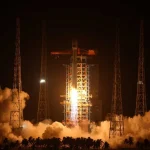
At 6:51 this morning, the Long March 6A Y11 carrying the test satellite No. 27 01-06 was successfully launched from the Taiyuan Satellite Launch Center LC-9A. The outside world is relatively familiar with the Long March 6A. This rocket’s well-known record is that it has undertaken four consecutive launch missions of the Qianfan constellation network satellite. With the media’s promotion of the Qianfan constellation, it has also become popular. I have never written an article specifically about the Long March 6A launch vehicle. Today I will briefly talk about this rocket. 1. Basic information
The Long March 6A is my country’s first solid-liquid bundled medium-sized launch vehicle. It is a rocket developed based on the successful first flight of the Long March 6 and fully inheriting existing technologies. It is mainly used to perform launch missions in low-Earth orbit (LEO) and sun-synchronous orbit (SSO). The LEO carrying capacity is more than 8t, and the SSO (500km) carrying capacity is not less than 6.5t.
In addition, the Long March 6A is also the only model among my country’s new generation Long March series of medium-sized launch vehicles that can be launched from inland launch sites. Currently, all launches of the Long March 6A are launched from the Taiyuan Satellite Launch Center LC-9A, using the “one horizontal transfer, vertical assembly, vertical test” test and launch mode (horizontal transfer, vertical assembly, vertical test), relying on a fixed launch tower for launch. The test and launch cycle is about 14 days, which is very important.
Among my country’s private rocket companies, there are also companies that plan to make solid-liquid bundled rockets. Oriental Space’s Gravity 2 is also a two-stage and a half configuration. The first and second stages use a liquid oxygen and kerosene engine, bundled with two solid boosters. However, the core diameter of Gravity 2 is 4.2 m, and the boost diameter is 2.62 m, which is larger than the Long March 6A.
2. Rocket composition
(1) Overall situation
The Long March 6A was developed by the Eighth Academy of Aerospace Science and Technology. It has a two-stage and a half configuration and is bundled with four solid boosters. The total length of the arrow is 50m, the take-off thrust is 720t, and the take-off mass is 530t.
(2) First level
The first stage of the Long March 6A has a diameter of 3.35m and uses two YF-100GAII liquid oxygen/kerosene engines with a thrust of 120t. The oxygen tank is on the top and adopts a self-generated supercharging scheme. The kerosene tank is on the bottom and uses a normal temperature helium supercharging scheme. The engine swings in two directions to provide control torque.
(3) Second level
The second stage of the Long March 6 has a diameter of 3.35m and uses a YF-115GIA liquid oxygen/kerosene engine with a thrust of 18t. The oxygen tank is on the top and adopts a self-generated supercharging scheme. The kerosene tank is on the bottom and uses a normal temperature helium supercharging scheme. The engine swings in two directions to provide control torque. The second stage is equipped with an independent auxiliary power system to complete tasks such as rolling channel control in the main flight section, terminal speed correction, and attitude adjustment in the taxiing section.
(4) Booster
The Long March-6A is bundled with four solid boosters with a diameter of 2m, using butyl hydroxyl propellant. The single booster uses an FG-112 segmented solid engine with a thrust of 120t, an omnidirectional swinging flexible nozzle and an electromechanical servo system to participate in full-arrow attitude control. The connection between the booster and the core stage uses front and rear binding connection devices, and the separation uses side thrust rockets.
(5) Fairing
The Long March 6A fairing has a diameter of 3.8m/4.2m/5.2m and other sizes. It is unlocked laterally through explosive bolt connections and longitudinally through linear devices and explosive bolt connections.
3. Launch record
At 17:50 on March 29, 2022, the Long March 6A Y1 was successfully launched from the Taiyuan Satellite Launch Center LC-9A. So far, the Long March-6A has been launched a total of 11 times, all of which were successful, with a success rate of 100%. Among the 11 launch missions, 5 were SSO orbital missions and 6 were LEO orbital missions. Most of the outside world’s understanding of the Long March 6A may come from the QianSail Constellation. After all, 4 of the 5 QianSail Constellation satellite launches were carried out by the Long March 6A. Thanks to the overwhelming outside reports after each launch of the QianSail Constellation, the Long March 6A also took the spotlight. But objectively speaking, without the Long March 6A, the launch progress of the Qianfan Constellation will be slower. There are many reasons here, which will not be discussed for the time being.
4. Rockets evaluation
(1) Advantages
The core stage of the Long March 6A launch vehicle uses a liquid oxygen/kerosene engine, and the booster uses a solid engine, which can give full play to the technical advantages of the solid engine’s large thrust and the liquid engine’s high specific impulse.
In addition, as the only model among my country’s new generation Long March series of medium-sized launch vehicles that can be launched from inland launch sites, Long March 6A has effectively improved my country’s ability to launch large-mass sun-synchronous orbit payloads inland. And thanks to the characteristics of launching at inland launch sites, the Long March-6A has also increased the launch density of my country’s new generation launch vehicle to a certain extent.
(2) Disadvantages
The Long March 6A needs to adapt to the landing area of the original Long March series launch vehicle, which forces the solid booster of the Long March 6A to not separate at the optimal time, which affects the capacity of the Long March 6A to a certain extent. In addition, because the second stage is equipped with the YF-115, which has poor performance, it also affects the transport capacity of the Long March 6A to a certain extent.