ESA’s Argonaut landers will carry up to 1500 kg of cargo to the Moon, including rovers, science instruments, and building blocks for lunar infrastructure. That cargo will need to be offloaded onto the lunar surface, and some of it, such as sensitive science instruments, must be placed metres away from the lander to take uninterrupted measurements.
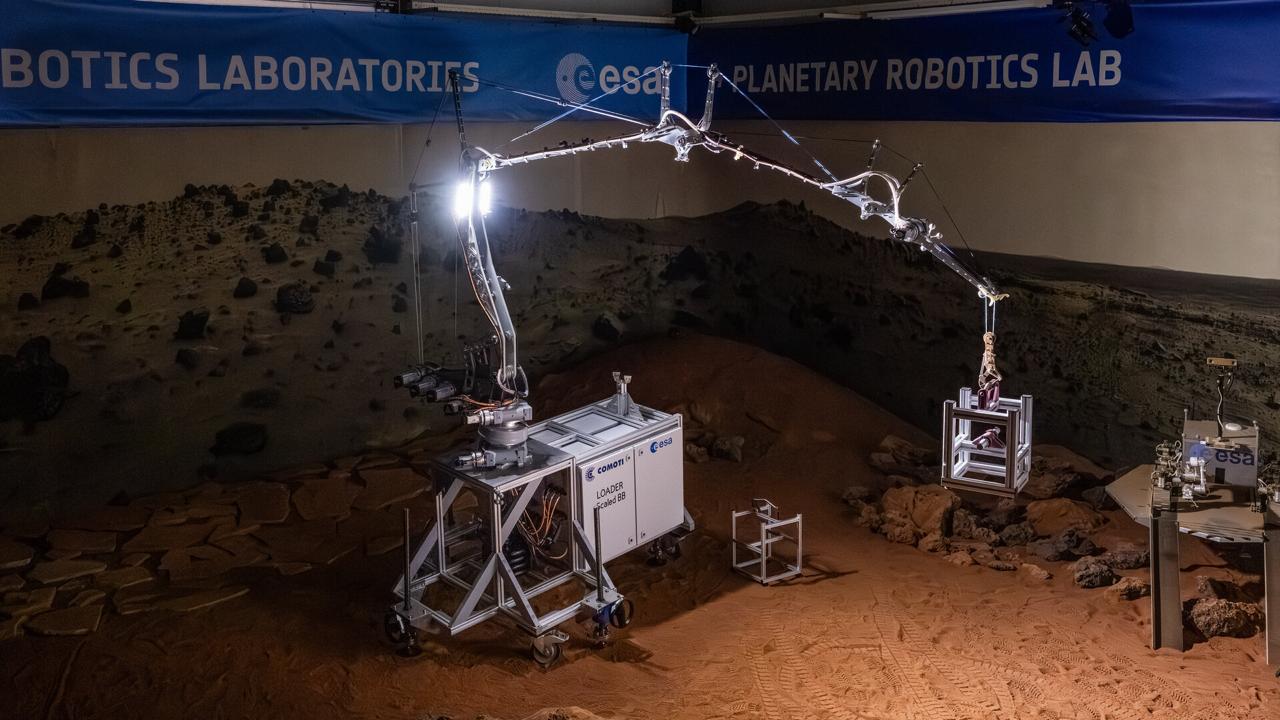
The crane was developed by Romanian research institute COMOTI together with Initium Space, with support from ESA’s Technology Development Element. A scaled model was tested in ESA’s Planetary Robotics Laboratory in the Netherlands, where it moved a payload mock-up around the lab.
The scaled model can lift 30 kg under Earth gravity, equivalent to a little over 180 kg on the Moon. “Ultimately, the crane will be more than twice as big, and with the Moon’s gravity being six times weaker than on Earth, it will be able to lift up to a tonne of material,” said Gunter Just, ESA’s robotics engineer.
The crane will launch in a folded configuration on the lander’s payload deck and deploy once it reaches the lunar surface. “A dedicated cable-management system and a carefully defined unfolding sequence ensure that the crane is very compact when stowed while still easy to control and deploy,” said Daniel Useriu of COMOTI. A levelling system keeps the crane vertical even if the lander comes to rest on sloped terrain. Above the base, a long arm connected by two joints ends in a set of grippers, a passive spring-loaded gripper that can lock into place without power, and a battery-powered gripper that can rotate the load for more precise positioning.
The project demonstrates a method for handling heavy cargo that cannot be reached by robotic arms. “We have successfully met, and in some areas exceeded, our initial expectations,” Useriu said. “This demonstrator gives us a strong foundation for the next steps.”
Useriu noted there is still a great deal of work ahead to refine the crane. No further milestones or dates were specified in the source.