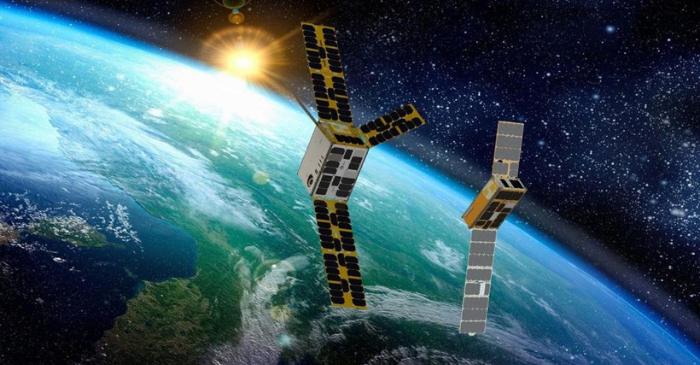
Open Cosmos, the leading space company that designs, manufactures, and operates satellites to understand and connect the world, has achieved a breakthrough with the successful deployment into orbit of two key platforms: 6GStarLab, the first in-orbit telecommunications laboratory, and a new satellite of the Open Constellation contributed by a Fortune 100 company.
The satellites, 6GStarLab, commissioned by i2CAT with support from the Spanish and Catalan governments, and the new Open Constellation satellite, were launched aboard SpaceX’s Falcon 9 (Transporter 15) on Friday, 28 November 2025, from Vandenberg, California.
The Open Constellation is a mutualised satellite infrastructure designed by Open Cosmos to enable organisations to access better quality, more frequent data generated out of the satellites they contribute to. Having pioneering companies involved in this initiative highlights its significance and growth in the commercial world, beyond the tenths of satellites already contributed to countries like Greece, Spain, Portugal, and the UK. By investing in Open Cosmos’ shared constellation, forward-thinking organisations are helping to build a truly integrated, cross-sector space ecosystem where satellite infrastructure serves as a common digital backbone. This was one of the key objectives of ESA’s commercialisation directorate program, SCALEUP, which has supported this project.
Open Cosmos is responsible for the satellite development, design, manufacturing, and orbital operations for both missions.
Rafel Jorda Siquier, founder and CEO of Open Cosmos, said, “This double launch reflects the breadth and ambition of what Open Cosmos now delivers: enabling research, innovation, and commercial value through a shared, connected infrastructure in space. 6GStarLab and the new Open Constellation satellite embody the future of our sector: collaboration between governments, industry and technology leaders to make space data more accessible and more powerful.”
6GStarLab: Europe’s First In-Orbit 6G Laboratory
The 6GStarLab mission, procured by Catalonia’s i2CAT Research Centre, is Europe’s first Low Earth Orbit (LEO) laboratory for experimentation in 6G non-terrestrial networks (NTN). Built to be an open, flexible testbed, it gives researchers a platform to test new communication technologies and allows for experiments to be deployed and executed in a real space environment, promoting innovation in an emerging ecosystem working on the interconnection between terrestrial and non-terrestrial networks.
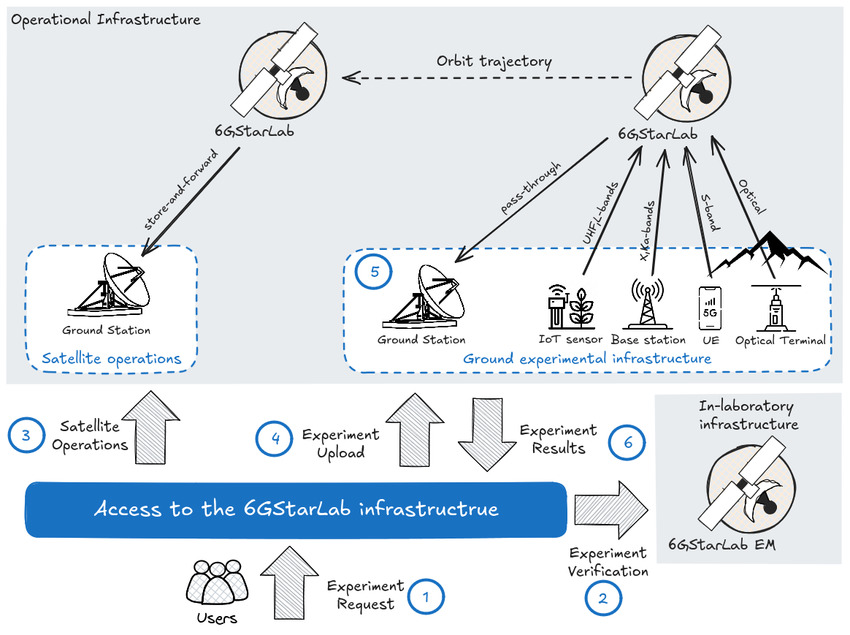
It will allow experiments in real conditions to be carried out in space, advancing the development of new technological applications such as remote communications, telemedicine, distance education, prevention and mitigation of fires and natural disasters, as well as autonomous mobility. It will do this by testing optical and radio-frequency links, AI-driven 6G network systems, orchestration, and autonomy.
Sergi Figuerola, PhD, Director of i2CAT, commented, “6GStarLab is a milestone for Europe’s digital ecosystem. By establishing an open, collaborative testbed for 6G and non-terrestrial networks, it will help researchers and innovators bridge the gap between lab research and real-space validation. With Open Cosmos’s expertise, speed, and the maturity of its satellite platforms, we were able to make this a reality.”
The satellite will carry payloads designed by i2CAT and Microwave Sensors and Electronics (MWSE), as well as a laser terminal for space-to-ground optical communications, and its ground station developed by Transcelestial. The antenna system for radio-frequency communications has been developed by the NanoSatLab group at the Universitat Politècnica de Catalunya (UPC). The mission is part of Spain’s UNICO I+D 6G program and is backed by the European Union’s NextGenerationEU initiative.
New Open Constellation Commercial Satellite
This new Open Constellation satellite hosts a hyperspectral payload, an IoT payload, onboard AI to fuse and process sensing data, and an intersatellite link enabling near real-time delivery of AI insights in an extremely compact form factor. The hyperspectral imager allows the satellite to identify and quantify specific materials, chemical compositions, and subtle environmental changes such as crop health, mineral deposits, or pollution types.
An AI-enabled onboard processing board allows machine learning algorithms to be executed directly on the satellite, processing the large hyperspectral datasets in space and sending down only actionable intelligence. This reduces latency and ground-processing costs.
A Narrowband-IoT payload tests low-power, wide-area connectivity, allowing the satellite to communicate with simple, battery-powered sensors in remote areas far beyond cellular coverage. With the intersatellite link, it can relay AI-processed data and sensor readings to customers in near real time.
This satellite incorporates technology developed by Connected, a company acquired by Open Cosmos earlier this year. The mission marks the first in-orbit demonstration of Connected’s innovations, strengthening the satellite’s ability to combine and analyse Earth observation data in orbit.
The launch also opens the Open Constellation to private companies that can now contribute satellites and benefit from the capabilities of the entire shared system alongside governments.
This launch follows several major milestones for Open Cosmos in 2025, including its selection by the UK Space Agency to lead QUIVER, the eight-satellite award for the Atlantic Constellation, and a £5.15 million contract from the UK’s Defence Science and Technology Laboratory for two satellites designed to enhance space situational awareness and monitor space weather.