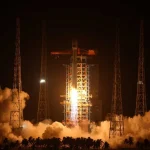
SpaceX continues to target no earlier than Thursday, July 23, for the next attempt to launch Starship on its 13th flight.
Preparations include swapping out engines on Booster 20, with a standalone test conducted at Pad 2 on Wednesday before returning to full stack countdown operations.
Both Booster 20 and Ship 40 were rolled back to the production site following a last-second automatic abort during the initial launch attempt on July 16.
SpaceX CEO Elon Musk stated that two Raptor engines on the booster would be swapped out “to be confident of a good flight.”
Notably, at least three engines associated with Booster 20 have been seen at SpaceX’s McGregor test site, which may be contributing to the extended turnaround from the originally hoped-for Monday attempt.
Another Raptor previously installed on Booster 20 is at SpaceX’s McGregor test site.
This is the third we’ve seen so far, indicating that more than two have been removed. This engine was also part of Booster 19’s 10-engine complement back in March. https://t.co/Eh5oaibOBY pic.twitter.com/4kTo52HNTL
— NSF – NASASpaceflight.com (@NASASpaceflight) July 20, 2026
The company’s public schedule currently lists July 23 as the target, though additional time could be added as further testing on Pad 2 has been confirmed via road and beach closure notifications.
This testing would likely take the form of a Spin Prime test rather than a full Static Fire, although nothing can be ruled out ahead of the test. The window for Wednesday’s testing ranged from 9 AM to 11 PM Central, with a prop load and what looked like a minor subset Spin Prime test before the vehicle was detanked.
Top o’ the morning to you, Booster 20. What does fate have in store for you today?
Approaching today’s road/beach closure at 9am for SpaceX teams to conduct prelaunch booster testing ahead of tomorrow’s launch attempt of Starship Flight 13, assuming all goes well.
-… pic.twitter.com/IHgLcy5fj1
— Max Evans (@_MaxQ_) July 22, 2026
The tank farm will require topping up, along with Ship 40 being rolled and stacked ahead of the launch attempt. A road closure has already been posted for Ship 40’s return, with the potential that it will be rolled partly down Highway 4 waiting for Booster 20 to complete safing.
The July 16 Launch Attempt
The next attempt began with standard pre-launch preparations.
Booster 20 was rolled out and stacked onto the Orbital Launch Mount just under two days before the scheduled liftoff.
Ship 40, carrying 20 Starlink V3 satellites for a planned test deployment on a suborbital trajectory, arrived at the launch site less than 24 hours before launch.
After deployment, the Ship was expected to perform atmospheric reentry and a controlled end-of-mission demonstration.
The target liftoff time was set for 22:45 UTC. The countdown progressed smoothly until a hold at T-60 seconds.
SpaceX had adjusted the planned hold point from the more traditional T-40 seconds to T-60 seconds.
Holds at this point are common for Starship, allowing controllers to perform one final check before committing to the final seconds of the count.
This change to T-60 seconds allows final pre-launch checks to be performed slightly earlier in the sequence, helping to distribute workload more evenly ahead of liftoff.
It also preserves the option to recycle the countdown back to T-60 seconds if a hold is called before the deluge system activates.
Once the deluge has fired, however, any hold automatically results in a scrub for that attempt, as the system cannot be reset quickly enough.

The OLM on Pad 2 as seen during Tuesday’s NSF flyover.
SpaceX typically maintains five to eight minutes of available hold time before a launch attempt must be called off.
Previous flights, including Flight 12, have shown the ability to hold and recycle for nearly 10 minutes in some cases.
After the T-60 hold was cleared, the countdown resumed without further interruption.
The detonation suppression system activated beneath the pad, followed by the flame trench and top deck deluge systems.
Telemetry then showed 29 of Booster 20’s 33 Raptor engines ignited.
Almost immediately afterward, the vehicle’s onboard computers triggered an automatic abort and shut the engines down.
This marked the first post-ignition abort during an actual Starship launch attempt, leading to some gallows humor from SpaceX senior manager Kate Tice.
First V3 full stack static fire complete…
— kate_tice (@kate_tice) July 16, 2026
What Triggered the Abort
The abort was triggered because the vehicle exceeded its engine-out criteria.
Starship is designed to tolerate up to three engine failures during the startup sequence.
Once a fourth engine failed to ignite, the launch commit criteria were no longer satisfied, and the system initiated the abort.
Starship Flight 13: T-0 Abort.
Live on X and YT:https://t.co/ekRmg2xswd pic.twitter.com/y9DcVZIV1c
— NSF – NASASpaceflight.com (@NASASpaceflight) July 16, 2026
The timing of the abort relative to deluge activation made recovery impossible for that day.
With the deluge system already operating, several minutes would have been required to reset it and prepare for another attempt.
That timeframe would have exceeded the available hold time.
Refueling the entire stack after detanking would have taken two to four hours, far beyond the 90-minute launch window.
The precise reason why four engines failed to ignite is still under review. It appears unlikely that the 10 refurbished engines carried over from Booster 19’s earlier static fire were the main cause. Only one of those engines, Raptor serial number 78, failed to start.
Any underlying issues should have been identified during the vehicle’s 25-second static fire test prior to rollout, unless damage occurred during or after that test.
This event differed from the hard shutdown experienced during Booster 19’s static fire. In that earlier test, an issue with the pad’s deluge system led to an abrupt engine cutoff just over a second after ignition. The rapid shutdown while engines were still in their startup sequence caused damage to the affected engines, which were later repaired and installed on Booster 20.
In contrast, the Flight 13 abort was initiated by the vehicle itself after deluge activation. This allowed the successfully ignited engines to shut down in a more controlled manner, reducing the risk of damage to both the engines and the launch pad. Post-abort analysis and imagery have so far shown no obvious signs of such damage.
Following the scrub, both the Ship and Booster were rolled back for detailed inspections. As the Booster was lifted off the mount, NSF cameras showed the Raptor engines clearly. Some paint chipping was observed around the Booster Quick Disconnects, but this is considered normal and has no impact on operations.
Looking Ahead
Flight 13 continues to carry forward improvements from previous missions, including the planned test deployment of the Starlink V3 satellites from the Ship upper stage during the suborbital flight profile.
The sequence of events on July 16 provided valuable data on Starship’s abort capabilities under real launch conditions. The system performed as designed by preventing a launch when engine performance fell below acceptable thresholds, even after ignition had begun.
The saying in the rocket industry is “Scrubs are better than RUDs” (Rapid Unplanned Disassembly). This outcome, while resulting in a scrub, reinforces confidence in the vehicle’s automated safety systems ahead of the next attempt.
(Lead image via Max Evans for NSF).

The post Path to Starship Flight 13 requires additional Booster 20 test appeared first on NASASpaceFlight.com.