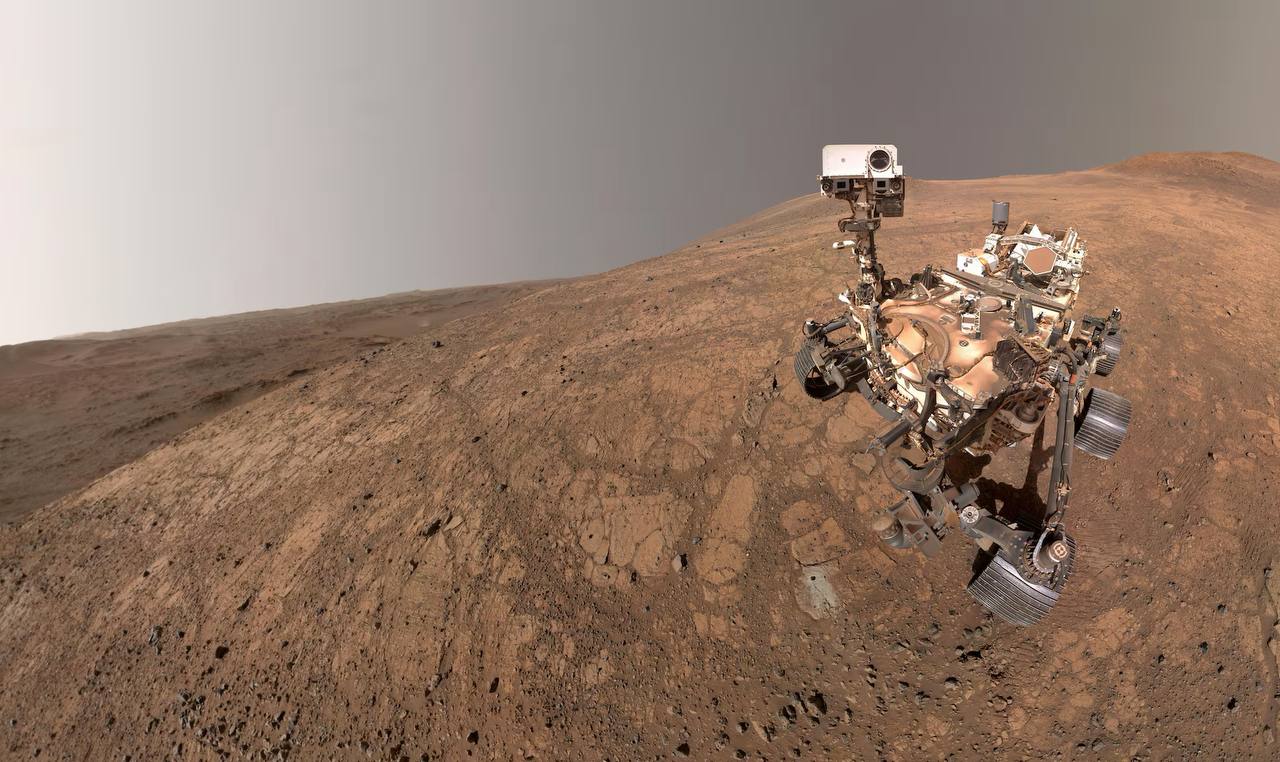
Perseverance landed in Jezero Crater in February 2021. Its autonomous navigation system has allowed it to cover ground far faster than earlier rovers, maximizing the time available for science by reducing the periods spent waiting for driving commands from Earth.
About 90 percent of the distance driven by Perseverance has been autonomous, made possible by its Vision Compute Element. The rover uses onboard cameras to image surrounding terrain, then processes those images algorithmically to calculate the safest route around hazards such as large boulders and sandy slopes. This allows the vehicle to sense and compute while its wheels are turning, though its maximum wheel speed is only about 150 meters per hour.
By comparison, the Curiosity rover, largely a twin of Perseverance that launched nine years earlier, drives autonomously for only about 10 percent of its travel. Its onboard computer is a generation older, with some of its chipset dating to the 1990s, making its processing too slow, said Steven Lee, the project manager for Perseverance at NASA’s Jet Propulsion Laboratory. Curiosity has driven 38.6 km over nearly 15 years on Mars.
In Jezero Crater, Perseverance is studying some of the most ancient rocks in the Solar System, dating back about 4 billion years to the later stages of the heavy bombardment era. Scientists are examining the terrain to understand what geological and environmental conditions existed at a time when large lakes and possibly oceans may have covered Mars, and how conducive the planet might have been to life.
Mission deputy project scientist Vivian Sun said the driving capability directly expands what the rover can accomplish. “It is very enabling for the science,” she said. “Not to sell the rover’s other advanced capabilities short, but the driving in particular has allowed us to have a larger scope than previous missions.” Sun added that studying this terrain in situ marks a first. “It’s the first time we’ve been able to investigate this terrain in situ, and that’s been very exciting,” she said. Because Jezero’s science objectives are spread out, the rover has often reached new sites ahead of the planned timeline.
Perseverance shows no signs of appreciable wear on its wheels, which were redesigned after Curiosity operators noted significant wear and tear on their vehicle, Lee said. The rover operates on RTG power and carries no propellants, consumables, or lubricants. For that reason, Lee said, the vehicle could keep driving itself across Mars for many years to come.
The only minor concern is the actuators in the wheels. They were initially life-tested for 20 km of driving, but NASA is now certifying them to at least 100 km, and possibly longer.