Rocket Lab launched its third Electron rocket launch of the year on Saturday. The seventh flight of Electron, named “Make It Rain,” carried seven satellites for Spaceflight Inc. Daily launch windows from 04:30 to 06:30 UTC began on June 27. However, the launch moved to Saturday (local time) after a 48 hour delay due to the need to conduct additional checks on ground equipment. Saturday’s attempt launched at the opening of the window with no issues.
The mission name was inspired by Spaceflight Inc.’s headquarters in Seattle, Washington. Make It Rain was Spaceflight’s inaugural launch with Rocket Lab and the first of five such launches planned for this year.
Spaceflight has already launched two missions aboard ISRO’s PSLV and SpaceX’s Falcon 9 rockets in 2019, and have ten additional missions scheduled for the year.
Rocket Lab, like other smallsat launch providers, is aiming to solve problems associated with large scale rideshare missions, such as limited control over destination orbits and lengthy delays. Dedicated smallsat launches, or rideshare missions like Make It Rain with only a few payloads, allow Rocket Lab to offer precise orbital insertion for all payloads on their own schedule.

BlackSky’s Global-3 satellite is integrated with Rocket Lab’s kick stage – via Rocket Lab
The largest of the seven satellites deployed, BlackSky’s Global-3 is a commercial Earth observation and imagery satellite. Global-3 is BlackSky’s first inclined launch, at an inclination of 45 degrees.
See Also
- Electron Make It Rain UPDATES
- Rocket Lab Electron Forum Section
- L2 Master Section
- Click here to Join L2
Also on board were two Prometheus cubesats, developed by the Los Alamos National Laboratory for the US Special Operations Command (USSOCOM) as technology demonstration satellites. A student built technology demonstration satellite from the Melbourne Space Program named ACRUX-1 was also aboard Electron, as were two SpaceBEE communications satellites for Swarm Technologies.
The seventh payload on the launch was not disclosed. The payloads were deployed into a circular orbit at 450 kilometers in altitude, and had a total mass of 80 kilograms.
With the exception of Global-3, all of the payloads were processed and integrated at Spaceflight’s facility in Auburn, Washington. In early June, they were shipped to Rocket Lab’s private spaceport: Launch Complex 1, on the Mahia Peninsula in New Zealand.

The Electron rocket arrives at Launch Complex 1 – via Rocket Lab
The final stage test for Make It Rain was completed on May 21. The Electron rocket arrived at LC-1 in early June, and rolled out to the launch pad on June 19 in preparation for a Wet Dress Rehearsal. The rehearsal of the launch countdown, including fueling of the Electron rocket, was completed on June 21.
(adsbygoogle = window.adsbygoogle || []).push({});
The mission countdown began six hours before liftoff when the road to the launch site were closed. Four hours before launch, the Electron rocket was lifted from its horizontal position to vertical on the launch pad and filled with RP-1 rocket fuel. Two hours before launch, Liquid Oxygen was loaded onto both stages of Electron.
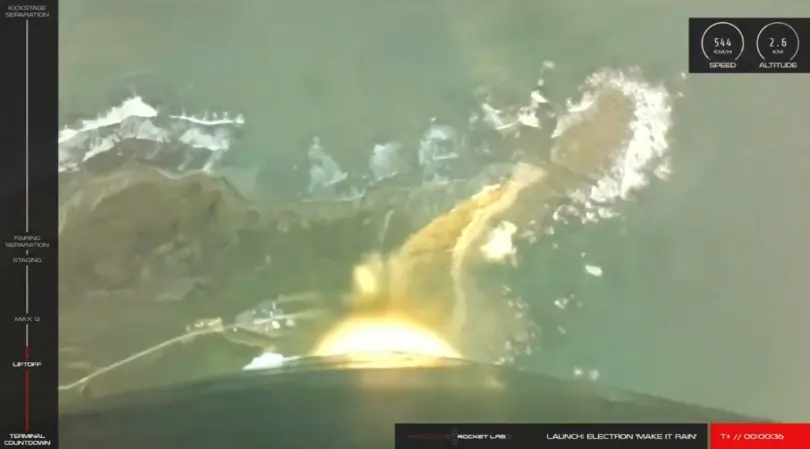
After Electron was fully fueled, the Launch Director conducted a go/no-go poll of the launch team at T- 18 minutes. Two minutes before liftoff, Electron’s on-board computers took over control of the countdown, beginning the launch autosequence. The nine Rutherford engines on Electron’s first stage ignited two seconds before liftoff.
LAUNCH! Rocket Lab’s Electron rocket launches on the “Make It Rain” mission.
Play By Play:https://t.co/rMJGnWAlle
Launch clip: pic.twitter.com/f0fecBKbGC
— Chris Bergin – NSF (@NASASpaceflight) June 29, 2019
Once Electron’s computers verified all systems are healthy, the rocket was released from the launch pad and began an approximately nine-minute flight to orbit. The first stage burned for two minutes and thirty-four seconds after liftoff, before separating from the second stage.
The vacuum Rutherford engine on stage two ignited at T+ 2 minutes, 44 seconds. Three minutes and five seconds after launch, the payload fairing which protected the payloads during ascent separated, with Electron above the dense parts of Earth’s atmosphere.
Stage two burned until eight minutes and fifty-five seconds after liftoff. Rocket Lab’s kick stage then separated from Electron and entered an approximately forty-minute-long coast phase. The Curie engine on the kick stage ignited at T+ 50 minutes, 27 seconds, and burn for 44 seconds. All seven payloads were deployed by T+ 53 minutes, 26 seconds.
After payload deployment, the kick stage will perform a deorbit burn, leaving no space debris in orbit. Rocket Lab has made limiting space junk a priority as part of their goal of growing the number of satellites in orbit with an accelerating launch cadence.
By the end of this year, Rocket Lab hopes that cadence will reach a pace of one Electron launch every two weeks. Part of this plan includes the first Electron launch from Rocket Lab’s new launch facility, Launch Complex 2, later this year. LC-2 is under construction at the Mid-Atlantic Regional Spaceport at NASA’s Wallops Flight Facility in Virginia.