Originally slated for launch atop a Russian Soyuz rocket, the Euclid mission found a new ride to space with SpaceX’s reliable Falcon 9 rocket.
This strategic collaboration underscored the adaptability and intercontinental cooperation within the scientific community, emphasizing the shared commitment to advancing our understanding of the universe.
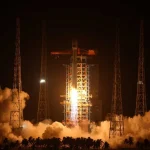
Following a flawless liftoff, the Falcon 9 propelled Euclid toward the cosmos. Once in space, the spacecraft was carefully maneuvered onto a trajectory that will eventually place it at its observing orbit at the Sun-Earth L2 Lagrange point — a gravitational balance between the Sun and Earth, providing a stable vantage point for uninterrupted observations.
From this strategic location, Euclid’s advanced instruments are set to embark on an extraordinary cosmic expedition, meticulously studying the distribution, structure, and evolution of galaxies on an unprecedented scale.
 100vw, 1024px”><figcaption class=) Euclid is prepared to be encapsulated in the payload fairing of SpaceX’s Falcon 9 rocket. Image: ESA
Euclid is prepared to be encapsulated in the payload fairing of SpaceX’s Falcon 9 rocket. Image: ESAOne of the key objectives of the Euclid mission is to unravel the mysteries of dark matter and dark energy, which together constitute some 95% of the universe.
By scrutinizing the effects of these elusive cosmic phenomena on the formation and distribution of galaxies, Euclid holds the promise of revolutionizing our understanding of fundamental physics and unraveling the enigma of the dark universe.
As part of its groundbreaking reusability program, the Falcon 9’s first-stage booster executed a precision landing on SpaceX’s drone ship “A Shortfall of Gravitas,” which was stationed downrange in the Atlantic Ocean.
The successful launch and deployment of the Euclid spacecraft represents a monumental leap forward in our cosmic journey, opening doors to unprecedented discoveries and transforming our understanding of the universe.
It embodies the collaborative spirit of international space exploration and the tireless dedication of scientists, engineers, and visionaries who strive to unravel the profound mysteries that surround us.
With the Euclid mission now in full swing, scientists and researchers around the world eagerly await the invaluable data and insights it will provide.
This historic achievement stands as a testament to human curiosity and our unwavering determination to unlock the secrets of the universe, pushing the boundaries of knowledge and shaping the course of our cosmic exploration.