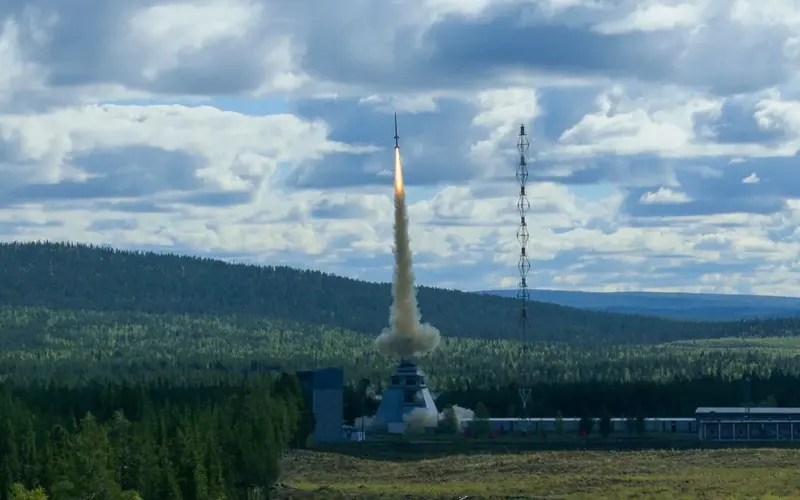
SSC Space successfully launched its SubOrbital Express-5 mission on 31 May from the Esrange Space Centre in northern Sweden, carrying 12 scientific and commercial experiments designed to operate in microgravity conditions.
The sounding rocket reached an altitude of approximately 260 kilometres and provided researchers with around six and a half minutes of microgravity during the flight.
Red Kite-Powered Mission
The 13-metre rocket was powered by Red Kite rocket motors on both its first and second stages.
The Red Kite propulsion system was developed by German aerospace company Bayern-Chemie under a contract with the German Aerospace Center (DLR).
While the motor has now flown on six missions, SubOrbital Express-5 marked only the second mission to use Red Kite motors on both stages of the launch vehicle.
Previous missions typically combined Red Kite with Improved Malemute or Black Brant upper-stage systems.
Launch from Esrange
The mission lifted off at 06:33 UTC from the Skylark Tower launch facility at Esrange Space Centre.
The suborbital flight carried a four-metre scientific payload section housing a combination of European Space Agency-funded research projects and commercial payloads.
Scientific Research in Microgravity
Three experiments funded by the European Space Agency focused on biological and materials science research.
The studies investigated the solidification of metal alloys in microgravity, the behavior of red blood cells under altered gravity conditions, and the response of blood vessel lining cells to changes in gravitational forces.
An additional rideshare module accommodated nine experiments from research organizations and commercial customers.
These projects examined subjects including immune cell responses, stem cell behavior, radiation shielding materials, microorganism activity and materials processing in microgravity environments.
Unusual Commercial Payload
Among the 12 experiments was SpaceGinger-01, one of the mission’s more unconventional payloads.
The experiment was designed to study the effects of microgravity on red hair samples provided by Swedish influencer Mauri “Mustiga Mauri” Hermundsson.
The mission highlights the growing use of sounding rockets as platforms for short-duration microgravity research, offering scientists and commercial organizations access to space-based testing environments without the cost and complexity of orbital missions.
SubOrbital Express-5 continues SSC Space’s role in supporting scientific research and technology development through suborbital launch services from the Esrange Space Centre.