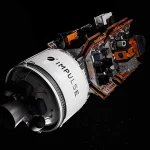
Stoke Space is developing Nova, a launch vehicle designed around 100% and rapid reusability to provide frequent and cost-effective access to orbit. Unlike conventional launch systems that discard major vehicle components after flight, Nova is being engineered to enable both stages to be recovered and reused. Stoke’s approach is intended to amortise production costs across multiple launches, reduce dependence on manufacturing new flight hardware and enable missions to repeatedly use flight-proven vehicles.

A key technology behind Nova is the fully reusable second stage, which combines a liquid, regeneratively cooled metallic heat shield with an integrated LH2/LOX rocket engine. The actively cooled metallic heat shield is designed to withstand repeated atmospheric reentries while using ductile materials and passive failure modes to improve robustness and reduce refurbishment requirements compared with conventional ceramic thermal-protection systems. The second stage is also designed for unlimited engine restarts, enabling flexible orbital operations, direct access to Geostationary Transfer Orbit (GTO) and Trans-Lunar Injection (TLI) and precision powered vertical landings.
Also Read: What are the the Different Types of Launch Vehicles used in Space?
Nova’s second-stage architecture incorporates several technologies intended to enable both orbital delivery and in-space operations. This 100% reusable payload fairing provides a 180° × 360° deployment hemisphere, while the vehicle is designed to support rendezvous, capture, repositioning and other dynamic space operations. The second stage’s unique engine nozzle is approximately 10 times shorter than traditional bell nozzles, while still supporting deep throttling even under atmospheric pressure. During re-entry, Nova’s low ballistic coefficient allows aerodynamic drag to reduce the vehicle’s velocity to below 100 m/s (224 mph) before the engine is restarted for a controlled vertical landing.

The Altair Stage 2 engine uses an expander-cycle architecture with LH2/LOX propellants, integrated heat shielding, more than 425 seconds of specific impulse, and more than 25,000 lbf of thrust. Stoke highlights liquid hydrogen for its combination of performance and thermal-management capabilities, citing approximately 30% higher efficiency and five times better cooling capability than hydrocarbon fuels. Nova is designed to accommodate 3000 kg to LEO with full reusability, with a maximum LEO payload capacity of 7,000 kg, alongside target capabilities of 2500 kg to GTO, 1,250 kg to TLI, and 800 kg to C3 = 0.

The first stage is powered by a full-flow staged-combustion (FFSC) LNG/LOX engine designed for high performance, efficiency, long life and rapid reuse. Stoke lists more than 100,000 lbf of thrust and 345 seconds of specific impulse for the first-stage engine. The FFSC architecture is intended to support repeated operation while maximizing engine performance and efficiency. Across Nova, rapid reuse is treated as a fundamental part of the vehicle architecture rather than an additional recovery capability, with the company targeting turnaround measured in hours rather than months.

Stoke Space is also vertically integrating Nova’s design, manufacturing, development and testing to accelerate iteration and improve reusability. The vehicle uses steel tanks instead of carbon-composite tanks, with Stoke highlighting steel’s thermal properties, strength and ductility for repeated pressurization, temperature cycling and mechanical stresses. The company operates a dedicated private test facility close to its vertically integrated manufacturing and development operations, allowing propulsion and vehicle technologies to be tested and refined rapidly. Together, Nova’s reusable stages, actively cooled heat shield, high-performance propulsion, reusable fairing and in-space operational capabilities form Stoke Space’s approach to building a rapidly reusable transportation system for future orbital missions.
About Stoke Space
Stoke Space is a U.S space company developing fully reusable launch vehicles and space transportation technologies. The flagship Nova system is designed around rapid and complete reusability, combining reusable first- and second-stage technologies, an actively cooled metallic heat shield, high-performance propulsion, reusable payload accommodations and capabilities for delivering payloads to orbit and returning assets from space.