China commercial aerospace
1. “Shanghai’s Several Measures to Accelerate the Cultivation of Commercial Aerospace Advanced Manufacturing Clusters” was released
On April 23, with the consent of the municipal government, the Shanghai Economic and Information Technology Commission issued “Several Measures of Shanghai on Accelerating the Cultivation of Commercial Aerospace Advanced Manufacturing Clusters” to support the construction of Shanghai’s high-standard industrial clusters, including the Minhang District Commercial Rocket Industrial Park and the Songjiang District Commercial Satellite and Terminal Characteristic Industrial Park.
Hello space:
Shanghai has formulated measures to vigorously support the development of the commercial aerospace industry chain. By arranging commercial rocket characteristic industrial parks, commercial satellite and terminal characteristic industrial parks, it will promote Shanghai to become a national-level commercial aerospace advanced manufacturing cluster with the entire satellite and rocket industry chain like Beijing. It is expected to compete for “China’s first aerospace city”.
2. The Shanghai Stock Exchange held a symposium on the commercial aerospace industry
On the morning of April 18, the Shanghai Stock Exchange (hereinafter referred to as the “SSE”) held a symposium on commercial aerospace industry enterprises to have in-depth exchanges with 10 leading companies in the field of commercial rockets and commercial satellites; on the afternoon of the 18th, it held a salon on the theme of the future industry of commercial aerospace, attended by more than 30 industry chain-related companies, venture capital institutions, securities analysts, and commercial banks.
Hello space:
This symposium brought together leading commercial aerospace companies to discuss how the capital market can serve the high-quality development of the industry, releasing a clear signal that the capital market is paying more attention to the commercial aerospace track. The participating companies are expected to become the “first stocks” of China’s commercial aerospace industry.
3. China Commercial Fire released launch opportunities for China Aerospace Science and Technology Group’s launch vehicles in 2025-2026
On April 25, China Aerospace Science and Technology Group Commercial Rocket Co., Ltd. officially announced the 2025-2026 China Aerospace Science and Technology Group launch vehicle loading and ride-sharing opportunities. China Commercial Rocket’s service products come from various Long March series rockets of China Aerospace Science and Technology Group.
Hello space:
The launch of the ride-sharing opportunity by China Commercial Space Marine launches three important signals: First, China Commercial Space Shuttle has begun to serve as the commercial launch service platform of the Aerospace Science and Technology Group, coordinating the provision of Long March series launch vehicle loading and ride-sharing launch services; second, my country’s commercial aerospace is upgrading from single-star customized launches to normalized shared launches, and launch costs have been reduced; third, the national team is actively adjusting traditional mission-based production capacity and converting redundant transportation capacity into commercial services;
4. The comprehensive test of the Interstellar Glory Hyperbolic 1 launch vehicle was a complete success
On April 17, the comprehensive test of the Star Glory Hyperbolic 1 launch vehicle was a complete success. During the test, the launch vehicle achieved excellent performance in various indicators, successfully passed the assessment, and was qualified to participate in subsequent flight missions.
Hello space:
After being equipped with the launch vehicle, the Hyperbola-1 launch vehicle can achieve automatic erection, high maneuverability transition and precise temperature control. The pre-launch process is shorter, safer and more reliable, and has wider application prospects.
5. Galaxy Power’s 85-ton liquid oxygen kerosene engine CQ-90 was officially released
On April 24, the tenth “China Space Day” home event was held in Shanghai. Galaxy Power’s 85-ton liquid oxygen kerosene engine CQ-90 was officially released at the air show.
Hello space:
The CQ-90 liquid oxygen/kerosene engine is improved and upgraded based on the technical status of the CQ-50 engine. In response to the reuse and recovery requirements, it has the ability to start more than three times. The main assembly uses a 3D printing solution, which has the advantages of short production cycle and low cost. In the future, it will support the research and development of Galaxy Power’s new generation of high-thrust liquid rockets.
6. Universal Aerospace and Xingyi Lianxin completed over 100 million yuan in financing
Recently, Oneworld Aerospace announced the completion of a new round of strategic financing of more than 100 million yuan, led by Liangxi Science and Technology Innovation Industry Fund of Funds, followed by Huafu Growth Investment; Xingyi Lianxin has successively completed Pre-A+ and Series A financing, of which the Pre-A+ round was additional investment from Meihua Venture Capital and Yuanhang Capital; Series A investment institutions include Meihua Ventures, Liangxi Science and Technology Industry Fund of Funds (Bohua Capital Management), Luxin Venture Capital, etc.
Hello space:
Huanyu Aerospace provides one-stop services for large-scale rocket integration, manufacturing, and testing, while Xingyi Lianxin focuses on satellite communication payload system products and solutions. Within a week, two commercial aerospace companies with different tracks received 100 million yuan in financing, and the capital’s deployment of commercial aerospace is showing a trend of blooming.
7. Spacetime Daoyu and Yuanxin Satellite actively plan overseas business
Recently, Spacetime Daoyu signed cooperation agreements with ATSS, a satellite communications company in the Middle East, and Soremar Group, a Moroccan company. On April 24, Yuanxin Satellite officially signed a strategic cooperation framework agreement with Thailand National Telecom to achieve business cooperation.
Hello space:
Spacetime Daoyu expands into a new territory in the Middle East market and promotes the application of Geely constellation in North Africa; Yuanxin Satellite will enhance satellite communication capabilities in remote areas of Thailand through the Qianfan constellation low-orbit satellite broadband network service capabilities. Domestic commercial aerospace overseas business is gradually moving from the manufacturing end to the service end closer to users, and the overseas business formats are becoming more and more abundant.
international commercial aerospace
1. The African Space Agency was officially established
On April 20, the African Space Agency held a ceremony in Cairo, Egypt, to announce its official establishment. Representatives from NASA, ESA, the Japan Aerospace Exploration Agency, the Italian Space Agency, the United Arab Emirates Space Agency and the French National Center for Space Research were all present.
Hello space:
On January 25, 2023, the African Union Commission and the Egyptian government signed an agreement at the Egyptian Space City in Cairo, and the African Space Agency officially began preparatory operations. With this official establishment, the African Space Agency has become the second regional space agency after the European Space Agency, tasked with coordinating and promoting the space development of 55 African countries.
2. SpaceX successfully launched Dragon spacecraft cargo mission
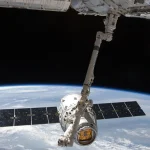
On April 21, Eastern Time, SpaceX Falcon 9 carried out the SpX-32 cargo supply mission, launching the Cargo Dragon spacecraft from the Kennedy Space Center to deliver 3021kg of supplies to the International Space Station, including 1468kg of astronaut supplies and only 255kg of scientific test load.
Hello space:
The Northrop Grumman NG-22 cargo mission spacecraft originally scheduled to launch in June was canceled due to damage to the pressurized cabin section during transportation. This mission needs to carry more astronaut supplies, which is a significant increase compared with the 545kg of the SpX-30 mission in March 2024 and the 961kg of the SpX-31 mission in November 2024.