China commercial aerospace
1. The sea recovery test of Jianyuan Technology’s Yuanxingzhe 1 verification rocket was a complete success
On May 29, Arrow Technology’s Yuanxingzhe 1 verification rocket successfully conducted its first flight recovery test at the Oriental Spaceport. The Yuanxingzhe 1 verification rocket is a full-size thin-walled stainless steel rocket with a diameter of 4.2 meters, a total height of approximately 26.8 meters, a take-off mass of approximately 57 tons, a test flight duration of 125 seconds, and a flight altitude of approximately 2.5 kilometers.
Hello space:
This recovery test is the first time that a domestic private rocket has achieved maritime recovery verification. It also marks that the large-size stainless steel reusable launch vehicle has entered the engineering application stage, laying a solid foundation for this year’s Yuanxingzhe 1 first flight.
2. China Aerospace Science and Technology Corporation Satellite Application Innovation Research Institute was unveiled
On May 23, China Aerospace Science and Technology Corporation held a science and technology innovation conference. At the meeting, Chen Mingbo, Party Secretary and Chairman of China Aerospace Science and Technology Corporation, unveiled the Satellite Application Innovation Research Institute of China Aerospace Science and Technology Group (referred to as the Research Institute). The Research Institute is affiliated to China Satcom and has been upgraded from the Innovation Research Institute under China Satcom to a group-level research institute.
Hello space:
At present, the overall development of my country’s satellite industry is uneven, and there is a clear gap between the commercialization capabilities on the application side and the technical level on the manufacturing side. The Aerospace Science and Technology Group positions the institute as a “systematic integration of satellite application technology” to promote the transformation of my country’s commercial aerospace industry from technology research and development to industrialization.
3. Shandong Haiyang invites bids worth 500 million yuan to build a new offshore liquid rocket launch station
On May 23, the China Bidding and Bidding Public Service Platform issued a bidding announcement for the “Lianli Island Sea Liquid Rocket Fixed Launch Station No. 1 Project.” The project construction site is located on the east island of Lianli Island, Haiyang City, covering an area of approximately 180,000 square meters, with a construction area of approximately 15,000 square meters, and a total investment of 500 million yuan.
Hello space:
This project is the first time to build a fixed liquid launch station at Haiyang Oriental Spaceport in Shandong Province. As my country’s only rocket sea launch home port, the rockets previously launched by the Oriental Space Port are all solid models. The construction of the liquid rocket launch station will fill the “gap” of Haiyang liquid launch and is expected to improve my country’s commercial space launch efficiency, mission adaptability and global market competitiveness.
4. Tianbing Technology’s Tianlong-3 Yaoyi rocket completed final assembly and testing
According to CCTV2 financial news on May 29, Tianbing Technology’s Tianlong-3 Yaoyi rocket has completed all assembly and testing work.
Hello space:
Tianlong 3 is a large liquid launch vehicle independently developed by my country’s commercial aerospace company Tianbing Technology. It has a low-Earth orbit carrying capacity of 17 tons. It plans to make its first flight in 2025. It chose to test the ability of the entire rocket to enter orbit before recycling it.
5. Jiuzhou Yunjian Longyun vacuum version completed series of hot tests
Recently, the vacuum version of Jiuzhou Yunjian Longyun engine passed a series of hot test runs. This round of test runs passed multiple starts and long-term taxiing flight profile assessments, the long-range reliability assessment of a single aircraft exceeded 2,000 seconds in total, and passed the engine thrust variation and mixture ratio adjustment assessments.
Hello space:
The vacuum version of the Longyun engine has a thrust of 80 tons and a thrust adjustment range of 32% to 106%. As a gas generator circulating liquid oxygen methane engine with relatively excellent performance, the Longyun engine will have important application value in the commercial aerospace field.
6. “Thousands of Miles Vast” and other Geely satellites were launched from the launch base
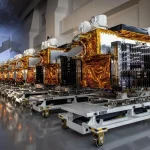
On May 27, several satellites including “Thousand Miles Vast” departed from the Geely Satellite Super Factory and were transported to the launch base. Geely’s future travel constellation is China’s first remote sensing, navigation, and communication satellite constellation operated by Geely Automobile’s Spacetime Daoyu Technology. Currently, a total of 30 self-developed satellites in three orbital planes are operating in orbit.
Hello space:
At present, Geely’s future mobility constellation has officially provided satellite communication services to overseas users, and plans to complete the first phase of network deployment of 72 satellites by the end of 2025 to achieve seamless global coverage. After the launch of this out-of-factory satellite is completed, the quality of constellation application services will be further improved and China’s commercial aerospace industry will go global.
7. Xingchen Optoelectronics completed Pre-A round of tens of millions of yuan in financing
Recently, laser communications start-up Xingchen Optoelectronics announced the completion of Pre-A round of tens of millions of yuan in strategic financing. This round of financing was jointly led by Yuanhang Capital and Yida Capital, with Yinlian Capital also participating. It is reported that this round of financing will be mainly used to accelerate product mass production, technology iteration, team building and market expansion.
Hello space:
Another laser communication technology company has successfully obtained tens of millions of yuan in financing. Behind the continuous increase in capital is the investment community’s firm optimism on the commercial value of inter-satellite laser communication technology. As the construction of low-orbit satellite constellations such as SpaceX Starlink, China Star Network, and Qianfan Constellation enters the fast lane, laser communication technology with significant performance advantages is continuing to heat up in the capital market.
8. Yushi Space completed angel+ round of financing, with cumulative financing exceeding 100 million yuan
Recently, private rocket startup Yushi Space successfully completed angel+ round of financing, with cumulative financing exceeding 100 million yuan. This round of financing was led by Qiancheng Capital and followed by Huacang Capital. The funds raised in this round of financing will be used to build the company’s rocket product R&D and production test base to accelerate the implementation of recyclable stainless steel liquid launch vehicle technology.
Hello space:
Yushi Space completed two rounds of financing in a row within three months, and old shareholders continued to increase their investment, with cumulative financing exceeding 100 million yuan. This not only reflects capital’s recognition of the company’s technical routes and engineering capabilities, but also highlights the market’s urgent need for low-cost, reusable rocket solutions for the commercial aerospace track.
international commercial aerospace
1. SpaceX Starship’s ninth test flight failed
On May 28, 2025, Beijing time, the SpaceX starship was launched from Texas for its ninth test flight. The test flight mission failed. The rocket’s first-stage booster exploded, and the rocket’s second-stage spacecraft entered space but subsequently lost control.
Hello space:
In this mission, the first-stage super-heavy booster of the Starship was reused for the first time. The booster had participated in the seventh Starship test flight mission in January 2025. In addition, a SpaceX spokesperson said that the satellite release hatch of the Starship spacecraft was not opened, so the eight Starlink satellite simulators were not deployed; the leakage of the propellant tank caused an attitude control failure and the Starship spacecraft exploded.