China commercial aerospace
1. Chang 5B launches satellite Internet low orbit 03 satellites
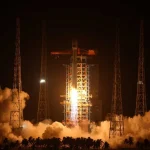
At 4:10 on April 29, 2025, Beijing time, my country used the Long March 5B carrier rocket/Yuanzheng 2 upper stage at the Wenchang Space Launch Site to successfully launch 10 satellites of the satellite Internet low orbit 03 group.
Hello space:
The third launch of the Star Network, there are currently 29 network satellites in orbit, two of which were launched by the Long March 5B rocket. Affected by the high cost of disposable rocket capacity, before China’s new generation of recyclable rockets are successfully commercialized, the construction of the star network will still be extremely slow.
2. Sichuan released the “Sichuan Province Commercial Aerospace High-Quality Development Action Plan (2025-2030)”
On April 29, the “Sichuan Provincial High-Quality Commercial Aerospace Development Action Plan (2025-2030)” released by the Sichuan Provincial Government Office clearly stated: Build a western commercial space port and create a commercial aerospace gathering area. Plan and build a commercial space launch site and build an industrial carrying area with high standards.
Hello space:
As a member of the third tier of the western region, Sichuan has always been an important base for my country’s military industry and aerospace industry. With the Xichang launch site and an excellent aerospace industry chain foundation, Sichuan has unique advantages in developing commercial aerospace. This development action plan is another step forward for Sichuan in the commercial aerospace industry.
3. China’s first commercial aerospace mutual insurance body was established in March
At the end of March 2025, China’s first commercial aerospace mutual insurance institution, “Beijing Commercial Aerospace Insurance Mutual Insurance Institution”, was officially established. The mutual insurance body is jointly established by 17 property and casualty insurance institutions, 2 reinsurance institutions and 1 insurance intermediary institution in Beijing, focusing on serving the national strategy and the industrial layout of the capital.
Hello space:
At present, my country’s commercial aerospace is in the early stages of development, and the risk of insuring test arrows is high and the compensation value is also large. Few insurance companies are willing to insure the first test arrows. Most insurance companies need to look for “reinsurance” when underwriting rocket launch insurance, resulting in high premiums and other problems.
“Co-insurance” is an internationally accepted practice. It is a mechanism for multiple insurance companies to jointly share risks for an emerging industry or industry. It is very important for the development of start-up industries and industries with relatively high uncertainty.
4. ITU passes 5G satellite standard
The 56th Plenary Session of the Satellite Research Group WP4B of the International Telecommunication Union Radiocommunication Bureau was held in Shanghai. The meeting adopted the “5G Satellite Radio Interface Technical Detailed Specifications”, confirming 3GPP’s NTN technology as the only technical solution for 5G satellites.
At this point, 5G’s ground technology solutions and satellite technology solutions have been unified into the 3GPP technology system. The technology system for space and ground integration has been officially established, and the industrialization process of space and ground integration has begun.
Hello space:
According to Wan Yi, deputy director of the Institute of Technology and Standards of China Academy of Communications, the meeting also initially determined the timetable for 6G satellites, which is generally consistent with the timetable for 6G ground systems. Wan Yi believes that judging from the existing documents, 6G must be an integrated system of heaven and earth.
international commercial aerospace
1. Starship S35 static ignition is suspected of explosion
On May 2, Starship S35, which is scheduled to carry out the next Starship test flight mission, conducted a static ignition test in Boca Chica. In the first static ignition test, one of the three sea-level Raptor engines in the central area successfully ignited; however, in the subsequent static point, an abnormality was suspected before the engine was shut down. The ignition lasted only about 30 seconds, and a fire and small explosion may have occurred.
Hello space:
The S35 tested this time, like the starships flown twice before, is a second-generation starship. The episode of this test flight indicates that there may be problems in the design of Starship II. The future of whole-arrow recycling is unclear.
2. Amazon launches the first batch of 27 “Kuiper” constellation networking satellites
On April 29, Beijing time, United Launch Alliance’s Atlas V rocket was launched from the Cape Canaveral Space Force Station in Florida, sending 27 broadband Internet satellites of Amazon’s Project Kuiper into low-Earth orbit.
Hello space:
In order to catch up with Starlink, Amazon has adopted a “multi-launcher” strategy. In addition to Atlas 5, it has also signed contracts with SpaceX’s Falcon 9, Blue Origin’s New Glenn and Europe’s Ariane 6 rocket, with a total of more than 80 launch plans. It not only spreads technical risks, but also maximizes the use of global launch resources.
3. Starship is approved to launch up to 25 times per year
On May 6, local time, the U.S. Federal Aviation Administration (FAA) released the final environmental assessment of SpaceX’s proposal to increase the number of Starship launches from Boca Chica, allowing it to launch 25 Starship rockets per year.
Hello space:
The number of Starship launches approved per year has increased from 5 to 25, which indicates that SpaceX will be able to iterate the full rocket reusability capability of the Starship rocket at a faster speed, increasing the efficiency by 5 times. Once the starship can be reused in two stages and put into Starlink construction, the United States will have an even greater advantage in competing for low-Earth orbit resources.