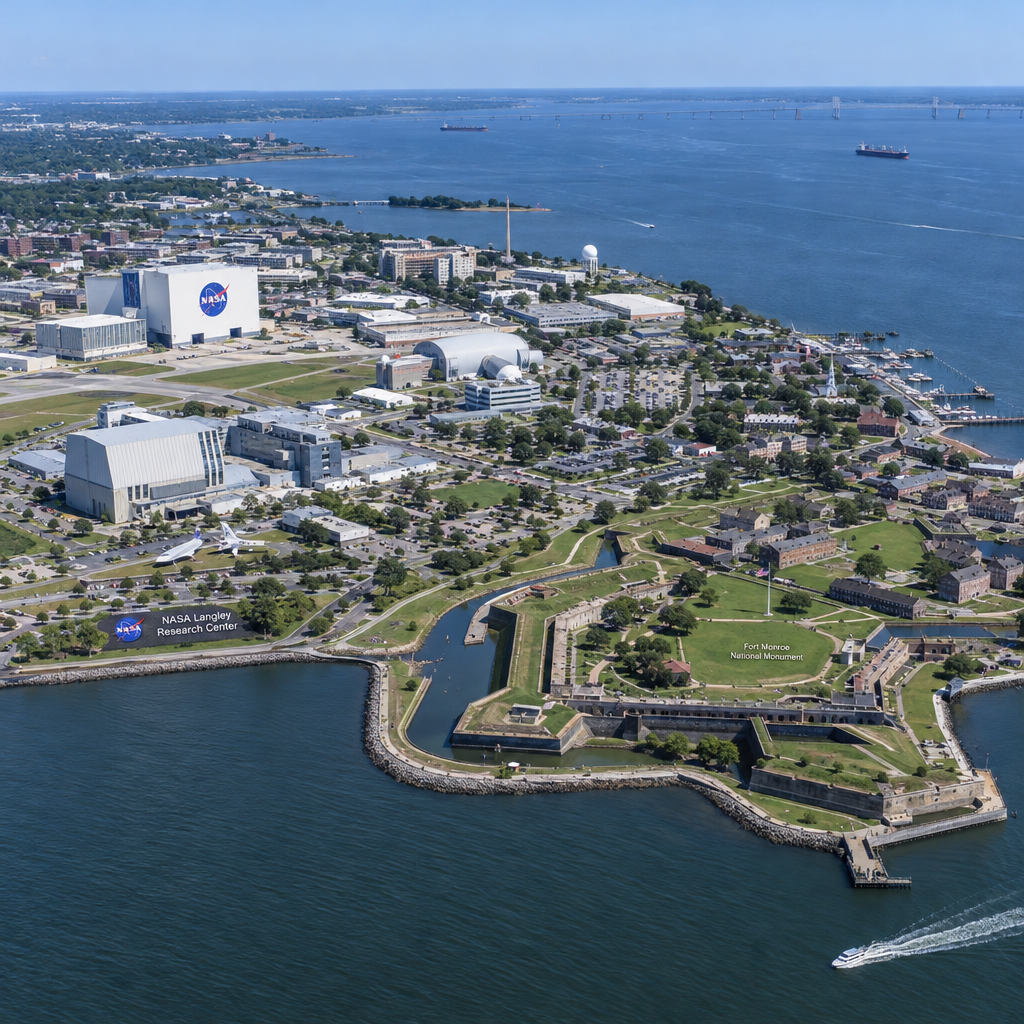
The proposal centers on existing facilities in Hampton and would draw on current academic, residential, laboratory, and student support capacity. Virginia envisions enrolling approximately 300 cadets in 2028, with students gaining access to NASA Langley and housing at Fort Monroe, the former home of the Army’s Training and Doctrine Command.
Virginia is proposing a campus of more than 600 acres spanning NASA Langley and Fort Monroe, with a satellite campus at the Virginia Spaceport Authority’s Mid-Atlantic Regional Spaceport, known as MARS, located at NASA’s Wallops Flight Facility. Under the plan, NASA Langley would provide the academy’s research, engineering, flight, innovation, and technical core. Fort Monroe would support residential life, instruction, leadership development, ceremonies, administration, and public engagement.
MARS and Wallops would serve as a satellite learning campus. That site would offer cadets experience in payload integration, space launch and range operations, mission planning, flight safety, uncrewed systems, and post-mission analysis.
The academic foundation would come from a consortium led by Virginia Tech. The group includes the University of Virginia, Hampton University, George Mason University, Old Dominion University, Christopher Newport University, and Virginia Commonwealth University. Together, they would support a unified curriculum covering aerospace engineering, data science, cybersecurity, power systems, and aviation.
The proposal ties the academy to Virginia’s existing federal and spaceflight infrastructure, positioning Langley as the technical hub and Wallops as the operational training ground for cadets.
NASA will decide whether to locate the United States Space Academy in Hampton. Virginia’s proposal targets an initial class of roughly 300 cadets in 2028.