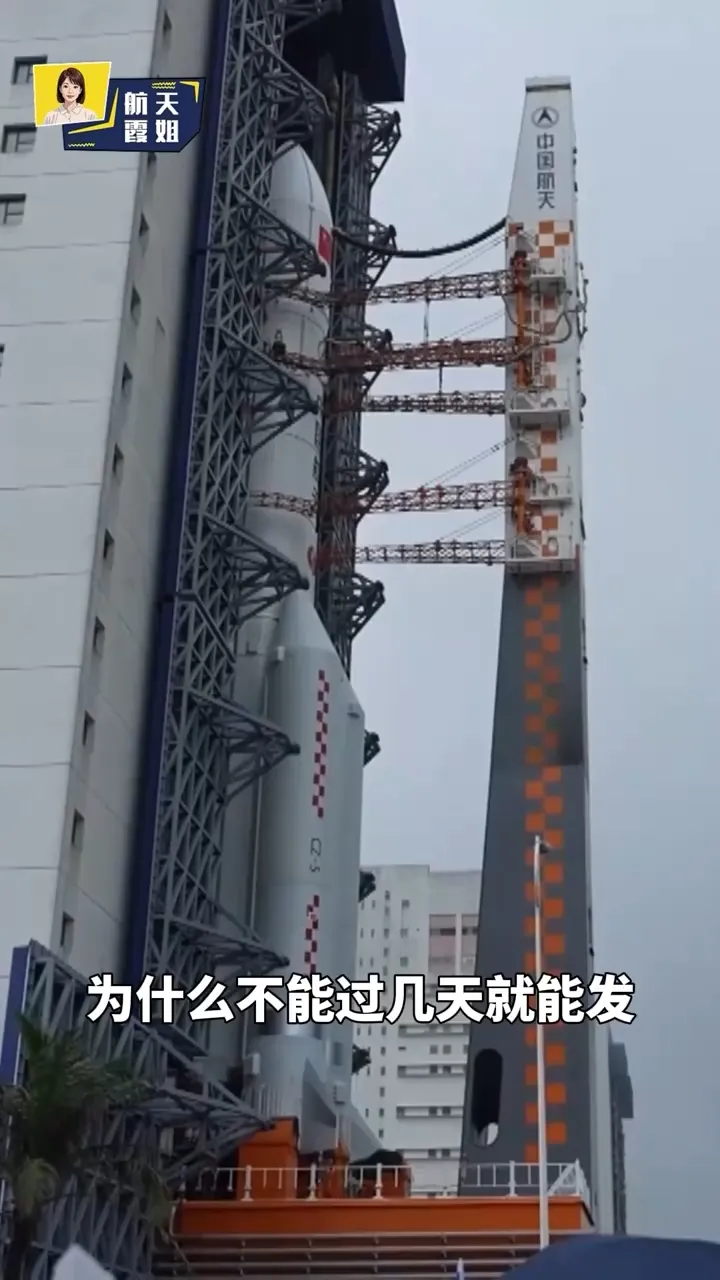
According to official information, the Chang’e-7 mission does not currently meet launch conditions and cannot be carried out within its scheduled launch window this year. Many people have asked: What exactly is a launch window, and why can’t the mission simply be delayed by a few days?
In simple terms, a launch window is the period of time during which a rocket is permitted to launch. Whether a spacecraft can launch, and exactly when it can do so, depends on a range of factors including orbital dynamics, the positions of celestial bodies, tracking and control requirements, and weather conditions. For typical Earth-orbiting satellite missions, launch windows are relatively flexible, and missing a planned date often means waiting only a few days for another opportunity. For deep-space missions, however, launch windows are far more restrictive.
That is particularly true for the Chang’e-7 mission.
Chang’e-7 is headed to the Moon’s south pole, where it will search for evidence of water ice. The region is of special interest because the Moon’s rotational axis has a very small tilt. Near the south pole, the Sun remains close to the horizon, allowing certain elevated areas to receive sunlight for most of the year, with illumination rates exceeding 80%. These locations are often referred to as “peaks of near-eternal light.” At the same time, the floors of nearby impact craters remain in permanent shadow, where temperatures can fall to around -230°C, creating conditions in which water ice may have accumulated.
Because Chang’e-7 relies primarily on solar power, mission planners must precisely time its arrival so that the spacecraft can land before a favorable period of continuous sunlight begins in the lunar south polar region. Preliminary estimates suggest that truly optimal illumination conditions suitable for stable scientific operations exist for only about 100 days each year. This opportunity does not occur every month, and it cannot simply be recovered by launching a few days later.
If the mission misses the optimal launch opportunity this year, the amount of sunlight available when the spacecraft reaches the lunar south pole could be significantly reduced. That would affect power generation, navigation, and surface operations, potentially shortening—or even eliminating—the planned exploration period.
This is why officials said the mission “cannot be carried out within its scheduled launch window this year,” rather than saying it would be delayed by only a few days.
China’s aerospace sector has long adhered to the principle of “reliability and mission assurance above all else.” Far from being a slogan, it reflects an operational philosophy. What may appear to be a missed opportunity is, in reality, a decision to protect mission safety and preserve the integrity of the mission’s scientific objectives.
This year marks the 70th anniversary of China’s space program. Over the past seven decades, China’s steady progress into deep space has been built on that commitment to reliability and caution. The focus now turns to the next launch opportunity, when Chang’e-7 is expected to begin its journey to the Moon’s south pole.