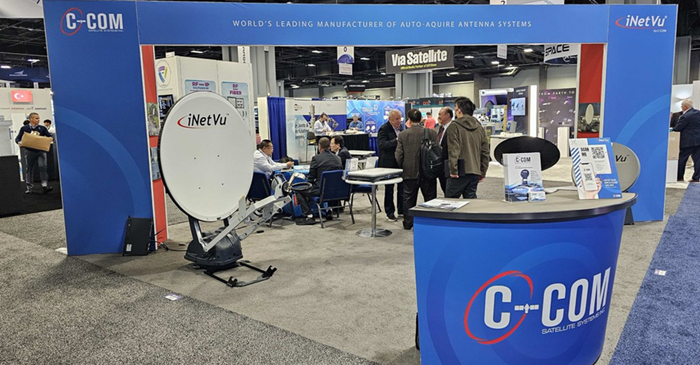
C-Com Satellite Systems Inc., headquartered in Ottawa, Ontario (Canada), develops a broad portfolio of auto-acquire, transportable and electronically steered satellite antennas under the iNetVu product line. Established in 1997, the company provides hardware designed for fast satellite acquisition, multi-network connectivity and reliable operation in field, enterprise, emergency-response and government environments. With thousands of systems deployed in more than 100 countries, C-Com supports broadband satellite access across GEO, MEO and evolving LEO architectures, delivering connectivity for mobile platforms, remote locations and fixed installations.
iNetVu Drive-Away Antennas – Vehicle-Mounted Auto-Acquire SATCOM Systems
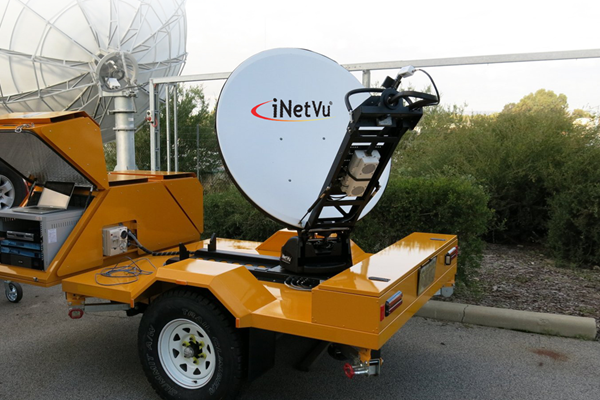
C-Com Satellite Systems’ iNetVu Drive-Away antennas are purpose-built for installation on mobile platforms that require rapid on-demand satellite connectivity. Designed for vehicles including vans, SUVs, broadcast trucks, emergency-response units and mobile command vehicles, it integrates an automated satellite-acquisition mechanism controlled by the iNetVu 7000-series controllers. These controllers perform fully automated azimuth, elevation and polarization alignment, enabling operators to locate and peak on GEO satellites using a one-button interface without manual pointing. The Drive-Away product line spans reflector sizes of 1.0 m, 1.2 m, 1.8 m and 2.4 m, with configurations available for Ku, Ka and C-band operation depending on mission requirements. Each antenna is constructed as a low-profile unit that stows horizontally to minimize wind drag during transit and deploys to operational position within minutes. Mechanical and environmental design elements include reinforced mounting, sealed electronics housings, and structural tolerance for vibration, dust exposure, rain, snow and high-wind deployment scenarios. These antennas are widely used in sectors requiring field-deployable broadband connectivity, including live broadcast uplinks, emergency-management operations, public-safety networks, utility-network restoration teams, mining and energy field operations, and governmental agencies conducting mobile communications. Their automated acquisition workflow and multi-band compatibility make them suitable for teams that must establish a stable satellite link quickly in remote or infrastructure-limited locations.
iNetVu Manpack Antennas – Ultra Portable Airline Checkable SATCOM Terminals
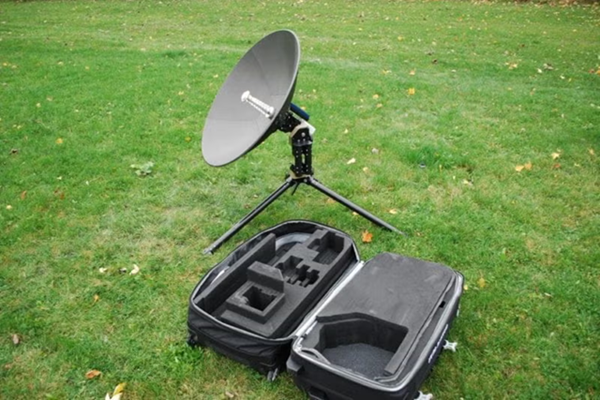
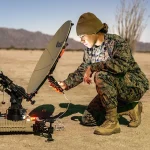
C-Com’s iNetVu Manpack antennas are designed as fully portable SATCOM terminals that can be transported and operated by a single user, making them suitable for missions where mobility and rapid link activation are essential. Available in reflector sizes of 0.98 m and 1.2 m depending on the selected frequency band (Ku-band, Ka-band and X-band), the antennas assemble in minutes without tools using a modular, segment-based structure that supports deployment on uneven or austere terrain. Once assembled, the unit can perform automated satellite acquisition through the iNetVu controller when integrated with compatible modems, reducing setup time and operator workload. The system is built using weather-resistant materials, includes rugged transit cases for airline transport, and provides fine manual peaking controls for environments with limited automation tolerance. Manpack antennas are widely used by humanitarian relief teams, defence and law-enforcement units, scientific expeditions and remote field researchers that require dependable broadband connectivity without access to vehicles or fixed infrastructure.
iNetVu Fly-Away Antennas – Airline-Transportable Field-Deployed SATCOM Systems
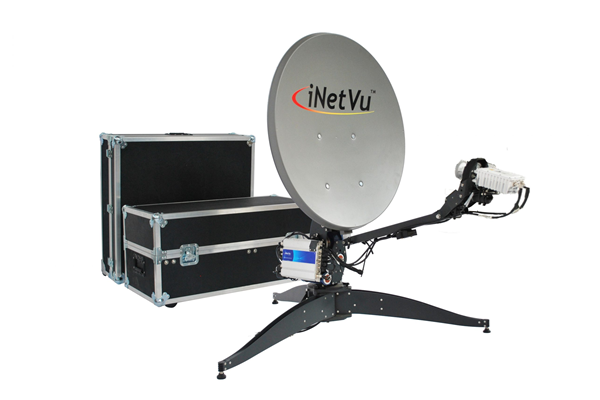
C-Com’s iNetVu Fly-Away antennas are designed for teams that require a transportable, high-gain satellite terminal that can be packed into compact, rugged transit cases and deployed rapidly in the field. Available in reflector sizes including 1.0 m, 1.2 m, 1.8 m and 2.4 m, the Fly-Away series supports Ku, Ka and C-band configurations depending on the operational requirement. The antennas are manufactured using lightweight materials such as carbon-fiber reflectors and modular aluminum frames to ensure manageable transport weight while maintaining structural stability during operation. All models are designed for tool-less or minimal-tool assembly, enabling field personnel to set up the antenna within minutes. The integrated iNetVu auto-acquire controller automates satellite search, pointing, and polarization alignment, reducing the dependence on trained SATCOM technicians. These characteristics make Fly-Away antennas suitable for broadcast uplinks, military detachments, emergency communications units, oil-and-gas installations, remote field teams and scientific expeditions requiring a deployable terminal that balances portability with higher link performance than handheld or manpack systems.
iNetVu Fixed Motorized Antennas – Automated Satellite Tracking for Permanent Installations
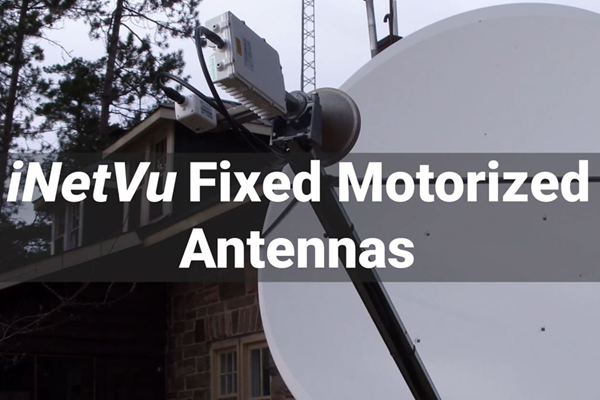
C-Com’s iNetVu Fixed Motorized Antenna (FMA) systems are designed for long-term, stationary SATCOM installations requiring automated pointing, remote operation, and high-availability connectivity. Unlike transportable or vehicle-mounted configurations, FMA units are configured for continuous service at fixed infrastructures such as enterprise gateways, government communication sites, network operations centers, maritime terminals, mining facilities and regional teleports. The product family spans reflector diameters from 1.2 m up to 6.2 m, supporting a range of RF bands including Ku-band, Ka-band, X-band and C-band depending on configuration. Each antenna is paired with an iNetVu motor control system that drives azimuth, elevation and polarization (A/E/P) axes, allowing operators to repoint or adjust the antenna remotely without on-site intervention. This is particularly important for networks that require periodic satellite switching, redundancy testing or link optimization. Mechanical designs are built to operate in outdoor environments with specifications that include structural stability for high-wind regions, corrosion-resistant materials, and heavy-duty pedestal mounts capable of maintaining alignment over long durations. The antennas are equipped with integrated position sensors and feedback loops, enabling precise motorized adjustments for peaking, tracking or scheduled repointing tasks. By combining large-aperture reflectors with automated motorized controls, the iNetVu Fixed Motorized series provides facilities with a reliable SATCOM platform that reduces the need for manual antenna servicing while supporting broadband-class GEO connectivity and operational resiliency for permanent ground installations.
iNetVu ESA Antennas – Electronically Steered Flat-Panel SATCOM Terminals

C-Com’s iNetVu Electronically Steered Antenna (ESA) family represents the company’s transition toward solid-state, multi-orbit SATCOM hardware designed for high-mobility and fixed-site applications. The ESA terminals use a fully electronic beam-steering architecture based on phased-array elements, allowing the antenna to acquire and track satellites without motors, gears, or moving reflectors. This design yields a low-profile, lightweight terminal suitable for roof-mounted vehicular platforms, maritime structures, ground stations and fixed infrastructure operating in constrained environments. The ESA series supports Ku-band and Ka-band operation and is engineered for compatibility with both GEO networks and emerging non-geostationary constellations. The electronically steered beam enables rapid satellite acquisition and seamless tracking, a requirement for LEO and MEO constellations where satellites traverse the sky quickly. The antenna’s digital beam-forming network supports configurable polarization modes, enabling integration with a wide variety of modem architectures and service-provider standards. The ESA enclosure incorporates weather-resistant materials intended for long-term outdoor deployment, including protection against dust, moisture, and thermal cycling. Its flat form factor enables simple installation on vehicles, shelters and maritime platforms without structural reinforcement. The embedded electronics reduce the need for external RF chains, minimizing cabling complexity and supporting quick field replacement or maintenance. It is designed for users seeking a compact, multi-orbit-capable antenna that maintains broadband connectivity across dynamic environments while meeting the operational requirements of defense mobility, emergency response, enterprise networks and future hybrid satellite architectures.
Product Ecology & Deployment Framework
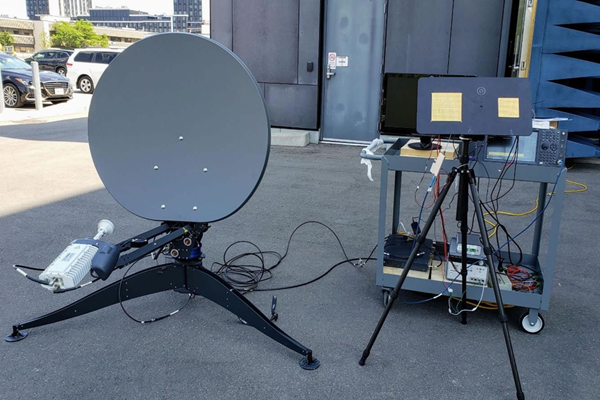
Mobile Platforms (Drive-Away, Manpack): These terminals are optimized for users who require rapid connectivity from moving or temporarily halted platforms, such as government field units, emergency-response vehicles, mobile news crews and tactical teams. Drive-Away antennas mount permanently on vehicles and automatically acquire satellites through the iNetVu controller. Manpack systems extend mobility further by providing fully portable, backpack-carried terminals that assemble in minutes without tools. Both product lines are designed for fast activation, rugged field deployment and reliable operation under varying environmental stresses.
Transportable Field Systems (Fly-Away): Fly-Away antennas support missions requiring higher gain than manpacks while maintaining portability for air, land, or sea transport. These systems pack into rugged cases, assemble without special tools and enable broadband satellite connectivity for temporary command posts, remote industrial operations, scientific field missions and defense detachments. Their modular reflector designs and lightweight carbon-fiber components reduce logistical burden while maintaining high RF performance.
Fixed Infrastructure (Motorized Antennas, ESA): For long-term installations, C-Com provides motorized antennas capable of automated tracking, satellite switching and remote re-pointing. These systems support enterprise gateways, teleports, government facilities and maritime infrastructure requiring continuous, high-availability links. Complementing these are C-Com’s electronically steered antennas (ESA), which offer a low-profile, solid-state alternative for GEO and emerging LEO networks where multi-orbit connectivity is required without mechanical steering.
Across all deployment modes, the iNetVu controller serves as the unified operational interface, standardizing auto-acquisition, polarization optimization, tracking routines, and modem integration. This common control architecture ensures consistent behavior and simplified training regardless of antenna type, reducing complexity for operators managing heterogeneous SATCOM deployments.
C-Com Satellite Systems delivers a comprehensive SATCOM antenna portfolio designed to support mobile, transportable and fixed communications across GEO, MEO and emerging LEO constellations. From rugged vehicle-mounted Drive-Away systems to lightweight Manpacks, larger Fly-Away terminals, motorized fixed antennas and electronically steered ESAs, C-Com’s iNetVu solutions provide reliable, auto-acquire connectivity for defense, emergency response, government agencies, enterprise customers and remote industrial operations. The company’s multi-band flexibility and global deployment record position the systems as a practical communications solution for modern satellite networks.
About C-COM Satellite Systems
C-COM Satellite Systems Inc., headquartered at 2574 Sheffield Road, Ottawa, Ontario (Canada), is a global provider of commercial-grade mobile satellite antenna systems and integrated SATCOM solutions. Established in 1997, the company designs, develops and manufactures a wide array of auto-pointing and motorized antennas under the iNetVu brand including driveaway, flyaway, manpack, fixed-motorized and electronically steerable array (ESA) terminals. With more than 11,000 units deployed across over 100 countries, C-COM’s systems are trusted by governments, militaries, broadcasters, commercial enterprises and humanitarian organisations for reliable satellite connectivity in remote, mobile or infrastructure-limited environments. The company supports multiple satellite frequency bands and delivers solutions that cover the full spectrum of user needs from portable field terminals to fixed infrastructure ground-stations. As satellite communications evolve into hybrid multi-orbit architectures, C-COM continues to develop next-generation electronically steering and auto-deploy antenna platforms, ensuring the readiness to support emerging demands for global broadband, mobility, emergency response and remote-site connectivity.