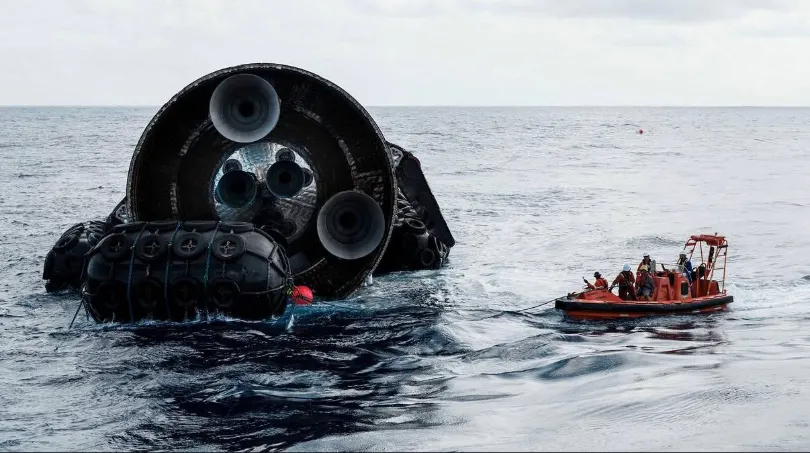
SpaceX’s attempt to recover the Starship upper stage from its 13th test flight is “not looking good”, Elon Musk tweeted on August 7th, roughly two weeks after the vehicle splashed down in the Indian Ocean. Flight 13 lifted off from the company’s Starbase site in South Texas on July 24th. The suborbital mission ended with the Super Heavy booster coming down in the Gulf of Mexico and the Ship landing in the Indian Ocean off the coast of Western Australia. In an unexpected first, Starship survived the homecoming, staying in one piece after its soft ocean landing despite toppling over and hitting the waves. It remained intact, prompting SpaceX to tow it toward shore for a closer look.
That ambition now appears out of reach. “Unfortunately, ship recovery is not looking good right now. Nonetheless, we were able to obtain close-up photos of critical regions of the heat shield and engines for future upgrades,” Musk wrote via X. He was responding to a SpaceX post an hour earlier that shared two photos and a video of the recovery activities.
The recovery team has “been overcoming challenging conditions and increasingly rough seas as they attempt to guide the 52 meter long spacecraft to port,” SpaceX said. The tow effort lasted at least two weeks before Musk signaled it would fail.

Starship stands about 408 feet tall when stacked and is the biggest and most powerful rocket ever built. Both stages, Ship and the Super Heavy booster, are designed to be fully and rapidly reusable. A key enabler of that reuse is Ship’s heat shield, which protects the vehicle during its trips through Earth’s atmosphere. Musk has described heat shield development as perhaps the biggest challenge on Starship’s road to operational flight. “I don’t want to jinx it or anything, but I think I’d consider the heat shield problem solved at this point,” he said on August 4th during SpaceX’s first-ever quarterly earnings call.
Flight 13 also delivered a milestone beyond Ship’s transition to seagoing vessel. During its time in space, the upper stage deployed 20 functional Starlink V3 satellites, the bigger, next-generation variant of SpaceX’s broadband spacecraft. SpaceX wants to operate a constellation of roughly 100,000 Starlink V3s, in addition to its orbital AI satellites, and both networks are intended to be lofted by Starship.
The likely loss reframes what looked like a triumph. Full reusability is the whole economic argument for Starship, and right now SpaceX still cannot bring both halves of the vehicle back intact. The flight was impressive, but the recovery, which is the actual goal, failed. Full reusability of Starship remains unachieved.
SpaceX continues working to guide the upper stage to port despite the rough seas, and Musk indicated the close-up photos of the heat shield and engines will inform future upgrades.