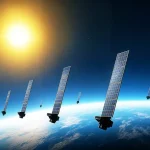
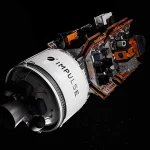
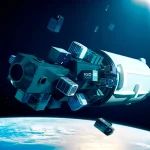
When Musk’s “Starlink 2.0” is no longer just a communication network, but begins to evolve into a space AI brain suspended in low-Earth orbit with perception and decision-making capabilities, a new competition has quietly begun. If every satellite in space is not just a “messaging station”, but an “intelligent node” that can see, calculate, and judge, then the commanding heights of future competition will not be on land, in the ocean, or even in the atmosphere – but in every inch of orbit that computing power can reach.
On November 4, 2025, Musk stated that he would expand the scale of Starlink V3 satellites and build a space data center, aiming to complete the annual data center deployment of 100GW through Starship within 4-5 years. Musk called space data centers “the fastest way to expand computing power in the next four years” and believed that this was the only way to solve the “power shortage” and “heat dissipation difficulties” of AI computing power on earth. At the same time, foreign giants such as Google, Amazon, and NVIDIA have also followed suit. On October 4, 2025, Bezos proposed building a gigawatt data center in space within the next 10 to 20 years. At present, Blue Origin has submitted an application to the U.S. Federal Communications Commission and plans to launch the “Sunrise Project” of more than 51,600 satellites with the goal of building an AI data center system in space. On November 5, 2025, Google announced the launch of Project Suncatcher, planning to launch two prototype satellites equipped with Trillium-generation TPU in early 2027 to directly deploy AI computing power into space. In March 2026, at the GTC conference, NVIDIA launched the Vera Rubin space module designed for orbital data centers that directly run LLM and advanced basic models in space. Its AI computing power in orbital inference workloads is 25 times that of H100. In addition, NVIDIA also strategically invested in StarCloud in 2024, a company dedicated to laying out orbital data centers to achieve innovation in computing power deployment, and plans to build a 5-gigawatt orbital data center within 5 years.
As Musk regards space data centers as the next growth engine of “Starlink”, and other overseas giants have followed suit, this “star effect” and urgent international competition have allowed domestic capital to see huge imagination space and benchmarking opportunities. As a result, many domestic capitals are “grabbing” for space computing power in 2026, and the current valuations of some companies are very high.
While looking at the development of the industry optimistically, there are also some issues that we have to think about. The first is the relationship between transportation capacity and computing power. Without a rocket with sufficient transportation capacity and low cost, it will be difficult for space computing power to move from concept to engineering. A high-power GPU may not have much mass itself, but the quality of its support system will explode, requiring anti-radiation reinforcement, a large heat dissipation system (space can only dissipate heat by radiation, and every 100W requires a huge heat dissipation area), a high-power power supply system, and high-strength structure, etc., without large transport capacity, it is likely to cause the dilemma of “cannot get up”. Even if it is barely able to get up, convection heat cannot be dissipated in the vacuum environment of space, and it can only rely on radiation. Every inch of the satellite is precious. After the heat accumulates, the chip will quickly overheat, followed by frequency reduction or crash. Therefore, within the foreseeable 3-5 years, my country’s rocket transportation capacity will be a rigid constraint on the development of the space computing power industry. The transportation capacity here not only refers to the development of high-thrust rockets, but also requires the rocket’s freight to be low enough. If the transportation cost is too high, the underlying logic of the development of space computing power will still not be established. The second is short-term application scenarios. Communication and delay have limited the types of tasks that space computing power is suitable for. Therefore, in the short term, it is difficult for the space computing power center to train a large model for OpenAI and Anthropic. It is more suitable for those close to the mission site. Computing, such as on-orbit data processing, space target recognition, orbit image analysis, etc., is the so-called “calculation of days and days”. As for the other direction everyone mentioned, “calculation of days and days”, although it is cutting-edge, it faces huge challenges in the short term, not only at the technical level, but also at the data security level. The third is the issue of commercial risks. Space computing power is an industry with high technical barriers. The initial cost of a single computing power satellite from design, tape-out, manufacturing to launch is very high. However, as a new business format, in the early stages of development, customers’ awareness and willingness to pay are generally not too strong. The revenue curve is definitely slower than the rate of burning money through financing. This requires high financing capabilities of the company. In the early stage, everyone can rely on “Constellation scale + computing power peak” tells the story, but once the liquidity of the capital market tightens, investors will most likely turn to demanding hard indicators such as “number of signed paying customers” and “single star payback cycle”. At this time, the stick of “bet” will definitely continue to come, and when funds are tight, not only investors will withdraw money, but chip suppliers are also likely to require cash and spot, further squeezing the cash flow space of enterprises. Fourth, this track still needs more subversive-minded innovators to participate. At present, the technical paths of mainstream players in this market are basically the same. For our country, the physical dilemma of rocket transportation capacity already exists. It is basically unrealistic to increase the rocket transportation capacity and reduce the cost in the short term. If we compete according to the existing technical path, we will only remain passive, and aerospace and aerospace and The knowledge gap between AI still exists. It is definitely not possible to use the traditional aerospace industry method to develop space computing power. Based on the needs of my country’s industrial development and the reality of transportation capacity, it is necessary to follow an asymmetric path of “technological lane change and overtaking” and “commercial gene reshaping” in parallel. Only then is it possible to achieve an overall breakthrough in the industry, and entrepreneurs with more subversive awareness are the core factors.