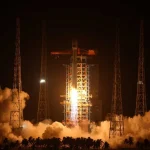
At 19:06 on the evening of October 15, 2024, the second batch of network satellites of the Qianfan Constellation successfully lifted off aboard the Long March 6A carrier rocket at the Taiyuan Satellite Launch Center in my country, and then successfully entered the predetermined orbit. The launch mission was a complete success. The successful launch of the second batch of Qianfan constellation networking satellites marks that the Qianfan constellation project has entered the stage of normalization and large-scale deployment. my country’s satellite Internet constellation network with a scale of more than 10,000 has officially kicked off the normalization construction.
The main implementation entity of Qianfan Constellation is Shanghai Yuanxin Satellite Technology Co., Ltd. Yuanxin Satellite was established in March 2018, led by Shanghai Lianhe Investment Co., Ltd. In August 2023, Yuanxin Satellite submitted an application for 1,296 low-Earth orbit slots to the International Telecommunications Union (ITU), planning to build and operate a commercial global low-orbit broadband satellite constellation composed of 15,000 satellites to provide global users with large-bandwidth, low-latency, high-quality, high-security, global coverage low-orbit satellite Internet services and industry solutions.
The deployment plan of the Thousand Sails Constellation is mainly divided into three stages. The first phase: from 2023 to the end of 2025, complete the launch mission of 648 GEN1 satellites to achieve regional network coverage; the second phase: from 2026 to the end of 2027, complete the launch mission of 648 GEN2 satellites to achieve global network coverage; from 2028 to the end of 2030, complete the launch mission of a total of 15,000 satellites, providing direct mobile phone connection multi-service integration services. Currently, the first phase of the deployment plan is being implemented. Prior to this, Yuanxin satellite had successfully completed three launch missions. On November 17, 2019, the first two test satellites of Yuanxin Satellite (Alfa A/B) were successfully launched from the Jiuquan Satellite Launch Center and successfully entered the predetermined orbit. On August 5, 2021, the second batch of two test satellites of Yuanxin Satellite (Beta A/B satellites) were successfully launched at the Taiyuan Satellite Launch Center, and the link indicators, laser communication, electric propulsion and other contents were verified in orbit. At 14:42 on August 6, 2024, the first batch of 18 Yuanxin satellites were successfully launched aboard the Long March 6A carrier rocket at the Taiyuan Satellite Launch Center and successfully entered the predetermined orbit.
Different from the first batch of networked satellites, the 18 satellites launched into orbit this time are all from Shanghai Gesi Aerospace Technology Co., Ltd. Gerth Aerospace is the ODM manufacturer of Yuanxin satellites, mainly undertaking the design, manufacturing and core component development of mass-produced satellites. Yuanxin Satellite holds 31.5997% equity of Gesi Aerospace. On the morning of December 27, 2023, the Gerth Aerospace Satellite Digital Factory was put into production. After the factory is put into operation, it can produce one satellite in about 1.5 days, and it is expected to produce 300 satellites throughout the year. This launch is also the first launch of Gerth Aerospace, which is a milestone in the development of Gerth Aerospace. Since then, in addition to Shanghai Weiwei, the whole satellite supplier of Yuanxin Satellite, Gerth Aerospace has also joined them.
Qianfan Constellation plans to complete the deployment of the first phase of 648 satellites by the end of 2025 and initially build a satellite Internet system that can achieve regional coverage. According to the launch efficiency of one arrow and eighteen stars, 36 launches are needed to build a complete first-generation system. With this successful launch, the Qianfan constellation will also enter a normalized and intensive networking stage, and the networking efficiency and launch frequency will become higher and higher. After the satellite is networked, assuming that satellites are replenished according to the five-year life of the satellite, the annual maintenance cost is about 20% of the satellite network cost. Once the network is started, if the network efficiency cannot be improved, the network cost will only increase. With the gradual construction and improvement of the Thousand Sails constellation, my country’s status in the global satellite Internet field will also be further improved. After experiencing Thousand Sails, chasing dreams of stars, China Aerospace Come on!