On July 10, 2026, the Long March 10B achieved a historic breakthrough by completing China’s first recovery of a rocket first stage, making China the second country in the world—after the United States—to recover a reusable rocket.
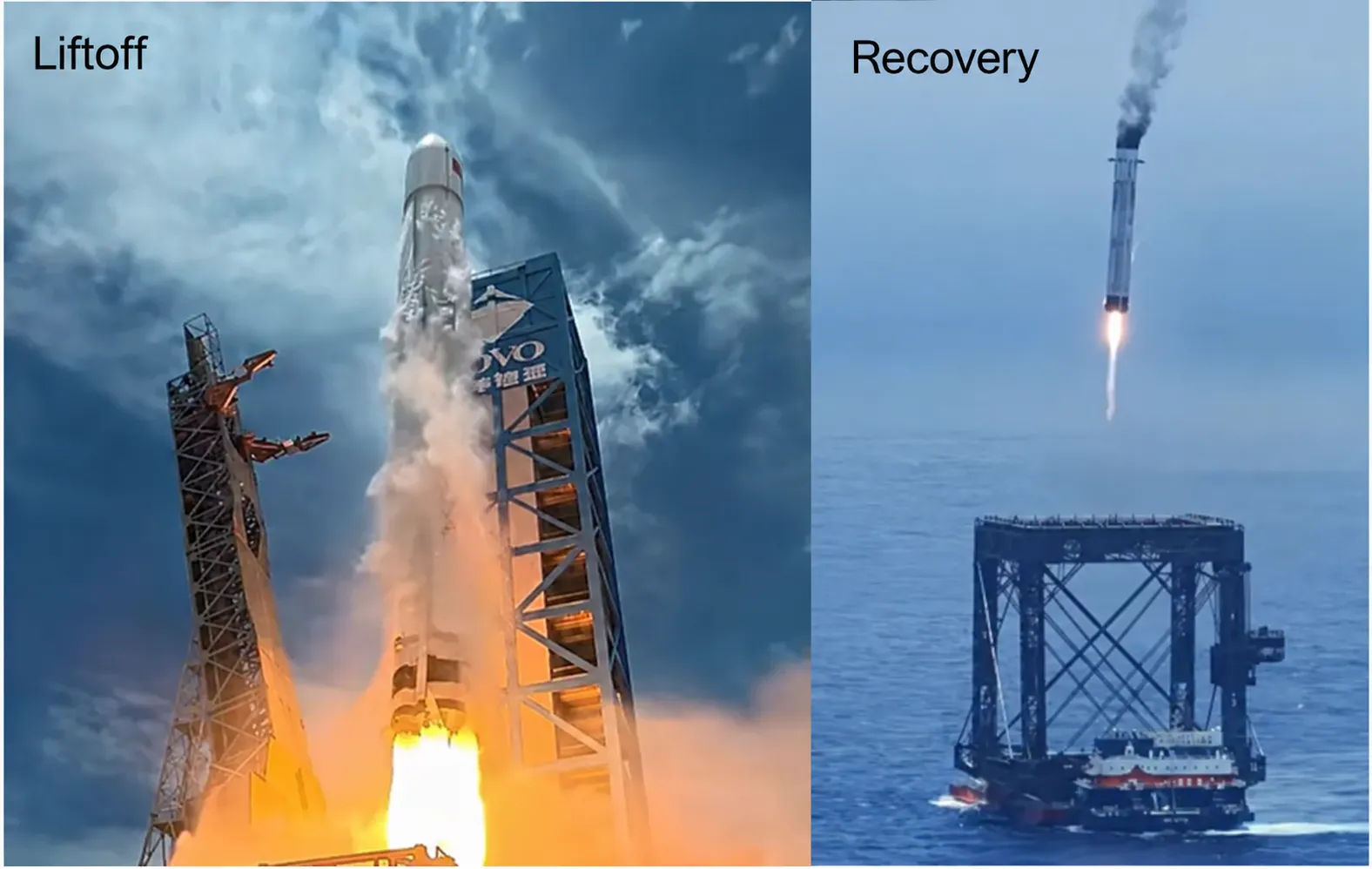
According to China Central Television, the Long March 10B carrier rocket, developed by the China Academy of Launch Vehicle Technology, lifted off from the Wenchang Commercial Space Launch Site in Hainan at 12:15 p.m. on July 10. It successfully delivered a satellite into its designated orbit. Approximately six minutes after stage separation, the first stage returned vertically and was successfully captured by a net system aboard the Linghang Zhe (领航者) offshore recovery platform.

The Linghang Zhe vessel with the recovered Long March 10B first stage, July 10, 2026. Credit: CASC
The mission marked China’s first successful controlled recovery of a carrier rocket’s first stage and the world’s first rocket recovery using a net-based capture system, representing a historic breakthrough in reusable launch vehicle technology.
This article provides a comprehensive analysis of the Long March 10B from five perspectives:
- The complete launch and recovery process and its strategic significance;
- The rocket’s overall configuration and basic specifications;
- An overview of the Linghang Zhe offshore recovery platform;
- The industrial chains and related companies; and
- Conclusions and outlook.

1. The Long March 10B Launch and Recovery Process and Its Strategic Significance
1.1 Complete Launch and Recovery Process
The maiden flight of the Long March 10B followed two parallel mission tracks: placing the payload into orbit and recovering the first stage. The mission consisted of an ascent phase and a return-and-recovery phase.
One part continued toward the stars, carrying the satellite into orbit, while the other returned to the ocean to be captured by the recovery net. Together, they completed a closed loop from liftoff to return.
1.1.1 Ignition, Liftoff and Stage Separation
The rocket lifted off from the Wenchang Commercial Space Launch Site in Hainan. Seven YF-100-series liquid-oxygen/kerosene engines ignited simultaneously, producing approximately 890 tonnes of thrust and propelling the rocket away from the launch pad.
Several seconds after rising vertically, the rocket initiated its programmed pitch maneuver, gradually tilting toward its designated flight direction and accelerating through the atmosphere.
During ascent, the rocket had to pass through two of the most mechanically demanding flight regimes: the transonic region, between approximately Mach 0.8 and Mach 1.2, where aerodynamic resistance rises sharply and the vehicle experiences intense vibration; and Max-Q, the point at which aerodynamic pressure reaches its peak and imposes the most severe structural constraints.
Approximately 160 seconds into the flight, as the first-stage propellant approached depletion, the separation system was activated. The first and second stages separated, and the second stage continued upward with the payload, ultimately delivering the satellite into its designated orbit.
1.1.2 Coasting and Attitude Reorientation
After separation, all first-stage engines were shut down and the stage entered an unpowered ballistic coast, continuing along its trajectory by inertia. At this point, the vehicle was still oriented nose-first in the direction of ascent. It therefore had to rotate by 180 degrees so that the engine section faced forward in preparation for atmospheric re-entry and retropropulsive deceleration.
To perform the maneuver, the stage activated its cold-gas reaction control system. Small thrusters using high-pressure nitrogen or helium generated rotational torque at different points on the vehicle.
Although the reaction control system produces only tens of newtons of thrust, this is sufficient to rotate a vehicle weighing several dozen tonnes in a vacuum or the rarefied upper atmosphere. The 180-degree maneuver normally takes between several seconds and slightly more than ten seconds.
Approximately 253 seconds after liftoff, the grid fins deployed and locked into position. These fins supplied aerodynamic control during the subsequent descent. Functioning like the rocket’s steering system, they adjusted their angles during atmospheric re-entry to correct the vehicle’s flight path.

1.1.3 Aerodynamic Deceleration
During the return, the first-stage engines restarted to initiate deceleration. The grid fins on the sides of the vehicle deployed and adjusted its aerodynamic attitude, continuously modifying the angle of attack and correcting the trajectory to guide the stage toward the designated offshore recovery zone.
Aerodynamic drag gradually reduced the vehicle’s velocity from several kilometres per second to several hundred metres per second. This portion of the deceleration process consumed no propellant—the atmosphere itself provided the braking force.
1.1.4 Terminal Deceleration
Aerodynamic deceleration alone could reduce the stage’s velocity only to several hundred metres per second, which was still far too fast for a safe recovery. The engines therefore ignited again, expelling high-temperature exhaust in the direction opposite to the vehicle’s motion.
This retropropulsive burn actively reduced the stage’s velocity from several hundred metres per second to nearly zero, enabling precise hovering and a controlled vertical descent.
Terminal deceleration generally involves two burns:
- Entry burn: Three engines ignite simultaneously to produce a substantial reduction in velocity.
- Landing burn: One engine provides precise thrust control for the final slow descent and hover.
Together, these two burns transform the vehicle’s motion from a high-speed dive into a slow, controlled descent.
1.1.5 Net Capture, Locking and Stabilization
As the rocket descended to an extremely low altitude, the capture mechanisms on the vehicle deployed in advance and accurately engaged the four specially arranged ropes on the Linghang Zhe platform.
At 12:23 p.m. on July 10, 2026, the rocket’s first stage was successfully captured by the flexible net system.
Once the ropes came under load, they absorbed energy and slowed the vehicle. Auxiliary ropes then pulled the rocket into an upright position. An automated clamping mechanism at the bottom of the platform moved into place, locked onto the stage and provided structural support, completing the recovery.
| Stage | Timing | Key action |
|---|---|---|
| 1. Ignition and liftoff | T+0 | Ignition at Launch Position No. 2. Seven liquid-oxygen/kerosene engines operate simultaneously, producing approximately 890 tonnes of liftoff thrust. |
| 2. Ascent | T+0 to several minutes | The rocket passes through the transonic and Max-Q regions while enduring complex mechanical and thermal conditions. |
| 3. Stage separation | Approximately 160 seconds after liftoff | The first and second stages separate. The second stage continues toward orbit with the payload. |
| 4. Attitude reorientation | After separation | The first stage rotates by 180 degrees so that its engine section faces forward in the return direction. |
| 5. Atmospheric re-entry | After separation | The first stage re-enters the denser atmosphere and withstands high-temperature airflow and aerodynamic loads. |
| 6. Aerodynamic deceleration | During re-entry | Atmospheric drag reduces the vehicle’s speed from several kilometres per second to several hundred metres per second. The grid fins continuously correct the trajectory toward the recovery zone. |
| 7. Terminal deceleration | During final approach | The engines restart for the entry and landing burns, reducing vertical velocity to nearly zero and enabling a controlled vertical descent. |
| 8. Net capture | Final phase | The rocket’s capture hooks engage the flexible cross-shaped net on the Linghang Zhe, whose cables progressively absorb the load. |
| 9. Locking and securing | After capture | An automated locking platform positions itself beneath the vehicle, clamps and supports the first stage, and forms a rigid connection with the deck. |
1.2 Strategic Significance
1.2.1 Breaking the US Technology Monopoly and Becoming the World’s Second
The Long March 10B has made China the second country in the world to master the complete set of technologies required for a reusable, high-capacity rocket. For more than a decade, vertical rocket recovery had been almost synonymous with SpaceX.
1.2.2 The World’s First Net-Based Recovery and an Independent Technical Path
Unlike SpaceX’s landing-leg approach, China has developed an independently designed offshore net-recovery system. It eliminates landing legs and instead combines hooks mounted on the rocket with a flexible capture net aboard an offshore recovery vessel.
This represents a previously untried technical path.
1.2.3 Recovery on the Maiden Flight and China’s Entry into the Reusable-Rocket Era
SpaceX’s Falcon 9 required more than ten launches before achieving its first successful recovery. The Long March 10B, by contrast, was successfully recovered on its maiden flight, demonstrating an engineering validation efficiency that exceeded outside expectations.
After repeated reuse, the cost of each launch could reportedly be reduced by 70% to 80%, opening the way for large-scale, lower-cost access to space.
1.2.4 Lower-Cost Launch Capacity for Large Constellations and Deep-Space Exploration
Reusable rocket technology could provide a more economical launch solution for large satellite constellations such as Spacesail and Guowang, routine deep-space exploration and China’s planned crewed lunar programme before 2030. It could substantially improve China’s capacity to access and operate in space.
Overall, although China has achieved the world’s first offshore net-based rocket recovery, the accomplishment should be assessed objectively. At this stage, China’s offshore net-recovery capability still represents technological catch-up rather than comprehensive superiority.
1.3 Comparison of Chinese and US Reusable-Rocket Technologies
China and the United States have adopted two distinctly different approaches to reusable rocket technology.
United States—SpaceX: Falcon 9 primarily uses landing legs for vertical powered landings. The technology is mature and supported by extensive reuse experience, with an individual booster reportedly flying as many as 36 missions and the fleet recording more than 600 recoveries. Falcon 9 can land either onshore or offshore. However, its landing legs add approximately two tonnes of dead weight, reduce payload capacity and require extremely high landing accuracy.
China: The Long March 10B uses an innovative offshore flexible-net capture system. By eliminating landing legs and combining rocket-mounted hooks with a large net aboard an offshore platform, it expands the permissible landing-error range to tens of metres. This substantially reduces weight, improves efficiency and offers greater adaptability to sea conditions. It also minimizes impact loads on the rocket and may increase its reuse potential.
The United States retains advantages in mature commercial operations and high-frequency reuse. China, meanwhile, has achieved a breakthrough from zero to one through a differentiated solution that may be better suited to offshore recovery and heavy-lift rockets. The two approaches are developing into a competitive but technologically complementary landscape.
In summary, China’s approach may offer advantages in payload efficiency, landing tolerance and potential service life. However, China remains in the catch-up stage in terms of scale, maturity, verified reuse cycles, high-cadence launch experience and commercialization.
| Comparison | China | United States, represented by SpaceX |
|---|---|---|
| Technical approach | Net recovery with Long March 10B; landing-leg recovery with Long March 12 and Zhuque-3 | Landing legs with Falcon 9; tower-arm capture with Starship |
| LEO capacity in reusable configuration | 16 tonnes for Long March 10B | Approximately 15.6 tonnes for Falcon 9 |
| Payload-capacity penalty | Approximately 15%–16% for net recovery | Approximately 23% for offshore landing-leg recovery |
| Landing tolerance | Approximately ±50 metres | Centimetre-level accuracy |
| Launch turnaround | Pending validation and dependent on transportation by recovery vessel | Approximately three to seven days |
| Offshore operating conditions | Sea State 6 | Sea State 4 |
| Successful demonstrations | Successful recovery on maiden flight | More than 600 landings |
| Commercialization and industrial chain | At an early stage but developing rapidly | Highly mature |
2. Overall Configuration and Basic Specifications of the Long March 10B
2.1 Overall Configuration and Basic Specifications
The Long March 10B was developed under the overall responsibility of the China Academy of Launch Vehicle Technology and is operated by China Aerospace Science and Technology Corporation’s Commercial Rocket Company. It is a large liquid-propellant launch vehicle with a five-metre-diameter, two-stage tandem configuration.

The image above shows the overall configuration of the Long March 10B, divided into four major sections from left to right:
- Payload fairing: A 5.2-metre-diameter carbon-fibre composite structure that protects the satellite payload and separates into two halves after leaving the atmosphere.
- Second stage: A liquid-oxygen/methane-powered stage equipped with one YF-219 vacuum engine. It performs the final orbital insertion and is not recovered.
- First stage: The core reusable section, with a diameter of five metres. It contains liquid-oxygen/kerosene tanks and carries four grid fins and four sets of recovery hooks.
- Aft section: The engine compartment, integrating seven main engines, servo mechanisms, pipelines and telemetry, tracking and control systems. It bears the full thrust generated at liftoff.
The following specifications are stated to be sourced from official information.
| Parameter | Specification |
|---|---|
| Configuration | Five-metre-diameter, two-stage tandem configuration without strap-on boosters |
| Total length | Approximately 63.6 metres |
| Vehicle diameter | Five metres |
| Payload fairing | Optional short or long 5.2-metre-diameter fairing; the maiden flight used the short version |
| Liftoff mass | Approximately 760 tonnes |
| Liftoff thrust | Approximately 890 tonnes-force |
| Thrust-to-weight ratio | Approximately 1.17 |
| LEO payload capacity | Approximately 20 tonnes in expendable mode and 16 tonnes in reusable mode |
2.2 Propulsion System: A Combination of Kerosene and Methane
The Long March 10B is described as the world’s first operational launch vehicle to combine kerosene and methane propulsion, using a different propellant combination in each stage.
The first stage uses mature and reliable liquid oxygen and kerosene, which provide high thrust and benefit from extensive operational experience. The second stage uses cleaner, easier-to-maintain liquid oxygen and methane, helping lay the foundation for future full reusability. The combination is intended to balance reliability with forward-looking technology.
The core first stage, derived from the first-stage configuration of the Long March 10A, uses seven YF-100-series liquid-oxygen/kerosene engines: three YF-100N engines and four YF-100P engines. Five engines can gimbal, while two are fixed.
These reusable engines can reportedly restart at least twice during a single mission and support rapid thrust adjustment across a range of 65% to 105%.
The newly designed core second stage uses liquid oxygen and methane and is equipped with one YF-219 engine. Methane propulsion offers lower cost, cleaner combustion with no carbon deposits and easier maintenance, making it an important technology for future reusable launch vehicles.
2.3 Recovery Method: Offshore Net Capture
The first stage of the Long March 10B uses a net-based recovery system. Its key feature is the removal of conventional landing legs, potentially eliminating one to two tonnes of landing hardware and minimizing the reduction in payload capacity.
Lightweight hooks are installed on the vehicle. The offshore capture net aboard the Linghang Zhe receives and supports the stage, while a hydraulic system absorbs the impact energy. Because the system provides flexible cushioning rather than a hard landing, it substantially reduces structural and engine fatigue.
Image below: Source: Kongtian Zhumeng

2.4 Long March 10B and Falcon 9 Comparison
| Comparison | Long March 10B | SpaceX Falcon 9 |
|---|---|---|
| Recovery method | Offshore net capture without landing legs | Vertical powered landing using landing legs |
| Configuration | Five-metre-diameter, two-stage tandem vehicle | 3.7-metre-diameter, two-stage tandem vehicle |
| Reusable-mode LEO capacity | At least 16 tonnes | Approximately 15.6 tonnes |
| Payload-capacity penalty | Approximately 15%–16% | Approximately 23% for offshore recovery and 40% for return-to-launch-site recovery |
| Landing-leg mass | None; only capture hooks are installed | Approximately one to two tonnes, equivalent to 5%–10% of first-stage dry mass |
| Required recovery accuracy | Approximately ±50 metres | Centimetre-level accuracy |
| Recovery impact | Flexible recovery with minimal structural impact | Hard landing that produces structural impact and metal fatigue |
| Reuse maintenance | Expected to require refuelling before another flight | Requires extensive inspection and refurbishment |
| Number of reuses | Pending validation following the maiden-flight recovery | Up to 36 flights by a single booster |
| Successful recoveries | One | More than 600 |
| Offshore recovery conditions | Operations reportedly possible in Sea State 6 | Upper limit reportedly Sea State 4 |
| Turnaround | Requires transportation by a dedicated recovery vessel | Approximately three to seven days |
| Recovery location | Offshore recovery along the launch trajectory | Return to the launch site or landing on an offshore droneship |
| Commercial maturity | Early stage | Highly mature |
3. Overview of the Linghang Zhe Offshore Recovery Platform
3.1 What Is This “Offshore Giant”?
A platform capable of receiving such a massive vehicle descending from the sky must possess an exceptionally strong foundation. The Linghang Zhe offshore net-recovery platform used for this mission is a major piece of equipment built in Guangdong.
3.1.1 Basic Specifications
The Linghang Zhe is China’s first offshore platform designed for net-based rocket recovery. It was jointly constructed by CSSC Offshore & Marine Engineering’s Guangzhou Shipyard International and the Institute of Deep-sea Science and Engineering under the Chinese Academy of Sciences. Its conversion took approximately one year, from the end of 2024 to the end of 2025.
The platform is 144 metres long, 50 metres wide and has a draught of 5.5 metres. Its full-load displacement reaches 25,000 tonnes.
Under conditions involving 1.5-metre waves and wind speeds of 12 metres per second, its positioning error is reportedly no more than three metres. It must also pass positioning tests involving waves approaching the vessel at angles of 60 and 90 degrees.
It is described as the world’s first dedicated offshore platform for net-based rocket recovery.
3.1.2 Technical Features
DP2 dynamic positioning system
In offshore conditions affected by strong waves and wind, the DP2 system uses the platform’s own thrusters to maintain its position accurately at the designated coordinates.
Unlike a DP1 system without full redundancy, a DP2 system includes sufficient redundant equipment to maintain position automatically following a single failure, such as the failure of a generator, thruster, controller, sensor or another dynamic component. This makes it suitable for deep-water operations that require high positioning accuracy and reliability under relatively demanding sea conditions.
Net-capture structure and materials
The recovery system consists primarily of an upper net-capture assembly and a lower clamping system.
The net is formed by four specially manufactured, high-strength ropes arranged in a crosshatched configuration. The principle resembles the arresting cables used for carrier-based aircraft, although the system must withstand a more complex combination of vertical and lateral loads.
The rigging consists mainly of arresting ropes, buffer ropes and traction ropes. These three layers form a flexible crosshatched net and operate with a four-stage damping system capable of absorbing the rocket’s enormous kinetic energy within 0.3 seconds.
The ropes are woven from ultra-high-molecular-weight polyethylene fibre. This material is reportedly 15 times stronger than steel while weighing only one-fifteenth as much. Each rope can withstand approximately 200 tonnes of tension—roughly equivalent to lifting 20 heavy trucks.
The material can withstand intense instantaneous impacts and resist corrosion in high-salinity marine environments. Together with the automated locking and support system at the bottom of the platform, it secures the vehicle at the moment of capture in a manner comparable to fastening a seat belt.
The hull uses high-strength marine steel plate with a yield strength of 690 MPa. Honeycomb-shaped impact-resistant structures beneath four large support bases distribute the concentrated loads generated during recovery and prevent deformation of the deck.
3.2 Comparison of Four Rocket-Recovery Approaches
3.2.1 Vertical Recovery Using Landing Legs
Examples: SpaceX Falcon 9 and LandSpace Zhuque-3.
This is currently the most mature mainstream approach. After first-stage separation, the rocket reignites its engines several times to decelerate and then lands vertically onshore or on an offshore platform, with landing legs absorbing the impact.
Its advantages include high recovery accuracy, a relatively straightforward reuse process and strong landing reliability across different commercial launch missions.
Its disadvantages are the large amount of propellant required for deceleration and hovering, as well as the additional structural mass introduced by the landing legs, which slightly reduces payload capacity.
3.2.2 Tower-Arm “Chopstick” Capture
Example: SpaceX Starship booster.
This approach uses giant mechanical arms mounted on the launch tower. When the returning rocket hovers above the tower, the arms capture it in mid-air and secure it directly to the launch structure, eliminating conventional landing legs.
Its advantages include high payload efficiency and rapid turnaround, because the rocket remains at the launch position and can be prepared and refuelled there. It is particularly suitable for super-heavy launch vehicles.
Its disadvantages are the extremely demanding hover-accuracy and servo-response requirements. Even a small deviation could cause the vehicle to strike the tower. The approach therefore has low tolerance for error, requires a fixed land-based tower and cannot support offshore recovery.
3.2.3 Ocean Splashdown Recovery
Example: Rocket Lab’s Electron rocket.
After separation, the rocket deploys multiple parachutes to reduce its speed. It may then splash down in the ocean or be captured in mid-air by a helicopter.
The approach has a relatively low technical threshold, requires limited modification and is suitable for small rockets.
Its disadvantages include poor landing accuracy, corrosion caused by seawater, difficult refurbishment and a relatively short reusable service life.
3.2.4 Net or Mechanical-Arm Capture
Examples: Long March 10B net capture and Starship mechanical-arm capture.
These are new lightweight recovery approaches that eliminate landing legs and use either an offshore net or tower-mounted mechanical arms to capture the rocket in mid-air.
Their advantages include significant mass reduction, improved payload capacity and a larger permissible recovery-error range. Net capture may be particularly suitable for medium-lift rockets.
The disadvantages are the considerable technical complexity of the supporting offshore platform and capture mechanisms, as well as their limited history of engineering application.
Image below: Comparison of Four Rocket Recovery Approaches

4. Industrial Chains and Related Companies
The Long March 10B offshore net-recovery system involves two principal industrial chains: the rocket industrial chain and the offshore recovery-platform industrial chain.
Within the rocket industrial chain, the propulsion system represents the highest-value segment, accounting for approximately 30%. Reusable engines constitute the core technological barrier, and the cost of a single engine may account for nearly one-third of the total rocket cost.
Within the offshore recovery-platform industrial chain, platform construction is the largest segment, accounting for approximately 35%. Building the hull of a specialized 25,000-tonne vessel represents the platform’s largest infrastructure investment.

4.1 Companies Associated with the Rocket Industrial Chain
4.1.1 Overall Development and Systems Integration
China Aerospace Engineering: Described as the only listed platform affiliated with the China Academy of Launch Vehicle Technology. It supplies ground telemetry, tracking and control equipment and supporting launch systems for the Long March 10B and possesses overall domestic reusable-rocket recovery technology.
China Aerospace Times Electronics: A listed platform affiliated with the Ninth Academy of China Aerospace Science and Technology Corporation. It supplies the “flight-control nerve centre” for rocket recovery, including domestically developed onboard computers, grid-fin controls and high-precision inertial navigation systems.
4.1.2 Propulsion Systems
China Aerospace Propulsion Technology: Described as the only A-share-listed platform affiliated with the Sixth Academy and a leading Chinese supplier of reusable liquid rocket engines. Its YF-100N reportedly supports thrust adjustment from 30% to 100% and more than ten flights, serving as a principal power source for the Long March 10B.
Yingliu: A leading supplier of precision castings for reusable-engine turbopumps and key components used in variable-thrust control during recovery.
4.1.3 High-Temperature Engine Materials
Xi’an Sirui Advanced Materials: A supplier of nanostructured copper-alloy inner walls for thrust chambers. The material reportedly withstands temperatures of approximately 3,000°C and supports more than 50 engine reuse cycles.
Hunan Boyun New Materials: A major supplier of carbon/carbon throat liners, with a stated domestic market share of approximately 70%.
Western Metal Materials: A leading Chinese producer of rare-metal materials and mass-produced niobium-tungsten-alloy nozzles capable of withstanding repeated ignition cycles.
Gaona Aero Material: A leading supplier of high-temperature alloys used in aero engines, turbine discs, turbine blades and hot-section components for gas turbines.
4.1.4 Rocket Structures and Composite Materials
Guanglian Aviation Industry: Supplies first-stage body sections and metal structural components to state-owned and commercial rocket programmes.
Chaojie Fastener: Supplies components for rocket aft sections, propellant tanks and payload fairings.
Baoti: Supplies high-strength aerospace titanium materials used in rocket structures.
Guangwei Composites: A leading supplier covering the complete aerospace-grade carbon-fibre industrial chain, including T1100-grade products.
Sinofibers Technology: Supplies carbon-fibre composites for lightweight rocket structures and payload fairings.
4.1.5 Recovery Attitude Control, Telemetry, Tracking and Control
Longsheng Technology: Supplies gas rudders and grid-fin components that affect the first stage’s landing accuracy.
Tianyin Electromechanical: A major supplier of star trackers used for attitude determination during the recovery phase.
AECC Aero-Engine Control: Supplies engine-control and servo systems used for thrust regulation and attitude stabilization during rocket recovery.
4.1.6 Manufacturing Processes and Supporting Equipment
Bright Laser Technologies: A leading metal additive-manufacturing company that produces integrated turbopumps and combustion chambers. Its processes reportedly reduce component weight by 20%–40% and shorten reusable-rocket manufacturing cycles.
AVIC Jonhon Optronic Technology: A leading Chinese supplier of military-grade connectors and advanced interconnection solutions, including high-speed and high- and low-temperature connectors and cable networks for the entire rocket.
China Aviation Optical-Electrical Technology: Supplies aerospace and defence connectors, drive systems, aerospace relays and servo-control connectors.
Aerosun: A leading Chinese supplier of specialized flexible aerospace structures, including metal hoses and corrugated expansion joints.
Jovo Energy: Supplies liquid oxygen and kerosene propellants to the Wenchang launch site.
4.2 Companies Associated with the Linghang Zhe Offshore Recovery Platform
4.2.1 Platform Construction
CSSC Offshore & Marine Engineering: Its associate Guangzhou Shipyard International, in which it reportedly holds a 41.02% interest, constructed the hull of the Linghang Zhe. The 25,000-tonne vessel is equipped with DP2 dynamic positioning and is described as the world’s first dedicated net-recovery platform.
China State Shipbuilding Corporation: The group’s flagship listed company, associated with the development of launch and recovery vessels for the Oriental Spaceport and potential future procurement of additional recovery platforms.
4.2.2 Shipborne Communications, Telemetry and Dynamic Positioning
Oceanalpha and Highlander: Their activities cover intelligent navigation, vessel-navigation systems, radar networking, seabed observation networks and marine monitoring. They are associated with telemetry, tracking and control systems used for offshore commercial-space recovery.
CSSC Science & Technology: A supplier of DP2- and DP3-class dynamic positioning systems that enable vessels to maintain their position in wind and waves.
Haige Communications: A major Chinese military communications and BeiDou navigation company. It supplies anti-jamming satellite-communications terminals and shipborne telemetry and data-transmission equipment for recovery vessels.
Hesai Technology: A Chinese lidar company whose systems are reportedly installed at multiple points on the offshore recovery platform.
RoboSense: A Chinese and international supplier of lidar and perception solutions whose lidar units are also reportedly installed on the recovery platform.
4.2.3 Net-Capture Hardware and Rope Materials
Juli Sling: Supplies crosshatched capture nets, 200-tonne-class buffer cables and capture mechanisms. It is described as the only listed rigging-hardware company associated with this net-recovery approach.
Nanshan Fashion: Supplies aerospace-grade ultra-high-molecular-weight polyethylene fibre used as the principal load-bearing material in the recovery net.
BJTYZ: A leading Chinese producer of ultra-high-molecular-weight polyethylene fibre. Its products have previously been used in offshore recovery nets for Shenzhou spacecraft.
5. Conclusions and Outlook
The successful maiden flight and recovery of the Long March 10B on July 10, 2026, was an epic milestone in the history of China’s space programme.
The Long March 10B completed its maiden flight and achieved what was described as the world’s first net-based offshore recovery of an orbital-class rocket, opening a new technical path for launch-vehicle reuse.
The system eliminates conventional landing legs and instead uses an arresting net on an offshore platform together with locking mechanisms on the rocket. This removes the dead weight associated with landing structures, improves payload capacity, expands the permissible recovery-error range and avoids structural damage caused by a hard landing.
The mission comprehensively validated key technologies including high-precision guidance, multiple retropropulsive engine burns and dynamic offshore capture. It filled an important gap in China’s engineering verification of reusable launch vehicles.
From an industry perspective, net recovery complements vertical take-off and landing and parafoil-based recovery, further diversifying the global portfolio of rocket-recovery technologies.
With a low-Earth-orbit payload capacity of 16 tonnes in reusable mode, the Long March 10B is well suited to the large-scale deployment of low-orbit satellite internet constellations. Repeated reuse could substantially distribute and reduce the cost of each mission, helping commercial spaceflight move toward routine, airline-like operations.
This maiden flight represents only the creation of a new paradigm. The true rise of the industry will depend on inspection, refurbishment and reflights of the recovered first stage—and ultimately on achieving hundreds of reuse cycles.
China’s commercial-space industrial chain remains immature. Costs have not yet fallen sufficiently, and large-scale applications will require a long period of sustained development. China has taken only its first steps on the long march toward a mature commercial-space industry.
Nevertheless, we firmly believe that the vast sea of stars above us represents an entirely new frontier waiting to be explored.
If your organization is exploring satellite development, payload integration, launch support, or cooperation with China’s commercial space supply chain, STARPATH GLOBAL can help identify and deliver a solution tailored to your requirements. Please complete the contact form, and our team will get in touch to discuss your project.