For the first time since 2002, humans departed for the International Space Station from Kazakhstan on a rocket other than the veteran Soyuz-FG, which was retired last year. Now, the Soyuz 2.1a rocket took up crew launch duties for the Russian element of crew support for the Station.
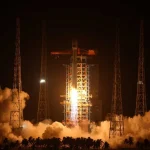
The Soyuz MS-16 three-person crew lifted off from Site No. 31/6 at the Baikonur Cosmodrome, Kazakhstan, on 9 April 2020 at 08:05:06 UTC (04:05:06 EDT) to begin a four orbit, six hour rendezvous with the Station that resulted in the vehicle docking with the ISS at 14:15 UTC (10:15 EDT).
Switching Rockets:
The switch of launch vehicles comes as Russia cuts its human launch cadence from four flights to just two a year.
It was always the plan that once Commercial Crew operations began from NASA that Roscosmos would cut their crew launches per year in half while the U.S. vehicles would pick up those two flights — keeping the total number of human launches to the Station each year for standard crew rotations to four.
However, the alignment of Russian crew launch rate reduction, the switch to the Soyuz 2.1a rocket for Roscosmos crew launches, and the commencement of Commercial Crew operations are all coincidental.
In the mid-1990s, Russia was utilizing the Soyuz-U, designed largely in the 1960s and having taken its first flight on 18 May 1973, as its workhorse rocket – which included crew missions to Mir.
Spaceflight history books
(adsbygoogle = window.adsbygoogle || []).push({});
Soyuz-U set several records, including the highest launch rate per year with 47 flights in 1979 and a total career flight number of 786 missions by the time of its retirement in 2017.

The business end of the Soyuz 2.1a rocket is rotated slowly into its launch mount at Site No. 31/6 as Soyuz MS-16 launch preparations continue. (Credit: Roscosmos)
But as technology improved and other rockets became more capable, the Soyuz-U began to show its age. Its computer systems were analog, severely restricting the upgrades possible on the rocket.
Because of the analog Flight Control System, the rocket was incapable of rolling onto the correct azimuth after lifting off from its launch pads. Therefore, the launch pads themselves had to literally be turned and angled in the correct direction so the rocket could simply pitch over and be on the correct course for its intended orbit.
See Also
- LIVE: Soyuz MS-16
- L2 Russian Section
- L2 ISS Section
- Click here to Join L2
Roscosmos knew they needed an upgraded version of the Soyuz for the 21st century, and designs began for what would eventually become the Soyuz 2 variant.
But concerns raised by the international partners of the International Space Station regarding the use of the brand new and still-in-planning Soyuz 2 for crew transportation, coupled with financial concerns and development delays to the new digital Flight Control Systems, led Roscosmos to create a new Soyuz variant designed solely to bridge the gap between Soyuz-U and Soyuz 2 and demonstrate flight performance of some of the new systems and engines.
The bridge-gap variant became the Soyuz-FG, which launched for the first time on 20 May 2001.
As part of the step upgrade, the Soyuz-FG rocket used new, more powerful engines for its first stage boosters and core, powered by the RD-107A engines for the boosters and the RD-108A engine for the core stage.
While the new engines provided the same amount of thrust as the older engines used on the Soyuz-U, they included several new safety and performance upgrades that increased their reliability.
The new Soyuz-FG continued to use the RD-0110 engine for its second stage, same as the Soyuz-U.
With the upgraded engines on its first stage and a host of other improvements over the Soyuz-U, the Soyuz-FG was designed largely for the purpose of taking over crew transportation duties to the International Space Station, a role it began to serve on 30 October 2002.

Location on the Station where Soyuz MS-16 will dock. (Credit: NASA)
Since that first crew flight, it was the only Russian rocket to launch humans to the International Space Station for 17 years, and after the retirement of the U.S. Space Shuttle fleet in July 2011 became the only rocket capable of transporting people to the Station.
But despite its upgrades, it still carried an analog flight control system and wasn’t capable of rolling onto course, meaning its launch pad still had to be rotated into the proper azimuth (heading) prior to the vehicle lifting off.
For this reason, Soyuz-FG was always an interim rocket that would eventually be replaced by the Soyuz 2 — which sports a digital flight control system.
A big change from Soyuz-FG is that Soyuz 2.1a can perform a roll maneuver after liftoff to place itself on the correct azimuth.
However, since the new Soyuz MS crew vehicle debuted on Soyuz-FG, its abort software had to be rewritten for flight on Soyuz 2.1a so the abort logic would not trigger when Soyuz 2.1a performs its roll program. (The Soyuz MS-series abort software had previously been written to trigger an abort if it noted the Soyuz-FG rolling.)
This rewritten software was successfully tested in flight via an uncrewed launch of the Soyuz MS-14 crew vehicle on a Soyuz 2.1a rocket last August to the Station.
What’s more, Roscosmos originally intended Soyuz 2.1a to take over crew launch duties years ago, but various delays and cutbacks and budget shortfalls on both sides have now created the coincidental scenario of two veteran rockets debuting new crew launch capabilities (Soyuz 2.1a and SpaceX’s Falcon 9) in back to back months at the same time Russia reduces its annual crew launch rate.
Soyuz MS-16 launch:
The Soyuz rocket launched with the Soyuz MS-16 crew at 08:05:06 UTC (04:05:06 EDT), a single-second, instantaneous launch window to permit a fast-track four orbit, six hour launch-to-docking rendezvous with the International Space Station.
At the time of launch, the International Space Station was 1,011 km east-northeast of Baikonur.
Seconds after reaching orbit and separating from the Soyuz’s Blok-I second stage, the Soyuz MS-16 spacecraft deployed its solar arrays and communication antennas and transmit its position and velocity data to the ground via the Vostochny Cosmodrome in eastern Russia.
This immediate downlink of flight data will permit Russian ground controllers to verify Soyuz MS-16 was inserted into the correct orbit to perform its fast track rendezvous.
Had Soyuz MS-16 not ended up in the correct orbit or has a communications malfunction that does not threaten mission and crew safety, the craft can always revert to the standard 32 orbit, two day rendezvous profile with the Station.
Per the plan, Soyuz performed an automated docking to the Poisk Module’s zenith port at 14:15 UTC (10:15 EDT). Soyuz automated dockings usually happen faster than the published timeline; so docking could take place 5 to 7 minutes earlier than planned.
Soyuz will use the call sign “Irkut” for this mission, after the river Commander Ivanishin’s home city is named after.
The Crew:
Anatoli Alekseyevich Ivanishin (Roscosmos):
Ivanishin is a veteran of two previous spaceflights, Soyuz TMA-22 – during which he served as Flight Engineer for Expeditions 29/30 — and Soyuz MS-01, for which he served as Flight Engineer for Expedition 48 and Commander of Expedition 49.
Born in Irkutsk on 15 January 1969, he entered the Irkutsk Polytechnic Institute in 1986 before successfully gaining admission to the Chernigov Higher Aviation School in 1987.
He graduated from Chernigov in 1991 with a gold medal, after which he served in combat units of the Russian Air Force flying MiG-29s.
Beginning in 1992, he served as a senior fighter pilot in the 159th Fighter Aviation Regiment, where he flew Su-27 jets.
In 2003, he graduated from Moscow State University with degrees in Economics, Statistics, and Information Technology and entered cosmonaut candidate training on 16 June 2003. Two years later, he passed all state examinations with an “excellent” rating.
Ivanishin’s first assignment was as backup commander for the Soyuz TMA-20 mission, after which he was assigned to Soyuz TMA-22 – the final flight of the Soyuz-TMA vehicle.
As a Flight Engineer for Expeditions 29/30, Ivanishin spent 165 days 7 hours and 31 minutes in space, launching on 14 November 2011 and returning to Earth on 27 April 2012.
He then received his second assignment to fly as Commander of the first Soyuz MS-series crew vehicle and return for a second long-duration mission to the Station, launching on this mission on 7 July 2016.
The flight was a planned two-day orbital rendezvous with the Station to allow Ivanishin and his crewmates time to test the Soyuz MS-series new systems.
After docking with the Station, Ivanishin took up the designation Flight Engineer 4 for Expedition 48.
In September 2016, he assumed command of the ISS from NASA astronaut Jeff Williams and served as Commander of Expedition 49.

Ivanishin undergoing pre-flight testing. Credit: Roscosmos)
After 115 days, 2 hours 22 minutes in space, he landed safely in Kazakhstan on 30 October 2016.
Ivanishin was originally part of Soyuz MS-16’s backup crew but was elevated to prime crew in February 2020 when an original crew member injured his eye and had to be removed from the flight.
Ivan Viktorovitch Vagner (Roscosmos):
This will be Ivan Vagner’s first trip to space.
Born 10 July 1985 in Severoonezhsk village in the Arkhangelsk region of Russia, Vagner studied engineering at Baltic State Technical University and graduated from there with a Master’s degree in Aeronautical Engineering in 2008.
A year prior to graduating, Vagner began work as a design engineer for a Russian company building gas turbine engines for military and civilian aircraft.
After graduating, he was hired by RCS Energia as an engineer to assist a flight manager of the International Space Station program, a job he worked for a year-and-a-half before being selected as a cosmonaut in October 2010.
He completed basic Cosmonaut training in 2012 and received his first assignment in January 2016 as part of the Expedition 53/54 crew.
That assignment was canceled in September 2016 when Russia decided to reduce their human presence on the International Space Station from three down to two until the nation could successfully launch the Nauka laboratory module — which is still yet to fly.

Ivan Vagner’s official cosmonaut portrait. (Credit: Roscosmos)
Vagner was then assigned as part of the backup crew to flight engineer Andrei Babkin for Soyuz MS-16. When Babkin’s prime crew partner suffered an eye injury, Roscosmos swapped both Russian crewmembers with their backups, elevating Vagner to prime crew.
He will serve as a Flight Engineer on board Soyuz MS-16 and as a Flight Engineer for both Expeditions 62 and 63 aboard the Station.
Captain Christopher John Cassidy (NASA):
Born 4 January 1970, in Salem, Massachusetts, Cassidy earned a Bachelor of Science in mathematics from the US Naval Academy in 1993 and a Master of Science in ocean engineering from the Massachusetts Institute of Technology in 2000.
He completed four six-month deployments, including two tours of Afghanistan, during his ten years as a member of the U.S. Navy SEALs team before being selected as an astronaut by NASA in May 2004.
After performing communications duties in Mission Control, Cassidy was assigned to his first space flight as a Mission Specialist on Endeavour’s STS-127 mission to the International Space Station.
The mission saw Cassidy become the 500th person to reach space and delivered the final elements of Japan’s Kibo module complex to the Station.
Captain Cassidy would return to the Station in 2013, flying with Russian cosmonauts Pavel Vinogradov and Alexander Misurkin on Soyuz TMA-08M.
Arriving at the Station marked the start of Capt. Cassidy’s Expedition 35/36 tour that lasted from 28 March 2013 through 11 September 2013 – and saw the arrival of the European ATV-4 cargo spacecraft, the Japanese HTV-4 cargo spacecraft, and two Russian Progress resupply spacecraft.
On 9 July 2013 Capt. Cassidy and ESA’s Luca Parmitano completed EVA-22 – laying the foundations for the arrival of the Russian Multipurpose Laboratory Module.
During a spacewalk a week later, Cassidy’s EVA partner, Luca Parmitano reported a rising amount of water in his helmet.
The significant quantity of water quickly became a concern as it was entering Parmitano’s eyes, nose, and mouth, and as such ISS flight controllers made the decision to terminate the EVA early.
Capt. Cassidy calmly assisted Parmitano – who by this time was struggling to see – back to the Station airlock, resulting in a safe conclusion to the terminated EVA.
After returning to Earth, Capt. Cassidy then became Deputy Chief of the Astronaut Office under Bob Behnken. When Behnken stepped down from the role, Cassidy became Chief of the Astronaut Office.
Coincidentally, Behnken will join Cassidy aboard the Station – per the current plan – in May when he launches on the first US crew flight via a SpaceX Falcon 9 and Crew Dragon since the retirement of the Space Shuttle Program in 2011.

Cassidy prepares to enter the Soyuz MS-16 during final crew fit checks. (Credit: Roscosmos)
Cassidy resigned as Chief of the Astronaut Office on 2 June 2017 to allow him to return to flight status.
On 30 October 2019, less than six months before launch, NASA pulled Japan astronaut Akihiko Hoshide from Soyuz MS-16 and replaced him with Chris Cassidy.
After arriving at the Station, Cassidy will assume Command of the complex and remain as Commander until he returns home in October.