While NASA pushes it Space Launch System (SLS) to make a mid-2020 debut, Orion also needs to find solutions to both match the realigned targets and achieve key objectives before the second flight with astronauts onboard.
Most notably, the Orion Environmental Control and Life Support System (ECLSS) is set to make its full debut on the first crewed mission, requiring the spacecraft to loiter in Low Earth Orbit (LEO) – before heading to the Moon – to allow for a speedy abort should issues be found in the system. Various test opportunities, including on the ISS, are being called upon to mitigate potential issues.
Exploration Mission -1 (EM-1) will be an uncrewed test flight paving the way for the crewed EM-2. However, EM-1’s Orion will not fly with a complete life support system.
See Also
- Orion Forum Section
- L2 Orion Section
- Click here to Join L2
This has been a concern for NASA’s Aerospace Safety Advisory Panel (ASAP) for some time, resulting in calls to mitigate the potential the system could suffer a mission-ending fault during the following flight, EM-2.
“In its 2018 Annual Report, ASAP expressed concern about the readiness of the ECLSS for crewed flight – more specifically, whether it would be fully tested, qualified, and ready to support the crew on EM-2,” noted the minutes from the latest ASAP missing in March.
“Because of the crucial importance of ECLSS function for successful crewed flight, ASAP had asked earlier for more information on the ECLSS systems or components that would actually be installed in EM-1.”
NASA had already provided the rationale for not flying EM-1 as a full-up test of the ECLSS, noting “the Orion System is much simpler than that of previous vehicles” and “the spaceflight environment would not significantly impact system performance compared to what is seen during ground testing”.
It also inserted a 24 hour checkout period for the EM-2 flight, allowing Orion to remain in Low Earth Orbit (LEO) for around a day to checkout the health of the ECLSS, before deciding if to abort the mission or press on to the TLI (Trans Lunar Injection) burn and head towards the Moon. This objective was first recommended back in 2013.

EM-1 TLI Burn – as envisioned by Nathan Koga for NSF/L2
“For these reasons, NASA concluded that no specific element of ECLSS hardware requires successful testing on EM-1 prior to EM-2. This conclusion may well prove to be correct; nevertheless, the Panel believes that the more that critical life-support systems and subsystems can be tested in an end-to-end fashion before they are used in crewed flight, the better,” added the ASAP meeting’s minutes.
The ASAP noted that it recommends that NASA should continue to assess whether additional ECLSS hardware could be incorporated on the EM-1 flight, “if the mission is delayed”, which is somewhat moot given the EM-1 mission is now being told to advance, rather than slip further to the right.
NASA has some very useful experience with life support systems, not least on the ISS which has allowed for a continued human presence in space for many years and the ability to learn techniques to repair and improve the ECLSS.

A basic diagram of how the ISS ECLSS works – via NASA
It is understood that some Orion ECLSS specific hardware has been tested on the ISS and the ASAP encourages further testing to help mitigate any potential concerns with the EM-2 flight.
“…emphasizing that the complete ECLSS system has not yet been tested on the ISS – only similar components, in conditions projected to be relevant to the new spacecraft, the Panel again emphasizes the value of end-to-end microgravity testing of the ECLSS system prior to EM-2,” added the ASAP minutes.
Orion itself is no longer the critical path on NASA’s EM-1 timeline, which has since been overtaken by concerns with the Space Launch System (SLS) flow, notably the core stage. Previously, Orion – specifically the European Service Module (ESM) – was the critical path that was threatening additional delays to the EM-1 timeline.
Orion will still need to be on its guard if it is to avoid becoming the schedule concern, should SLS find a way to viably target mid-2020, as instructed by the NASA Administrator Jim Bridenstine. As such, it has already looked into a plan to allow for several months of schedule mitigation.
One such option would be to skip most of the Orion fueling tests at the MPPF (Multi-Payload Processing Facility).

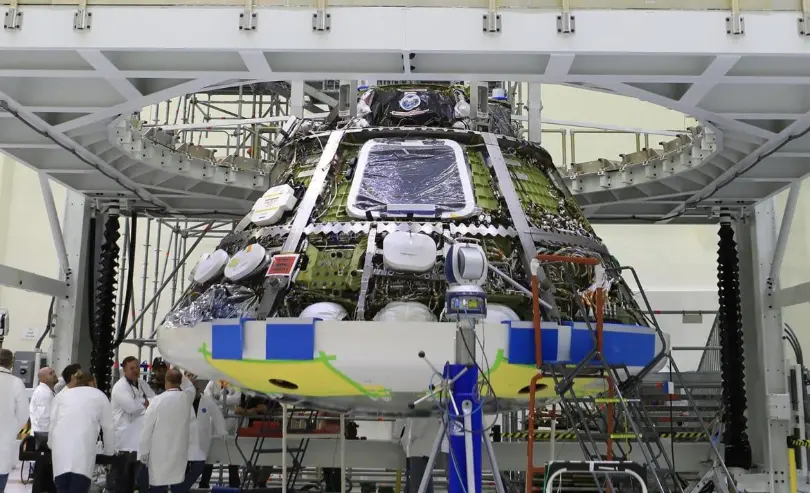
Orion’s MPPF – via NASA
The thought is that KSC could save six months of schedule by skipping all the hypergolic loading and unloading testing now scheduled for the Orion stack in the MPPF.
Thus Orion would go from the O&C (Operations and Checkout Building) to MPPF, be fueled, then go to the VAB (Vehicle Assembly Building) for stacking on the SLS.
Such a change to save schedule would likely be a last-ditch measure should Orion become the critical path again, given once Orion is fueled, it can not go back into the O&C in the event of a problem – such as contamination being found – until it is defueled and decontaminated of all hypergolic fuel traces and would require remedy outside the O&C building.
The next major test objective for Orion will be the Ascent Abort -2 test (AA-2), which is now Range Approved for launch on a Minotaur IV booster from Cape Canaveral’s SLC-46 on June 12 during a four hour window opening at 11:00 UTC.