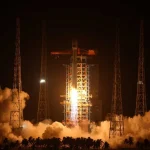
A new satellite – that will help humanity to unravel the mysteries of the ‘Dark Matter’ – was launched on Thursday by China. The launch of the DAMPE satellite took place at 00:12 UTC using a Long March-2D launch vehicle from the 603 Launch Pad at the Jiuquan Satellite Launch Center’s LC43.
Chinese Launch:
DAMPE (DArk Matter Particle Explore) is one of the five satellite missions in the framework of the Strategic Pioneer Research Program in Space Science of the Chinese Academy of Sciences (CAS).
Other missions include: Hard X-ray Modulation Telescope, Quantum Experiments at Space Scale, Shijian-10, Intensive Study of Future Space Science Missions and Advanced Research of Space Science Missions and Payloads.
The new satellite will be operational at a sun-synchronous orbit with an altitude of 500 kilometers and an inclination of 97.4° with 3-year lifetime.
 DAMPE is a powerful space telescope for high energy gamma-ray, electron and cosmic rays detection.
It consists of a double layer of plastic scintillator strips detector (PSD) that serves as anti-coincidence detector, followed by silicon-tungsten tracker-converter (STK), which is made of 6 tracking double layers; each consists of two layers of single-sided silicon strip detectors measuring the two orthogonal views perpendicular to the pointing direction of the apparatus.
Spaceflight history books
(adsbygoogle = window.adsbygoogle || []).push({});
Three layers of Tungsten plates with a thickness of 1mm are inserted in front of tracking layer 2, 3 and 4 for photon conversion.
The STK is followed by an imaging calorimeter of about 31 radiation lengths thickness, made up of 14 layers of Bismuth Germanium Oxide (BGO) bars in a hodoscopic arrangement. A layer of neutron detectors is added to the bottom of the calorimeter. The total thickness of the Bismuth Germanium Oxide calorimeter (BGO) and the STK correspond to about 33 radiation lengths, making it the deepest calorimeter ever used in space.
 Finally, in order to detect delayed neutron resulting from hadron shower and to improve the electron/proton separation power a neutron detector (NUD) is placed just below the calorimeter. The NUD consists of 16, 1 cm thick, boron-doped plastic scintillator plates of 19.5 × 19.5 cm2 large, each read out by a photomultiplier.
The main scientific objective of DAMPE is to measure electrons and photons with much higher energy resolution and energy reach than achievable with existing space experiments in order to identify possible Dark Matter signatures.
It has also great potential in advancing the understanding of the origin and propagation mechanism of high energy cosmic rays, as well as in new discoveries in high energy gamma astronomy.
 Scientific objectives of the mission are the search and study of dark matter particles by conducting high-resolution observation of high-energy electron and gamma ray; the study the origin of cosmic rays by observing the high energy electron and heavy nuclei above TeV; and the study of the propagation and acceleration mechanism of cosmic ray by observing high-energy gamma ray.
DAMPE will have unprecedented sensitivity and energy reach for electrons, photons and cosmic rays (proton and heavy ions). For electrons and photons, the detection range is 5 GeV – 10 TeV, with an energy resolution of about 1% at 800 GeV. For cosmic rays, the detection range is 100 GeV – 100 TeV, with an energy resolution better than 40% at 800 GeV. The geometrical factor is about 0.3 m 2 sr for electrons and photons, and about 0.2 m2 sr for cosmic rays. The angular resolution is 0.1° at 100 GeV.
The total weight of the payload is of 1400 kg and its power consumption is of 400 W. The total weight of the satellite is of 1900 kg.
Instruments on DAMPE:
The plastic scintillator strips detector (PSD) consists of one double layer (one x and one y) of scintillating strips detector made of scintillating strips of 1.0 cm thick, 2.8 cm wide and 82.0 cm long. The strips are staggered by 0.8 cm in a layer, thus fully covers an area of 82.0 cm by 82.0 cm.
The PSD serves as an anti-coincidence detector for photon identification, as well as charge detector for cosmic rays. The design specification is a position resolution of 6 mm, and a charge resolution of 0.25 for Z = 1 to 20.
 The silicon tungsten tracker converter (STK) consists of multiple layers of silicon micro-strip detectors interleaved with Tungsten converter plates. The principal purpose of the STK is to measure the incidence direction of high energy cosmic rays, in particular gamma rays, as well as the charge of charged cosmic rays.
The STK identifies gamma rays by their conversions to charged particles in tungsten plates and infers their incident direction by the measuring with great precision the path of the charged particles within the STK.
The STK is made of 6 tracking planes each consists of two layers of single-sided silicon strip detectors measuring the two orthogonal views perpendicular to the pointing direction of the apparatus. Three layers of tungsten plates of 1 mm thick are inserted in front of tracking layer 2, 3 and 4 for photon conversion.
 The STK uses single-sided AC-coupled silicon micro-strip detectors. The sensor is 9.5 cm by 9.5 cm in size, 320 μm thick, and segmented into 768 strips with a 121 μm pitch. Only every other strip is readout but since analogue readout is used the position resolution is better than 80 μm for most incident angles, thanks to the charge division of floating strips. The photon angular resolution is expected to be around 0.2° at 10 GeV.
The high dynamic range of the analog readout electronics of the STK allows to measure the charge of the incident cosmic rays with high precision. The full tracker uses 768 sensors, equivalent to a total silicon area of ~7 m 2.
The Flight Model of STK was delivered to China in April 2015. The total weight of STK is of 155 kg. The total power consumption is of 85 W. Its dimensions, including the outer envelope, are: 1.12m x 1.12m x 2.52m.
The DAMPE Tracker collaboration is formed by leading research institutes and universities from China, Switzerland and Italy. The institutes responsible for the STK construction are: DPNC (Département de physique nucléaire et corpusculaire), University of Geneva, Switzerland; INFN (Istituto Nazionale di Fisica Nucleare) and University of Perugia, Italy; IHEP (Institute of High Energy Physics), CAS, Beijing, China; INFN (Istituto Nazionale di Fisica Nucleare) and University of Bari, Italy; and the INFN (Istituto Nazionale di Fisica Nucleare) and University of Lecce, Italy.
See Also
- Chinese Forum Section
- 65 Launch Vehicle Manuals (L2)
- Click here to Join L2
The calorimeter (BGO) is made up of 14 layers of BGO bars in a hodoscopic arrangement. Each BGO bar is 2.5 cm by 2.5 cm in cross section and 60 cm in length, making it the longest BGO crystals ever produced.
The bars are readout at both ends with PMTs, each PMT is readout from 3 dynodes (2, 5, 8) to extend the dynamic range. The total thickness of the calorimeter is equivalent to 31 radiation lengths and 1.6 interaction lengths. An excellent electromagnetic energy resolution of 1.5% above 100 GeV, and a very good hadronic energy resolution of better than 40% above 800 GeV can be expected.
The neutron detector (NUD) consists of 16 1 cm-thick boron-doped plastic scintillator plates of 19.5 cm by 19.5 cm large each read out by a PMT. The purpose of the NUD is to detect delayed neutron resulting from a hadron shower in order to improve the electron/proton separation power, which should be 105 overall.
Launch Vehicle and Launch Site:
The Chang Zheng-2D launch vehicle is a two-stage rocket developed by the Shanghai Academy of Spaceflight Technology. With storable propellants is mainly used to launch a variety of low earth orbit satellites.
The development of CZ-2D was started in February 1990. From 2002, to meet the demand of SSO satellites, the payload fairing of 3350mm in diameter and attitude control engine for the second stage have been successfully developed; and the discharge of remaining propellant and de-orbit of the second stage have been realized. This launcher is mainly used for launching LEO and SSO satellites. It is characterized with high reliability, wide application and mature technology.
 The CZ-2D can launch a 1,300 kg cargo in a 645 km SSO. The rocket is 41.056m long and the first, second stages and payload fairing are all 3.35m in diameter.
Its first stage is the same of the CZ-4 Chang Zheng-4. The second stage is based on CZ-4 second stage with an improved equipment bay. Lift-off mass is 232,250 kg, total length 41,056 meters, diameter 3.35 meters and fairing length 6.983 meters. At launch, it develops 2961.6kN engine thrust.
The first stage has a 27.910 meter length with a 3.35 meter diameter, consuming 183,200 kg of N2O4 / UDMH (launch mass of the first stage is 192,700 kg). Equipped with a YF-21C engine capable of a ground thrust of 2,961.6 kN and a ground specific impulse of 2,550 m/s. Burn time is 170 seconds.
The second stage has a 10.9 meter length with a 3.35 meter diameter, launch mass of 39,550 kg and consuming 45,550 kg of N2O4 / UDMH. Equipped with a YF-24C cluster engine with a main engine vacuum thrust of 742.04 kN and a vernier engine with a vacuum thrust of 47.1 kN (specific impulses of 2,942 m/s and 2,834 m/s, respectively).
The CZ-2D can use two types of fairings depending on the cargo. Type A fairing has a 2.90 meters diameter (total launch vehicle length is 37.728 meters) and Type B fairing with a diameter of 3.35 meters – total launch vehicle length is 41.056 meters.
The first launch of the CZ-2D was on August 9th, 1992 from the Jiuquan Satellite Launch Center orbiting the Fanhui Shei Weixing FSW-2-1 (22072 1992-051A) recoverable satellite.
This launch was the 234th Chinese orbital launch and the 221st launch of the Long March launch vehicle family. It was also the 82nd orbital launch from the Jiuquan Satellite launch Center, the 5th launch from this space center in 2015 and the 18th orbital launch for China this year.
The Jiuquan Satellite Launch Center, in Ejin-Banner – a county in Alashan League of the Inner Mongolia Autonomous Region – was the first Chinese satellite launch center and is also known as the Shuang Cheng Tze launch center.
The site includes a Technical Centre, two Launch Complexes, Mission Command and Control Centre, Launch Control Centre, propellant fuelling systems, tracking and communication systems, gas supply systems, weather forecast systems, and logistic support systems.
 Jiuquan was originally used to launch scientific and recoverable satellites into medium or low earth orbits at high inclinations. It is also the place from where all the Chinese manned missions are launched.
The LC-43 launch complex, also known by South Launch Site (SLS) is equipped with two launch pads: 921 and 603. Launch pad 921 is used for the manned program for the launch of the Chang Zheng-2F launch vehicle (Shenzhou and Tiangong). The 603 launch pad is used for unmanned orbital launches by the Chang Zheng-2C, Chang Zheng-2D and Chang Zheng-4C launch vehicles.
Other launch zones at the launch site are used for launching the Kuaizhou and the CZ-11 Chang Zheng-11 solid propellant launch vehicles.
The first orbital launch took place on April 24, 1970 when the CZ-1 Chang Zheng-1 rocket launched the first Chinese satellite, the Dongfanghong-1 (04382 1970-034A).