Isaacman and a group of NASA executives toured INL’s Materials and Fuels Complex, meeting the scientists and engineers developing nuclear power for space. The visit followed a period of accelerated activity at the laboratory tied to a May 2025 executive order signed by President Donald Trump, which called for at least three nuclear power criticalities before July 4, 2026. To mark the nation’s 250th birthday, three of four reactors tested by Antares, Deployable Energy, and Aalo Atomics went critical at INL on schedule.
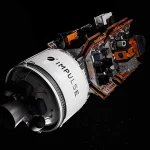
During the tour, the group explored a microreactor test bed built at INL that will be used by Radiant to test its Kaleidos microreactor. NASA executives also viewed Deployable Energy’s Unity Nuclear Battery demonstration and the Fuel Cycle Facility, where INL reprocesses used nuclear fuel. The plan is to build a compact reactor small enough to fit on the spacecraft for the 2028 mission.
“It’s an absolute honor to work alongside the Department of Energy and the great team at Idaho National Laboratory, as we take the next giant leap together and finally get America underway under nuclear power in space,” Isaacman said. He described the relationship between the two agencies as close, saying the Department of Energy powers NASA’s missions while NASA explores the universe. “The stars are for everyone,” he said.
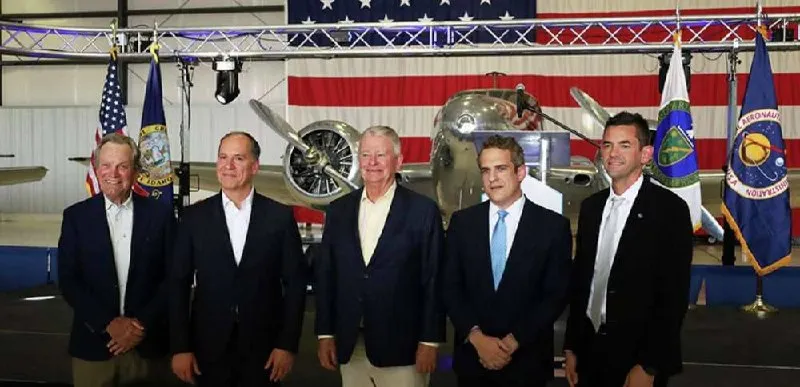
The day closed with a celebration at the Aero Mark aviation hangar, where Isaacman, Idaho Governor Brad Little, Congressman Mike Simpson, and U.S. Department of Energy Deputy Secretary James Danly addressed INL employees, interns, and experts. INL Director John Wagner told the audience he had recently stood in the Oval Office with President Trump, saying that to his knowledge an INL director had never done so in the laboratory’s 77 years. “That’s the kind of attention, that’s the kind of momentum that we’ve established,” Wagner said.
The speakers framed the work as proof of American capability. “The country now knows what Idaho National Laboratory is capable of. It now knows that INL is proving America can get back to putting a reactor in space,” Wagner said. “I’m not describing a hope, I’m describing a track record.” Little noted that INL generated the first usable electricity from nuclear power, saying, “The work happening at INL reminds us that America’s never been afraid of our biggest challenges.” Simpson said he looked forward to watching the mission land on Mars. “You’re gonna turn on your TV in the not-too-distant future, and you’re gonna see this rover land on Mars,” he said. “How cool is that?”
The visit signals NASA elevating nuclear technology as a programmatic priority for deep space exploration and Mars missions, with the speakers presenting eastern Idaho as the site where that work is being built. Nuclear propulsion could shorten a Mars transit from roughly nine months to as few as three, altering crew health, mission cost, and mission frequency.
The next milestone named is the SR-1 Freedom mission’s planned flight to Mars in 2028, carrying the compact reactor INL is developing.