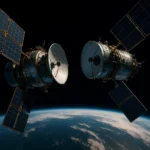

The UK government launched a new national space strategy on September 8, bringing £7.8 billion in planned investment through 2030 under a single framework covering economic growth, defence and national security. The plan prioritises military space capabilities and calls for a resilient, integrated national satellite communications system to support government and defence operations.
The strategy replaces the National Space Strategy published in 2021 and is intended to support the government’s Modern Industrial Strategy and wider efforts to reindustrialise the UK. It introduces a more coordinated approach to how government departments procure and develop space technology, beginning with satellite communications.
Defence and security account for some of the strategy’s largest commitments. The government plans to invest £880 million in space control and intelligence, surveillance and reconnaissance capabilities. The funding will support technologies for monitoring military activity on Earth and identifying potential attacks against satellites.
Another £2.8 billion is allocated to connectivity, including the Connectivity in Low Earth Orbit programme and SKYNET, the UK Ministry of Defence’s satellite communications system. SKYNET provides secure communications for British forces and government users worldwide, while the low Earth orbit programme is intended to explore more resilient and distributed connectivity architectures.
Combining satellites in different orbital regimes can reduce dependence on a small number of high-value spacecraft. Low Earth orbit networks can provide lower-latency services and additional capacity, while established military satellite communications systems offer protected and long-range coverage. Integrating these layers, along with commercial services and ground infrastructure, could make communications more difficult to disrupt.
The government said more than £3 billion will be invested in military space capabilities through the Defence Investment Plan as threats to satellites and space-enabled services increase.
Tracking Threats and Protecting Orbital Infrastructure
Space Domain Awareness is another major component of the strategy. The UK will provide £149 million for the European Space Agency’s Vigil mission and £85 million for the National Space Operations Centre.
Vigil is intended to improve warnings of solar activity that could affect satellites, navigation signals, communications networks and terrestrial power infrastructure. The National Space Operations Centre combines civil and military expertise to monitor objects and events in orbit, including collision hazards and potentially hostile behaviour.
These investments reflect the UK’s dependence on satellites for communications, navigation, weather forecasting, financial services and military operations. Earlier detection of debris, spacecraft manoeuvres and space-weather events gives operators more time to protect spacecraft or maintain critical services.
Business, Innovation, Science and Trade Secretary Jonathan Reynolds said the strategy would strengthen the UK’s ability to launch satellites, detect threats and protect services used across the economy. Defence Secretary Wes Streeting said national security depends on maintaining freedom of action in space and being able to protect British and allied space assets when necessary.
Launch, Exploration and In-Orbit Manufacturing
The strategy includes £148 million for European launch vehicle programmes and £30 million for SaxaVord Spaceport in Shetland. The SaxaVord funding supports the UK’s effort to establish domestic orbital launch capability, particularly for small satellites operating in polar and sun-synchronous orbits.
Space science and exploration programmes will receive £163 million, including support for the Rosalind Franklin Mars rover, which was assembled in Stevenage. The rover is designed to drill below the Martian surface and search for evidence of past life in material less exposed to surface radiation.
The government is also committing £40 million to in-orbit servicing, assembly and manufacturing. These technologies could extend satellite operating lives, support spacecraft inspection and repair, and allow structures or equipment to be assembled in orbit rather than launched as fully completed systems. Their commercial viability will depend on technical standards, reliable rendezvous operations, customer demand and a regulatory framework capable of managing liability and orbital safety.
Other allocations include £190 million from UK Research and Innovation for astronomy and space science, £9 million from the Met Office for space-weather forecasting and £57 million from the Department for Transport for rail connectivity.
The government will also reform space regulations with the stated objectives of lowering costs, rewarding responsible operators and simplifying investment in activities ranging from satellite servicing to lunar missions. Regulatory changes will be important for emerging operations that involve close approaches between spacecraft, transferring control of assets or conducting missions beyond Earth orbit.
The strategy targets further growth in a UK space industry valued at £18.6 billion and supporting more than 55,000 skilled jobs. Industry groups broadly welcomed the integrated approach but said detailed implementation and delivery plans will determine whether the funding translates into sustained contracts and private investment.
UKspace Chair Doug Liddle described the strategy as a constructive route towards a refreshed national approach. ADS Group Chief Executive Kevin Craven said greater certainty would help companies make long-term commitments and demonstrate UK intent to international partners. Space Academic Network co-chairs Anna Hogg and Mark Sims also welcomed the integrated delivery framework.
The first major test will be the government’s unified approach to satellite communications procurement. Its effectiveness will depend on how requirements, budgets and acquisition responsibilities are coordinated across civil departments, the Ministry of Defence and commercial service providers.