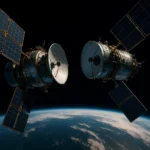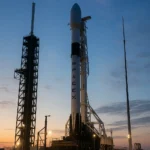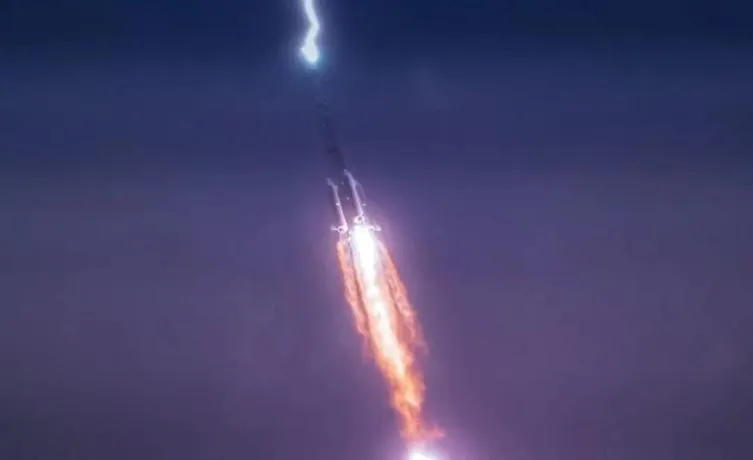
On July 24, China successfully launched the Tianlian II-06 satellite aboard a Long March-3B carrier rocket from the Xichang Satellite Launch Center. During its ascent, lightning flashed near the rocket, creating a spectacular scene.
A rocket had barely lifted off when it was suddenly struck by lightning, sending electrical arcs scattering across its body in a dramatic display. Yet the rocket emerged unscathed and continued carrying its satellite into the planned orbit.
The incident occurred on July 23 during the launch of China’s Long March-3B carrier rocket. Inside the payload fairing at the top of the rocket was Tianlian II-06, a second-generation data relay satellite designed to provide relay communications, tracking, telemetry and command services for space stations and spacecraft.
The rocket lifted off in rainy weather. Shortly after liftoff, a bolt of lightning struck the vehicle directly, extending from the fairing down to the exhaust plume and instantly lighting up the night sky. The sight startled observers at the scene.
Fortunately, the rocket showed no instability in its flight attitude and continued climbing steadily. It ultimately placed the satellite accurately into its planned orbit. Telemetry remained normal throughout the flight. After reaching orbit, the satellite successfully deployed its solar arrays, and all onboard systems operated normally, apparently unaffected by the lightning strike.
Lightning currents can easily reach tens of thousands of amperes. So how did the rocket escape unharmed?
The Rocket’s Layers of Lightning Protection
The basic principle behind a rocket’s ability to withstand lightning is not particularly complicated.
First, most of the rocket’s outer structure is made of metal. Electric current follows the path of least resistance, so when it encounters the metallic body, it travels along the exterior surface. The principle is similar to the protection offered by a car during a thunderstorm.
Second, the rocket’s exhaust plume consists of extremely hot engine gases in a highly ionized state, forming plasma. Its electrical conductivity approaches that of metal, effectively providing lightning with a direct conductive path into the atmosphere.
The current travels along the rocket’s exterior to its aft section, then enters the lightning channel through the exhaust plume and dissipates into the atmosphere. This helps prevent the electrical discharge from damaging the rocket.
That explanation may make lightning protection sound straightforward, but in reality, it depends on a comprehensive protection system. Long March rockets incorporate multiple layers of defense, with engineers accounting in advance for factors that could damage internal systems.
For the rocket’s airframe, all sections are electrically bonded using heavy-gauge conductors. The payload fairing separation interfaces are also treated to ensure electrical continuity, keeping the entire exterior at the same electrical potential and preventing localized arcing. Multiple static discharge wicks are installed on the rocket’s surface to release accumulated static electricity during flight, reducing the likelihood that the vehicle itself will trigger a lightning discharge.
For the rocket’s internal electronics, critical navigation, guidance and telemetry units are enclosed in metallic shielding, creating a second Faraday cage specifically designed to protect them from the powerful electromagnetic pulses generated by lightning. All cables use double-layer shielding with multiple grounding points to prevent electromagnetic interference from penetrating the system. Surge suppressors are installed at every power and signal port so that any high-voltage current entering the system can be discharged immediately before it damages electronic components.
Lightning Protection Is Not Foolproof
Despite these comprehensive safeguards, lightning remains a genuine threat to launch vehicles. There have been documented cases worldwide in which lightning caused rocket malfunctions or even explosions and vehicle breakups.
To date, five publicly documented lightning-strike incidents have occurred during the ascent of orbital-class launch vehicles worldwide. Three launches succeeded and two failed. Most involved triggered lightning caused by a rocket’s hot, electrically conductive exhaust plume while passing through electrically charged clouds, rather than a random strike by naturally occurring lightning.
For this reason, launch vehicles still avoid thunderstorm conditions whenever possible, regardless of how robust their lightning protection may be. Launch sites enforce strict lightning-warning and weather criteria to minimize the risk. But if an unexpected discharge occurs after liftoff—as happened when this rocket triggered a discharge within the clouds—the vehicle is designed to withstand it.
It was precisely because aerospace engineers had anticipated and designed for such possibilities that the rocket remained stable under these sudden and extreme conditions, safely delivering its payload into space.