The mission was intended to demonstrate that Vulcan is ready for both commercial and government payloads. Vulcan is replacing ULA’s Delta and Atlas V rockets and is central to the company’s future, with a large backlog of commercial orders including many for Amazon’s satellite internet constellation. This was only the fifth Vulcan launch since the vehicle debuted in January 2024.
Of those prior flights, only the first and third went as planned. On flights two and four, in 2024 and 2026, nozzles on the Northrop Grumman Solid Rocket Boosters malfunctioned. Vulcan’s core stage compensated and delivered the payloads, but the U.S. Space Force has been hesitant to assign its most sensitive satellites to the rocket. Several launches were shifted to SpaceX, though the intent is to reassign some SpaceX missions back to ULA to keep each company’s launch count even.
Sunday’s attempt followed multiple delays. The launch was originally scheduled for Friday but scrubbed by a pump failure at Air Liquide’s gaseous nitrogen plant. A reschedule for the following day was postponed over a network communication issue between ground equipment and the launch vehicle. On November 15, the 12:11 pm ET liftoff slipped to the end of the 29-minute window because of oscillations in a liquid hydrogen pressure relief valve.
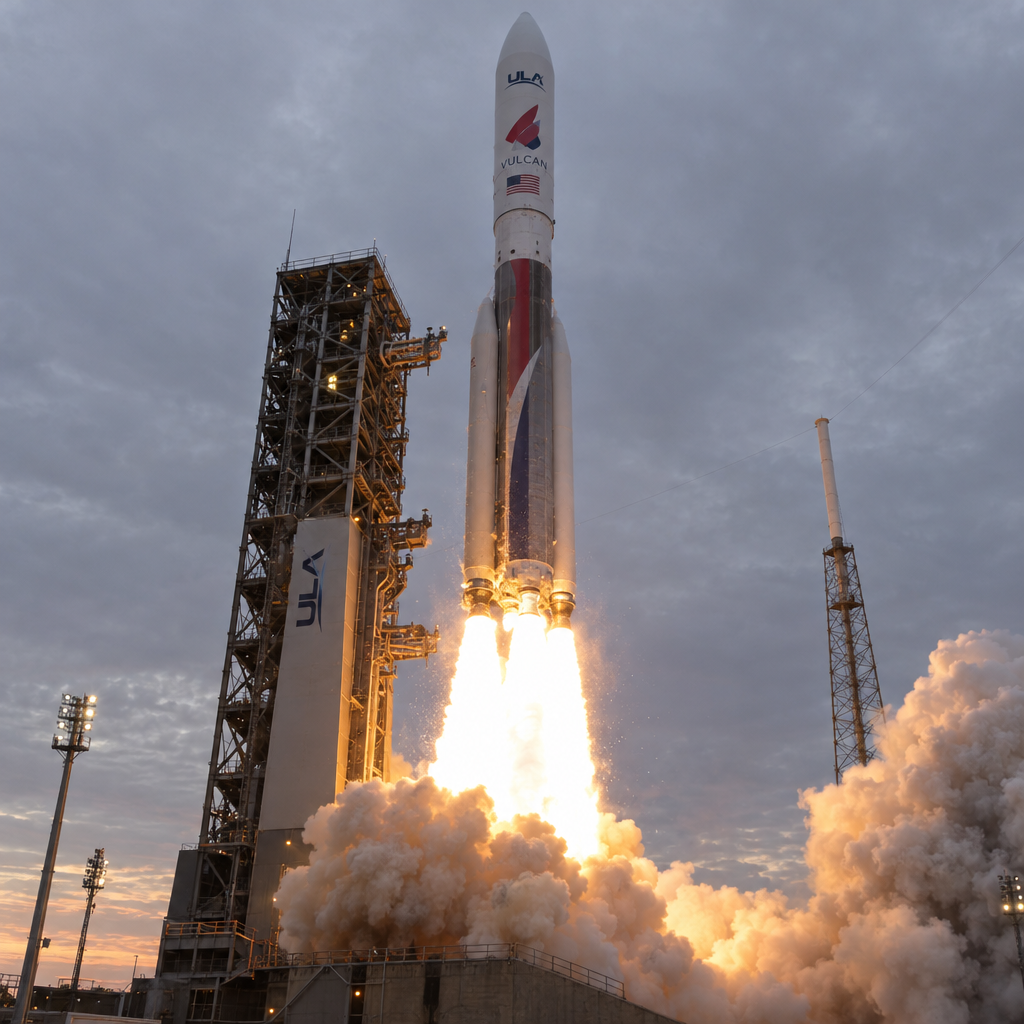
Vulcan finally lifted off at 12:40:30 pm ET from Space Launch Complex 41. All six Solid Rocket Boosters appeared to perform as planned and separated from the core stage as expected. But 10 minutes into flight, the mission failed. ULA confirmed in a statement at 1:30 pm ET that the vehicle suffered an anomaly and failed to deliver the Amazon mission to orbit, adding that it did not yet have specific data to understand what occurred. The company said it would work with its customer and other organizations to find the cause, determine corrective action, and return to flight as quickly as possible, pledging full transparency with customers throughout the investigation.
On November 16, the FAA said it is requiring ULA to conduct a mishap investigation, which is common in such situations. The FAA will oversee the ULA-led investigation, be involved in every step, and approve the final report, including any corrective actions. During the event, the FAA activated two Debris Response Areas and briefly slowed or held aircraft outside the area where space vehicle debris was falling.
ULA stated that mission success is the standard it holds itself to, and that on this flight it did not meet that standard. The failure stands apart from the company’s prior record. Atlas V has a 100 percent mission success record, Delta IV Medium achieved 100 percent across 29 launches, and Delta IV Heavy recorded one partial failure in 16 flights, on its 2004 debut. This is the first total failure since ULA was formed in 2006 as a joint venture between Boeing and Lockheed Martin.
ULA said it will provide further updates when new information becomes available. The FAA will oversee the investigation and approve ULA’s final report, including any corrective actions, before the rocket returns to flight.